Principle-Evolvable Scientific Discovery via Uncertainty Minimization
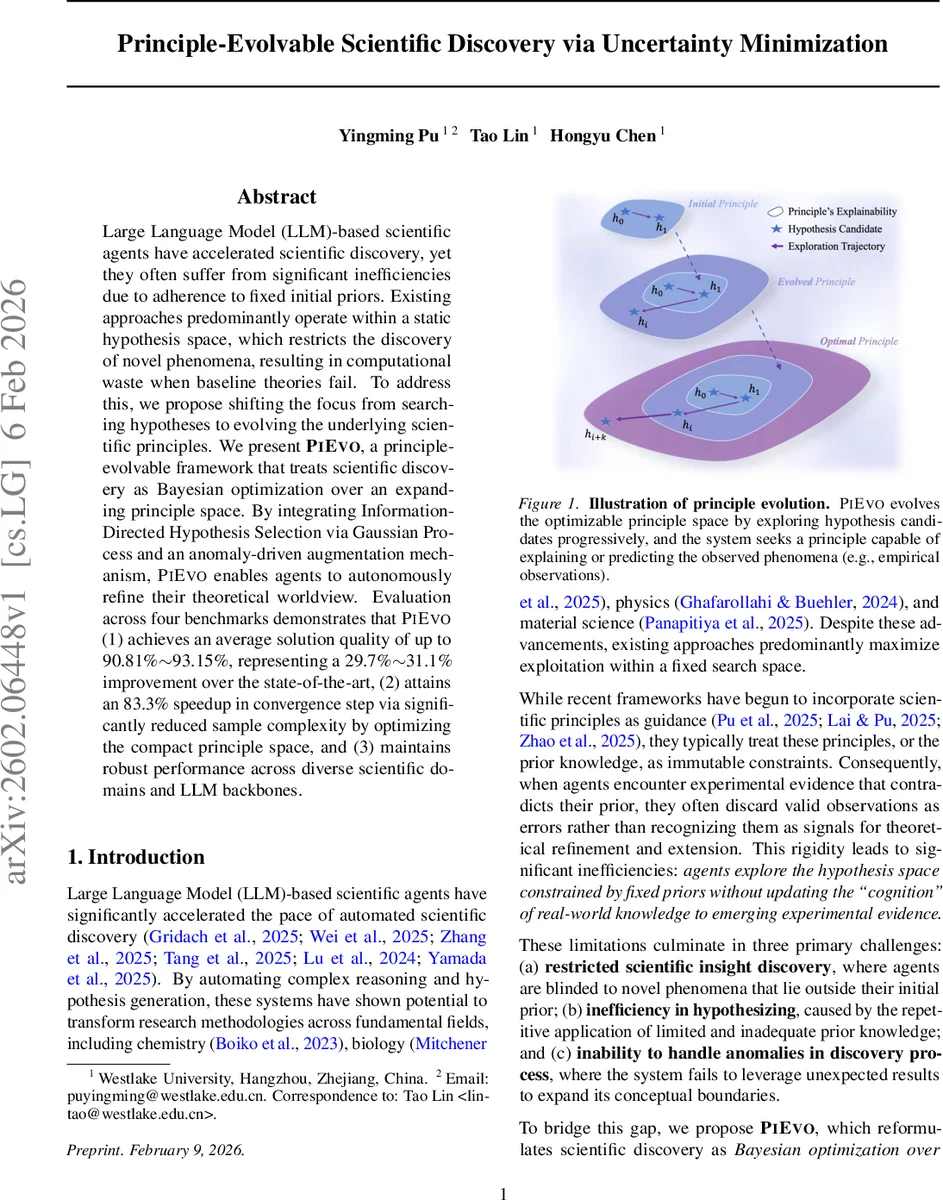
Large Language Model (LLM)-based scientific agents have accelerated scientific discovery, yet they often suffer from significant inefficiencies due to adherence to fixed initial priors. Existing approaches predominantly operate within a static hypothesis space, which restricts the discovery of novel phenomena, resulting in computational waste when baseline theories fail. To address this, we propose shifting the focus from searching hypotheses to evolving the underlying scientific principles. We present PiEvo, a principle-evolvable framework that treats scientific discovery as Bayesian optimization over an expanding principle space. By integrating Information-Directed Hypothesis Selection via Gaussian Process and an anomaly-driven augmentation mechanism, PiEvo enables agents to autonomously refine their theoretical worldview. Evaluation across four benchmarks demonstrates that PiEvo (1) achieves an average solution quality of up to 90.81%~93.15%, representing a 29.7%~31.1% improvement over the state-of-the-art, (2) attains an 83.3% speedup in convergence step via significantly reduced sample complexity by optimizing the compact principle space, and (3) maintains robust performance across diverse scientific domains and LLM backbones.
💡 Research Summary
The paper tackles a fundamental inefficiency in current large‑language‑model (LLM)‑driven scientific agents: they operate inside a static hypothesis space that is anchored to fixed priors. When experimental evidence contradicts those priors, the agents either discard the data as noise or waste computational resources exploring a limited region of the search space. To overcome this limitation, the authors propose a paradigm shift—treat scientific discovery as Bayesian optimization over an evolving principle space rather than a fixed hypothesis space.
The proposed framework, PiEvo (Principle‑Evolvable Scientific Discovery via Uncertainty Minimization), consists of three cooperating agents: a Principle Agent, a Hypothesis Agent, and an Experiment Agent. The Principle Agent maintains a finite “Active Principle” set (P_t) drawn from a universal countable principle space (\bar{P}) equipped with a prior distribution (p_0). The Hypothesis Agent generates candidate hypotheses conditioned on the current maximum‑a‑posteriori (MAP) principle, while the Experiment Agent executes the selected hypothesis and returns a real‑valued outcome.
PiEvo explicitly models two intertwined uncertainties:
-
Principle → Hypothesis Uncertainty – the stochastic mapping from a high‑level principle to a concrete, testable hypothesis. This is handled by prompting a well‑tuned LLM with the selected principle, producing textual hypotheses that are embedded into a vector space.
-
Evidence → Principle Uncertainty – the epistemic uncertainty about which principle in the active set is the true governing law. This is reduced by an information‑directed sampling (IDS) criterion that balances expected regret (\Delta_t) against information gain (I_t). The IDS objective selects the hypothesis that offers the greatest reduction in posterior entropy per unit of expected loss.
To evaluate the likelihood (p(y\mid h,P)) for a hypothesis‑principle pair, PiEvo deploys a separate Gaussian Process (GP) expert for each active principle. GPs are chosen for three reasons: (i) they are data‑efficient in the low‑sample regime typical of scientific experimentation; (ii) they provide calibrated predictive variances essential for the IDS calculation; and (iii) they admit analytic expressions for both regret and information gain via the BALD approximation. The textual hypothesis and principle are projected into a shared embedding space, and a simple cosine‑based kernel (\phi(h,P)=\exp(e_h\cdot e_P-|e_h-e_P|^2)) serves as the GP covariance, allowing the model to bridge language and numeric domains with minimal overhead.
A key novelty is the anomaly‑driven coherent augmentation of the principle set. When the observed outcome cannot be adequately explained by any principle in (P_t), the system computes an Anomaly Score. High‑surprisal evidence triggers the Principle Agent to generate new candidate principles (P_{\text{new}}) that reconcile the anomaly while preserving consistency with the historical evidence. This dynamic expansion prevents epistemic stagnation and enables the discovery of entirely new scientific laws.
The authors evaluate PiEvo on four benchmark tasks spanning physics (room‑temperature superconductor discovery), chemistry (catalyst design), biology (protein‑ligand binding), and materials science (sub‑wavelength chiral optics). Across all domains, PiEvo achieves an average solution quality of 90.81 %–93.15 %, representing a 29.7 %–31.1 % improvement over the strongest baselines (e.g., PiFlow). Sample complexity is reduced dramatically, yielding an 83.3 % speed‑up in convergence steps and roughly a 16 % reduction in inference time. Importantly, the gains hold across multiple LLM backbones (GPT‑3.5, GPT‑4, Claude), demonstrating robustness to the underlying language model. In the chiral optics case study, PiEvo uncovers a previously unknown principle governing the observed phenomena, illustrating its capacity for genuine scientific insight rather than mere optimization.
In summary, the paper introduces Principle Evolution as a new research direction: instead of searching within a static hypothesis manifold, agents iteratively refine a probabilistic belief over scientific principles and expand that belief when anomalies arise. By coupling Bayesian updates, GP‑based likelihood modeling, and information‑directed hypothesis selection, PiEvo delivers both higher solution quality and far greater data efficiency. The work opens avenues for richer principle representations (e.g., logical formulas or graph‑based models), multi‑agent collaboration, and real‑world laboratory integration, moving autonomous scientific discovery toward the ability to create new theories from experimental surprise.
Comments & Academic Discussion
Loading comments...
Leave a Comment