Pointwise Tracking Optimal Control Problem for Cahn Hilliard Navier Stokes system
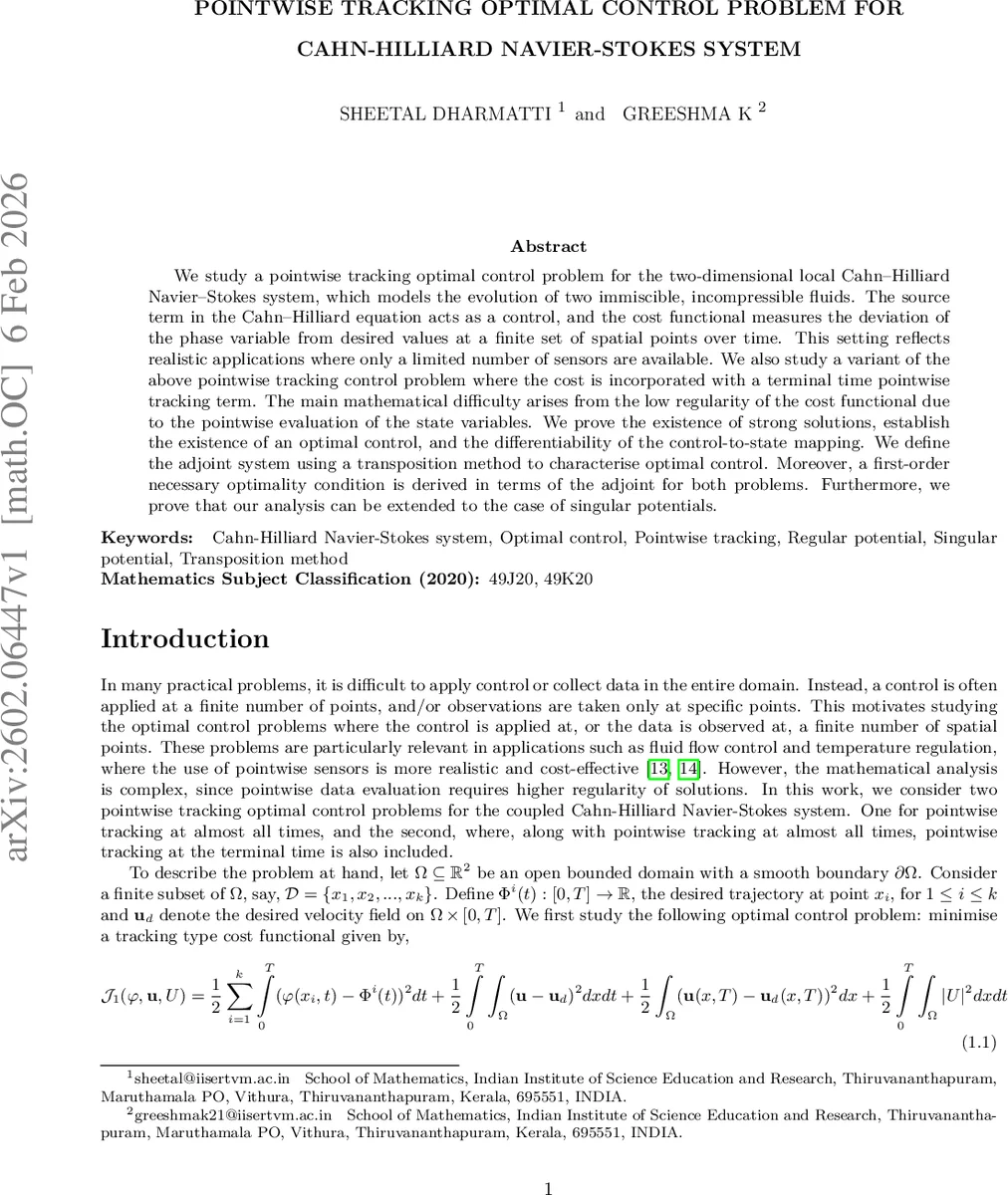
We study a pointwise tracking optimal control problem for the two-dimensional local Cahn Hilliard Navier Stokes system, which models the evolution of two immiscible, incompressible fluids. The source term in the Cahn Hilliard equation acts as a control, and the cost functional measures the deviation of the phase variable from desired values at a finite set of spatial points over time. This setting reflects realistic applications where only a limited number of sensors are available. We also study a variant of the above pointwise tracking control problem where the cost is incorporated with a terminal time pointwise tracking term. The main mathematical difficulty arises from the low regularity of the cost functional due to the pointwise evaluation of the state variables. We prove the existence of strong solutions, establish the existence of an optimal control, and the differentiability of the control to state mapping. We define the adjoint system using a transposition method to characterise optimal control. Moreover, a first-order necessary optimality condition is derived in terms of the adjoint for both problems. Furthermore, we prove that our analysis can be extended to the case of singular potentials.
💡 Research Summary
This paper investigates pointwise tracking optimal control problems for the two‑dimensional local Cahn‑Hilliard‑Navier‑Stokes (CHNS) system, which models the dynamics of two immiscible, incompressible fluids. The control variable is the source term (U) that appears in the Cahn‑Hilliard equation, and the objective functional measures the deviation of the phase field (\varphi) from prescribed trajectories (\Phi_i(t)) at a finite set of spatial points (D={x_1,\dots,x_k}\subset\Omega). Two cost functionals are considered:
- (J_1) contains a time‑integrated pointwise tracking term, an (L^2) tracking term for the velocity field (u) against a desired velocity (u_d), and a quadratic penalty on the control.
- (J_2) adds to (J_1) a terminal‑time pointwise tracking term (\sum_i (\varphi(x_i,T)-\Phi_i(T))^2).
The main analytical challenges stem from the low regularity of the cost due to Dirac evaluations at the observation points. To give meaning to the cost and to differentiate it with respect to the control, the authors first prove the existence of strong solutions of the CHNS system in two dimensions under a set of structural assumptions: bounded, smooth mobility (m(\cdot)) and viscosity (\nu(\cdot)), a regular polynomial‑growth potential (F), and a source term (U) belonging to (L^2(0,T;V\cap L^\infty(\Omega))). They obtain \
Comments & Academic Discussion
Loading comments...
Leave a Comment