Wavefront-Dislocation Evolution via Quadratic Band Touching Annihilation
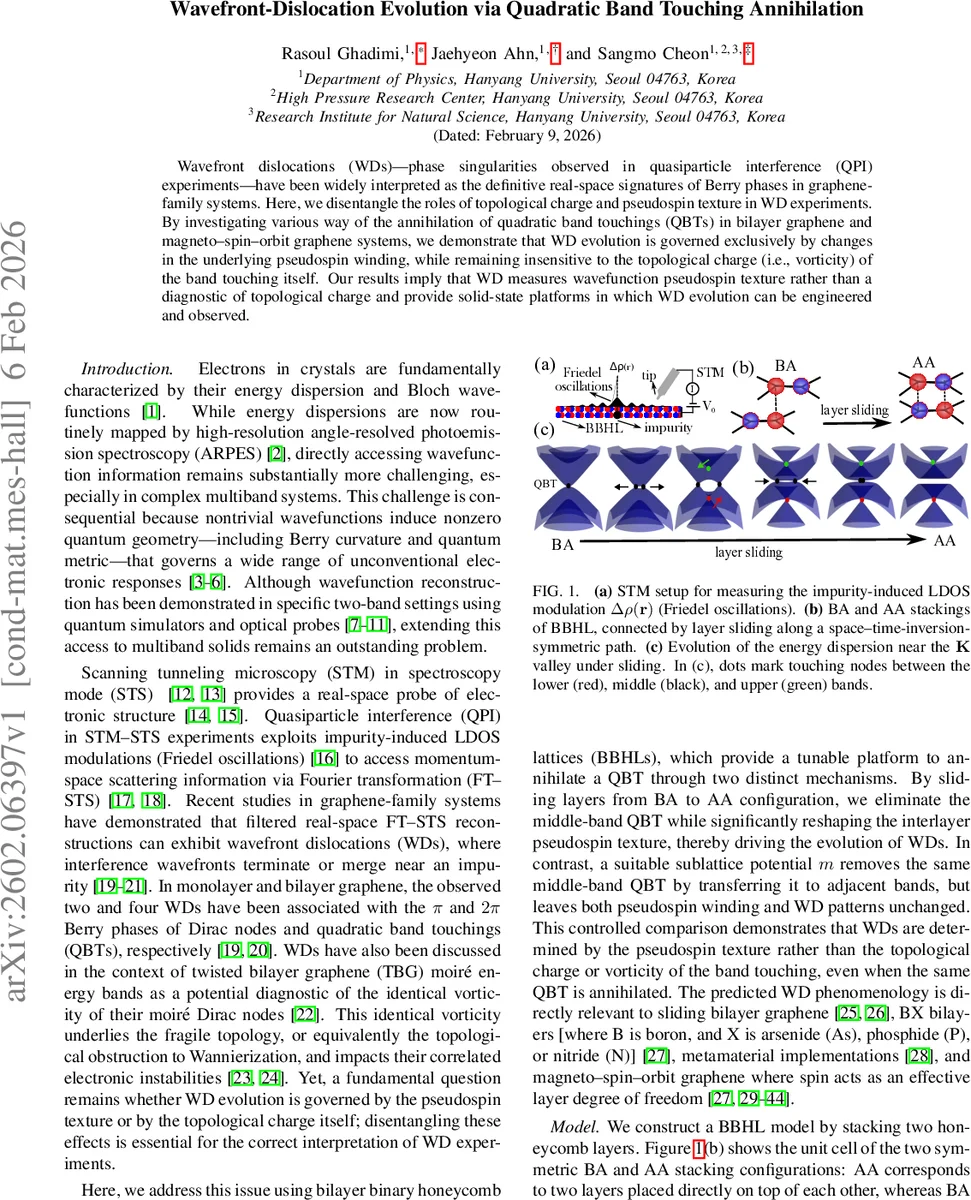
Wavefront dislocations (WDs) – phase singularities observed in quasiparticle interference (QPI) experiments – have been widely interpreted as the definitive real-space signatures of Berry phases in graphene-family systems. Here, we disentangle the roles of topological charge and pseudospin texture in WD experiments. By investigating various way of the annihilation of quadratic band touchings (QBTs) in bilayer graphene and magneto-spin-orbit graphene systems, we demonstrate that WD evolution is governed exclusively by changes in the underlying pseudospin winding, while remaining insensitive to the topological charge (i.e., vorticity) of the band touching itself. Our results imply that WD measures wavefunction pseudospin texture rather than a diagnostic of topological charge and provide solid-state platforms in which WD evolution can be engineered and observed.
💡 Research Summary
The paper investigates the origin of wavefront dislocations (WDs) observed in quasiparticle‑interference (QPI) measurements on graphene‑family materials. Historically, the number of WDs—two for monolayer graphene and four for bilayer graphene—has been linked directly to the Berry phase (π or 2π) associated with Dirac points and quadratic band touchings (QBTs). The authors challenge this interpretation by separating two distinct ingredients that can affect a QBT: its topological charge (vorticity) and the underlying pseudospin texture of the Bloch wavefunction.
To do this they study two concrete platforms: (i) a bilayer honeycomb lattice (BBHL) in which the relative stacking of the two layers can be continuously tuned from the Bernal‑type BA configuration to the AA configuration by a “sliding” motion, and (ii) the same BBHL with an added sub‑lattice potential (m) that shifts the QBT from the middle band to either the lower or upper band. In the sliding scenario the QBT at the K point first splits into two Dirac nodes of the same vorticity, then additional Dirac nodes appear in neighboring bands. Non‑Abelian charge conservation forces the two middle‑band Dirac nodes to acquire opposite relative vorticities and annihilate, leaving a gapped middle band while Dirac nodes survive in the adjacent bands. In the (m)‑tuning case the QBT is simply transferred between bands without changing the pseudospin winding.
The authors then simulate STM‑STS experiments. An impurity placed on a specific sub‑lattice and layer creates Friedel oscillations in the local density of states (LDOS). By Fourier transforming the LDOS, selecting a narrow window around the intervalley scattering vector (\Delta K), and inverse‑transforming, they isolate the real‑space interference pattern for a chosen scattering channel ((l’,\sigma’;,l,\sigma)). The phase of this pattern can be written as
\
Comments & Academic Discussion
Loading comments...
Leave a Comment