FlowConsist: Make Your Flow Consistent with Real Trajectory
Fast flow models accelerate the iterative sampling process by learning to directly predict ODE path integrals, enabling one-step or few-step generation. However, we argue that current fast-flow training paradigms suffer from two fundamental issues. First, conditional velocities constructed from randomly paired noise-data samples introduce systematic trajectory drift, preventing models from following a consistent ODE path. Second, the model’s approximation errors accumulate over time steps, leading to severe deviations across long time intervals. To address these issues, we propose FlowConsist, a training framework designed to enforce trajectory consistency in fast flows. We propose a principled alternative that replaces conditional velocities with the marginal velocities predicted by the model itself, aligning optimization with the true trajectory. To further address error accumulation over time steps, we introduce a trajectory rectification strategy that aligns the marginal distributions of generated and real samples at every time step along the trajectory. Our method establishes a new state-of-the-art on ImageNet 256$\times$256, achieving an FID of 1.52 with only 1 sampling step.
💡 Research Summary
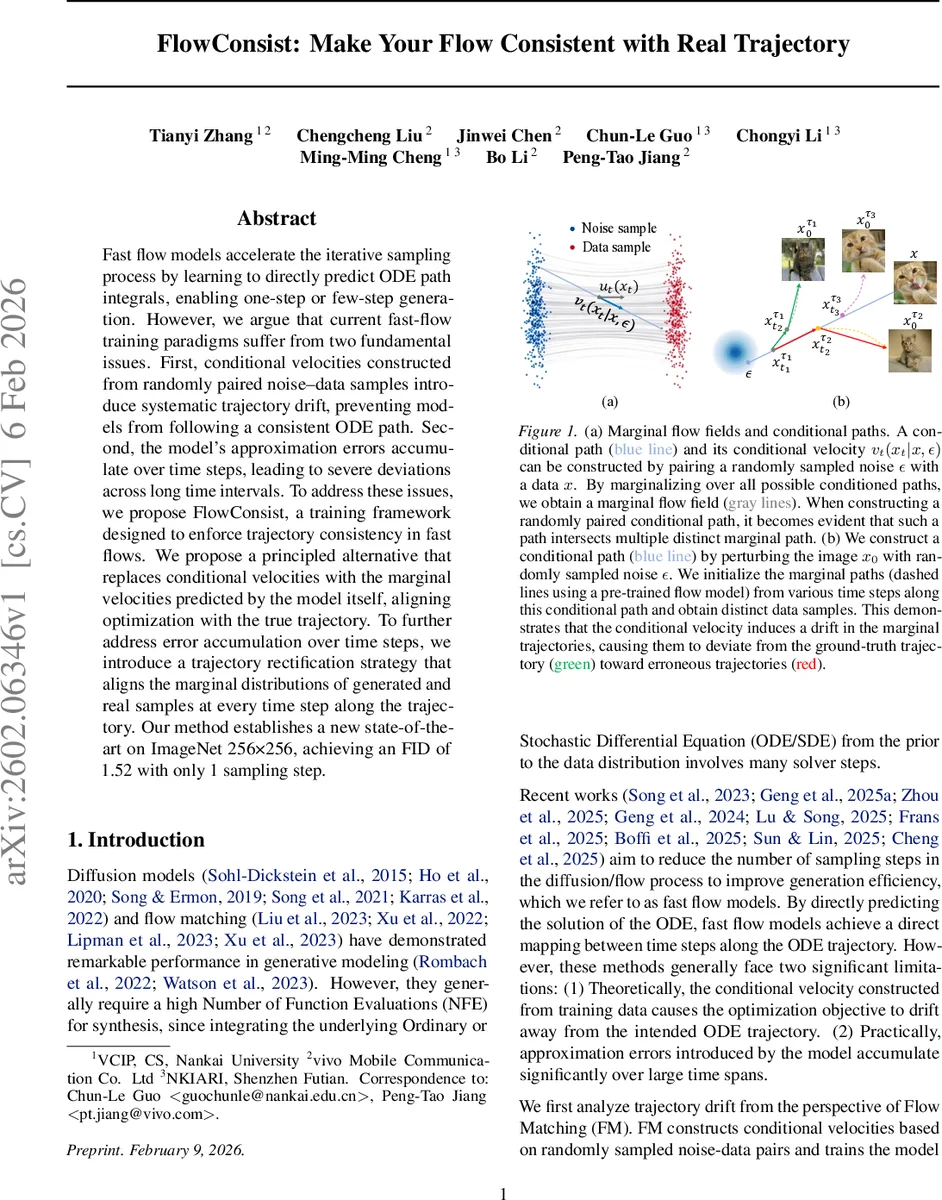
Fast‑flow generative models aim to dramatically reduce the number of function evaluations (NFEs) required for sampling by directly predicting the solution of the underlying ordinary differential equation (ODE). Recent works such as Consistency Models and MeanFlow achieve one‑step or few‑step generation by learning an average velocity that maps a state at time t to a state at an earlier time s. While these approaches are empirically impressive, the authors of “FlowConsist: Make Your Flow Consistent with Real Trajectory” identify two fundamental shortcomings that limit their performance, especially when the number of steps is reduced to one.
1. Trajectory drift caused by conditional velocities
In the standard Flow Matching (FM) formulation, a conditional velocity vₜ(xₜ|x,ε)=ε−x is constructed from a randomly paired data sample x and Gaussian noise ε. Because many (x,ε) pairs can produce the same intermediate point xₜ, the conditional velocity field is highly ambiguous. FM treats the marginal velocity uₜ(xₜ,t)=E
Comments & Academic Discussion
Loading comments...
Leave a Comment