Non-uniform Continuity for the MHD equations with only Magnetic Diffusion
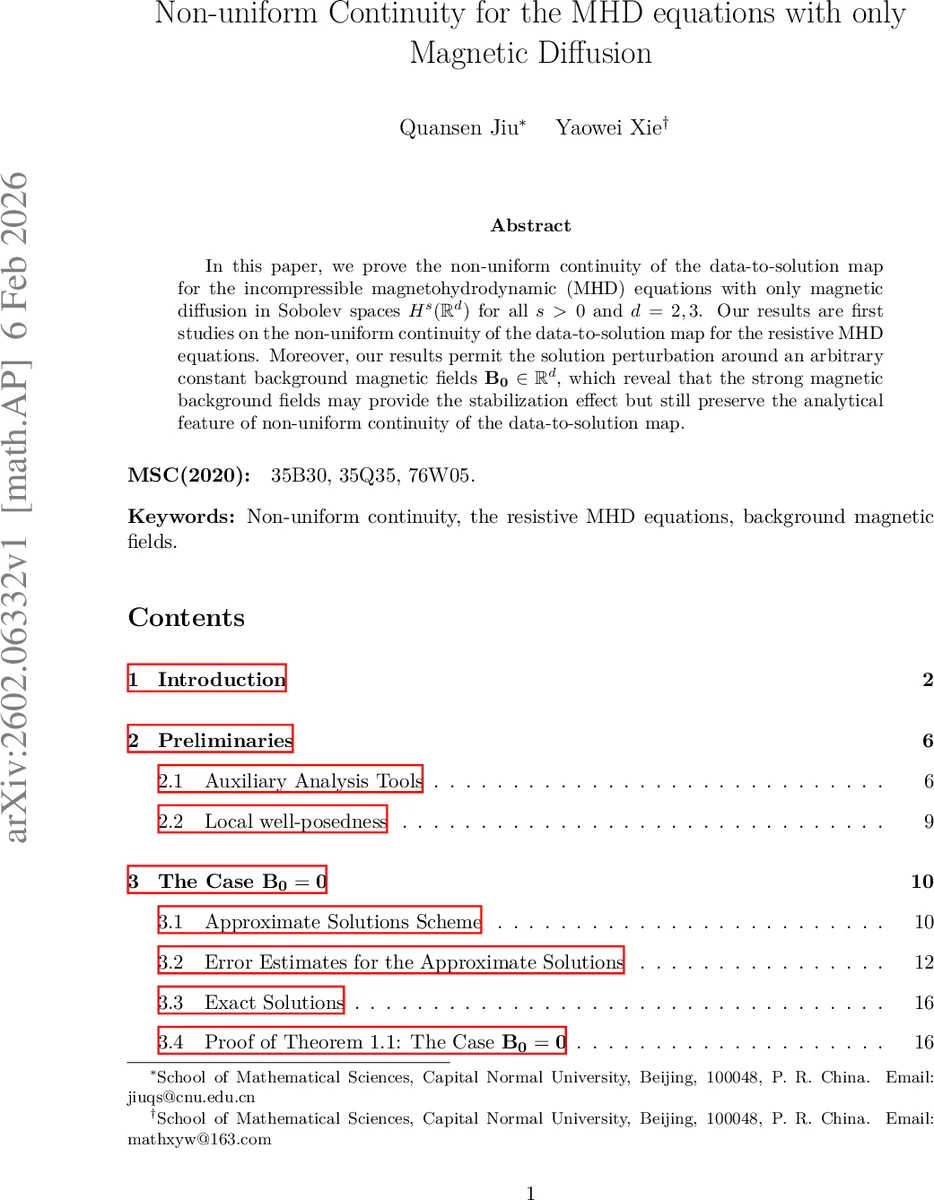
In this paper, we prove the non-uniform continuity of the data-to-solution map for the incompressible magnetohydrodynamic (MHD) equations with only magnetic diffusion in Sobolev spaces $H^s(\mathbb{R}^d)$ for all $s>0$ and $d=2,3$. Our results are first studies on the non-uniform continuity of the data-to-solution map for the resistive MHD equations. Moreover, our results permit the solution perturbation around an arbitrary constant background magnetic fields $\mathbf{B_0} \in \mathbb{R}^d$, which reveal that the strong magnetic background fields may provide the stabilization effect but still preserve the analytical feature of non-uniform continuity of the data-to-solution map.
💡 Research Summary
The paper investigates the regularity of the data‑to‑solution operator for the incompressible magnetohydrodynamic (MHD) system with magnetic diffusion only (no velocity viscosity). The authors consider the Cauchy problem in the whole space (\mathbb{R}^{d}) with (d=2,3) and Sobolev regularity (H^{s}) for any (s>0). Their main result is that, for any fixed positive time (t), the solution map ((u_{0},b_{0})\mapsto (u(t),b(t))) is not uniformly continuous on bounded subsets of (H^{s}\times H^{s}). In other words, one can construct two families of initial data that are arbitrarily close in the Sobolev norm yet whose corresponding solutions separate by a fixed amount at later times.
The proof follows a frequency‑decomposition strategy originally introduced for the Euler equations. The initial data are split into low‑frequency components, which evolve according to the full resistive MHD system, and high‑frequency oscillatory components that are added only to the velocity field. The high‑frequency part is chosen as a highly localized wave packet with wavelength proportional to a large parameter (\lambda). For the two families the sign of the temporal phase is opposite, producing a (\sin t) factor in the difference of the solutions.
Because the magnetic field obeys a diffusion equation, the authors keep the magnetic perturbation at low frequencies and exploit the diffusion term to cancel the most dangerous error terms generated by the high‑frequency velocity. They rewrite the problematic nonlinear terms as divergences, integrate by parts, and use the Laplacian acting on the magnetic field to obtain an extra decay factor (\lambda^{-s-\delta}). When a constant background magnetic field (\mathbf B_{0}\neq0) is present, a linear change of variables eliminates the linear term (\mathbf B_{0}\cdot\nabla u^{h}) and yields an even better decay.
Energy estimates for the difference between the approximate and exact solutions are derived (Lemma 2.2), showing that the error remains small as (\lambda\to\infty). Meanwhile, the main part of the velocity difference retains a size of order (|\sin t|) multiplied by a constant depending only on (s) and the dimension. Consequently, the data‑to‑solution map fails to be uniformly continuous for any Sobolev exponent (s>0).
The result holds both for zero background magnetic field and for any non‑zero constant background field, demonstrating that strong magnetic fields, while providing a stabilizing influence on the dynamics, do not restore uniform continuity. This work extends previous non‑uniform continuity results for the Euler equations and for MHD with velocity dissipation, and it is the first to establish such a property for the resistive MHD system with magnetic diffusion alone.
Comments & Academic Discussion
Loading comments...
Leave a Comment