Soliton-type metrics associated with weighted CSCK metrics on Fano manifolds
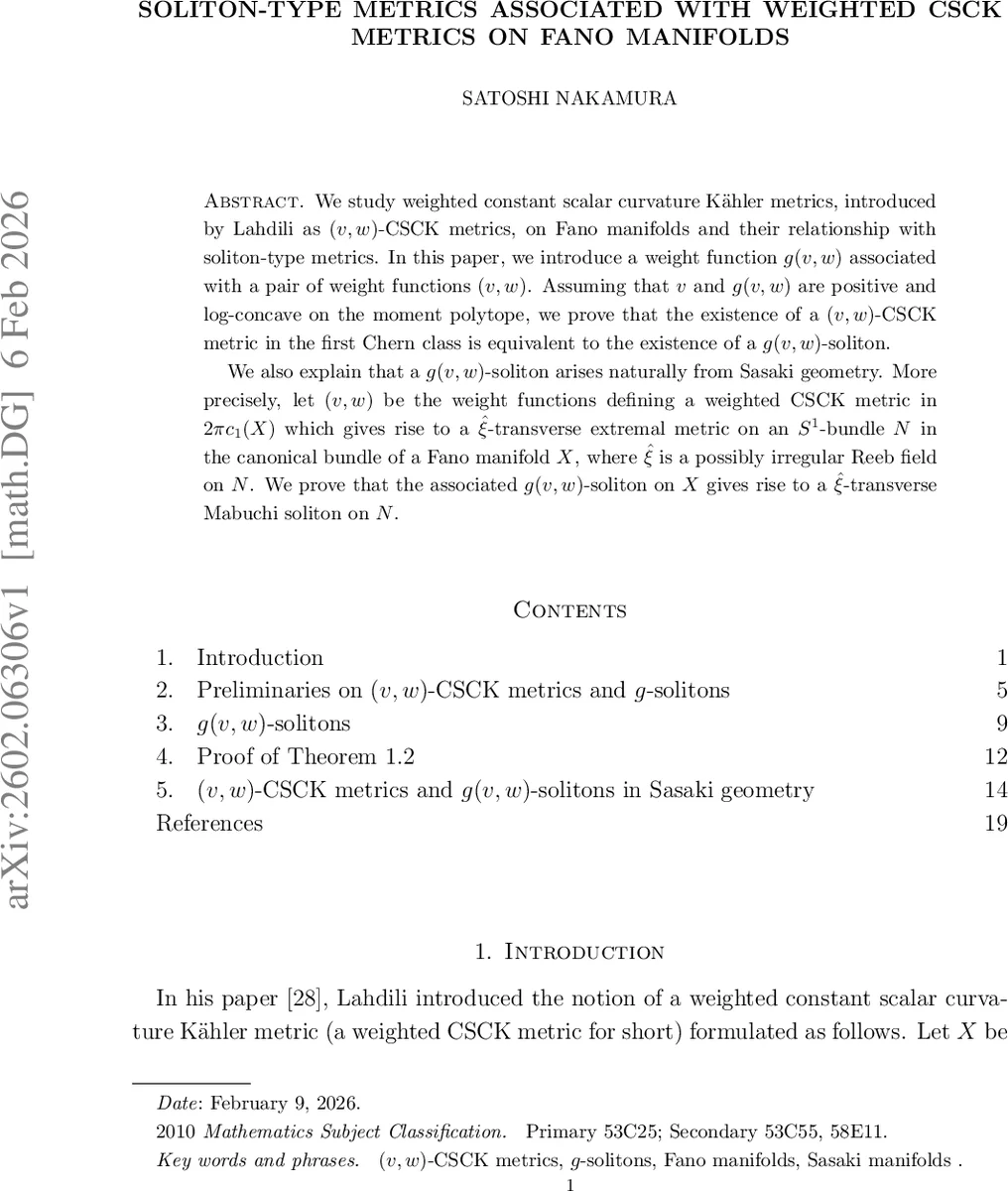
We study weighted constant scalar curvature Kähler metrics, introduced by Lahdili as $(v,w)$-CSCK metrics, on Fano manifolds and their relationship with soliton-type metrics. In this paper, we introduce a weight function $g(v,w)$ associated with a pair of weight functions $(v,w)$. Assuming that $v$ and $g(v,w)$ are positive and log-concave on the moment polytope, we prove that the existence of a $(v,w)$-CSCK metric in the first Chern class is equivalent to the existence of a $g(v,w)$-soliton. We also explain that a $g(v,w)$-soliton arises naturally from Sasaki geometry. More precisely, let $(v,w)$ be the weight functions defining a weighted CSCK metric in $2πc_1(X)$ which gives rise to a $\hatξ$-transverse extremal metric on an $S^1$-bundle $N$ in the canonical bundle of a Fano manifold $X$, where $\hatξ$ is a possibly irregular Reeb field on $N$. We prove that the associated $g(v,w)$-soliton on $X$ gives rise to a $\hatξ$-transverse Mabuchi soliton on $N$.
💡 Research Summary
The paper investigates the deep relationship between weighted constant scalar curvature Kähler (CSCK) metrics—known as (v,w)-CSCK metrics—and soliton‑type metrics defined via a weighted Ricci form, called g‑solitons, on Fano manifolds. Starting from Lahdili’s formulation of (v,w)-CSCK metrics, the author recalls that a T‑invariant Kähler metric ω in a fixed Kähler class Ω is a (v,w)-CSCK metric if its v‑weighted scalar curvature Sv(ω) coincides with a prescribed weight function w on the moment polytope P_X. The functions v>0 and w are smooth on P_X; when both are constant the condition reduces to the usual CSCK equation, while various choices recover extremal, μ‑CSCK, Sasaki‑Einstein, and other canonical metrics.
The central contribution is the introduction of a new weight function
g(v,w)(x) = v(x)·
Comments & Academic Discussion
Loading comments...
Leave a Comment