On the Difficulties with Late-Time Solutions for the Hubble Tension
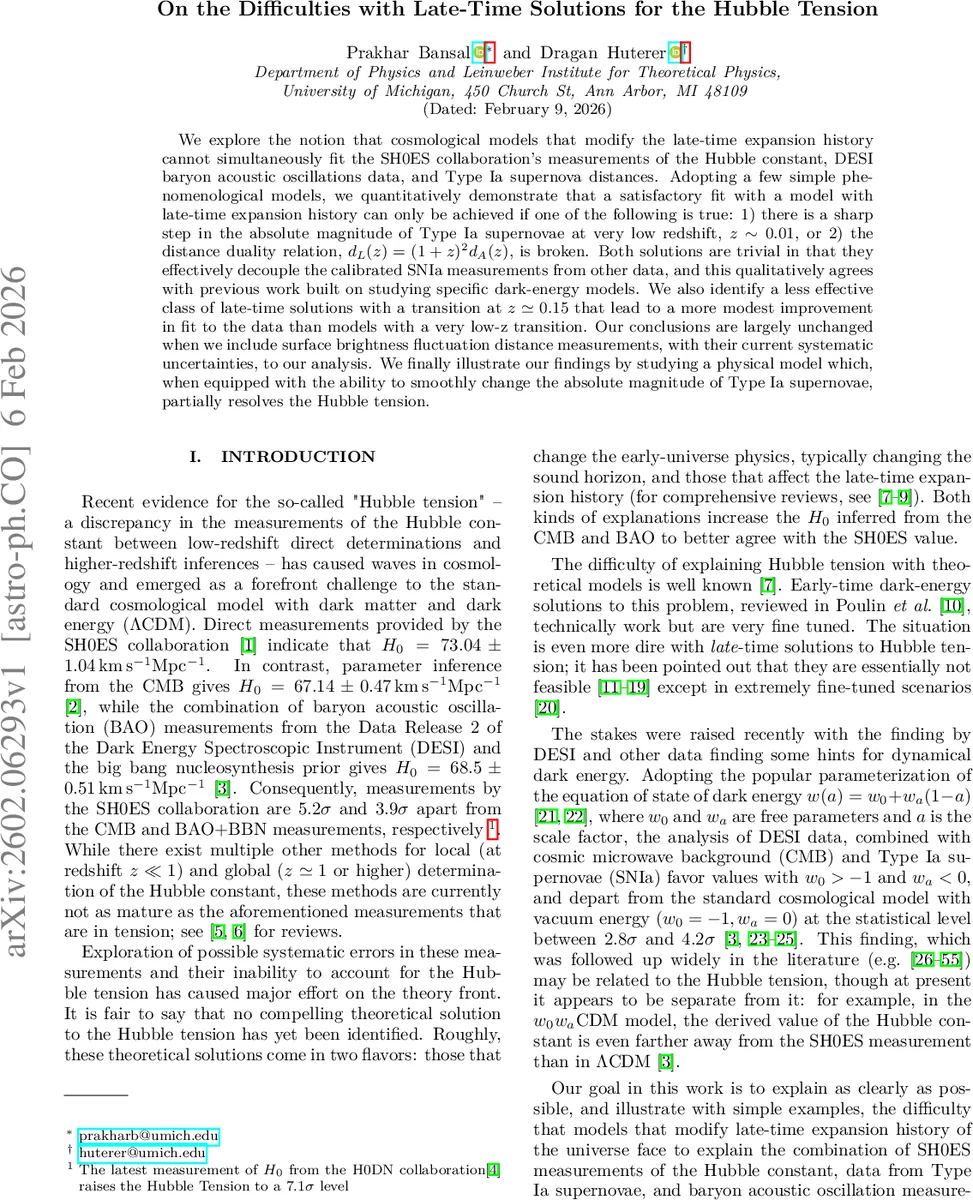
We explore the notion that cosmological models that modify the late-time expansion history cannot simultaneously fit the SH0ES collaboration’s measurements of the Hubble constant, DESI baryon acoustic oscillations data, and Type Ia supernova distances. Adopting a few simple phenomenological models, we quantitatively demonstrate that a satisfactory fit with a model with late-time expansion history can only be achieved if one of the following is true: 1) there is a sharp step in the absolute magnitude of Type Ia supernovae at very low redshift, $z\sim 0.01$, or 2) the distance duality relation, $d_L(z)=(1+z)^2d_A(z)$, is broken. Both solutions are trivial in that they effectively decouple the calibrated SNIa measurements from other data, and this qualitatively agrees with previous work built on studying specific dark-energy models. We also identify a less effective class of late-time solutions with a transition at $z\simeq 0.15$ that lead to a more modest improvement in fit to the data than models with a very low-z transition. Our conclusions are largely unchanged when we include surface brightness fluctuation distance measurements, with their current systematic uncertainties, to our analysis. We finally illustrate our findings by studying a physical model which, when equipped with the ability to smoothly change the absolute magnitude of Type Ia supernovae, partially resolves the Hubble tension.
💡 Research Summary
The paper investigates whether modifications to the late‑time expansion history of the Universe can simultaneously accommodate three key data sets that currently disagree on the value of the Hubble constant: the local measurement from the SH0ES collaboration, baryon acoustic oscillation (BAO) distances from DESI Data Release 2, and Type Ia supernova (SNIa) distances from the PantheonPlus compilation (including the SH0ES Cepheid calibrators). The authors adopt a set of phenomenological extensions to the standard flat ΛCDM model, each adding a small number of extra parameters: a curvature term (Ω_k CDM), a step in the Hubble rate at a transition redshift (Hstep), a step in the absolute magnitude of SNIa at a transition redshift (Mstep), a combination of both steps (Hstep+Mstep), and finally a CPL‑parameterized dark‑energy equation of state (w₀,w_a) together with an Mstep. The step models allow either the expansion rate or the SNIa absolute magnitude (or both) to change abruptly at a chosen redshift.
The analysis uses a compressed CMB likelihood (shift parameter R, angular scale ℓ_a, and physical baryon density Ω_b h²), the 12 DESI BAO distance measurements, and the full PantheonPlus+SH0ES data set (1550 SNIa plus 77 Cepheid‑calibrated low‑z SNIa). The authors modify CAMB to compute distances and magnitudes for the non‑standard models, and they run MCMC chains with Cobaya, imposing the Gelman‑Rubin convergence criterion R < 0.01. They also test the impact of surface‑brightness‑fluctuation (SBF) distances, finding that the conclusions are robust against the current systematic uncertainties of SBF.
Results are summarized in Table I and Figure 2. The baseline ΛCDM model (and the Hstep model, which changes the Hubble rate but not the SNIa magnitude) cannot fit the combined data: the best‑fit absolute magnitude inferred from the high‑z SNIa and BAO is M ≈ ‑19.40, which is 4–5 σ away from the SH0ES calibrated value M ≈ ‑19.24. Consequently the Cepheid point sits far above the theoretical curve. Introducing an Mstep dramatically improves the fit: the total χ² drops by ≈ 40–43 relative to ΛCDM (Δχ² ≈ ‑40), corresponding to a statistically significant improvement. However, this improvement relies entirely on allowing the SNIa absolute magnitude to jump at a very low redshift, z_t ≈ 0.01. In physical terms this is equivalent to breaking the distance‑duality relation d_L = (1+z)² d_A, because the calibrated SNIa distances become decoupled from the BAO and CMB distance ladder.
Models that place the transition at higher redshift (z ≈ 0.15) or that modify the Hubble rate together with the magnitude step (Hstep+Mstep) achieve only modest χ² reductions (Δχ² ≈ ‑2 to ‑3). The curvature extension (Ω_k CDM) and the CPL dark‑energy model without a magnitude step also provide negligible improvement. Adding SBF distances does not change these conclusions.
To illustrate that a physical mechanism could in principle generate a varying absolute magnitude, the authors construct a toy model where a scalar field couples to the SNIa progenitor physics, allowing M to evolve smoothly. When this smooth evolution is imposed, the fit improvement disappears, confirming that only an abrupt, essentially “step‑function” change in M can reconcile the data within the late‑time framework.
The authors conclude that any viable late‑time solution to the Hubble tension must either (1) invoke a sharp, low‑redshift change in the SNIa absolute magnitude (effectively a step at z ≈ 0.01) or (2) break the distance‑duality relation, both of which are highly non‑standard and lack a compelling physical justification. Consequently, the class of late‑time modifications to the expansion history faces a fundamental obstacle: without such exotic assumptions they cannot simultaneously fit SH0ES, DESI BAO, and SNIa data. The paper therefore reinforces earlier findings that early‑time (pre‑recombination) physics remains the more promising avenue for resolving the Hubble tension, while highlighting the need for future work on ultra‑low‑z supernova calibration or tests of distance‑duality violations.
Comments & Academic Discussion
Loading comments...
Leave a Comment