Data-Centric Interpretability for LLM-based Multi-Agent Reinforcement Learning
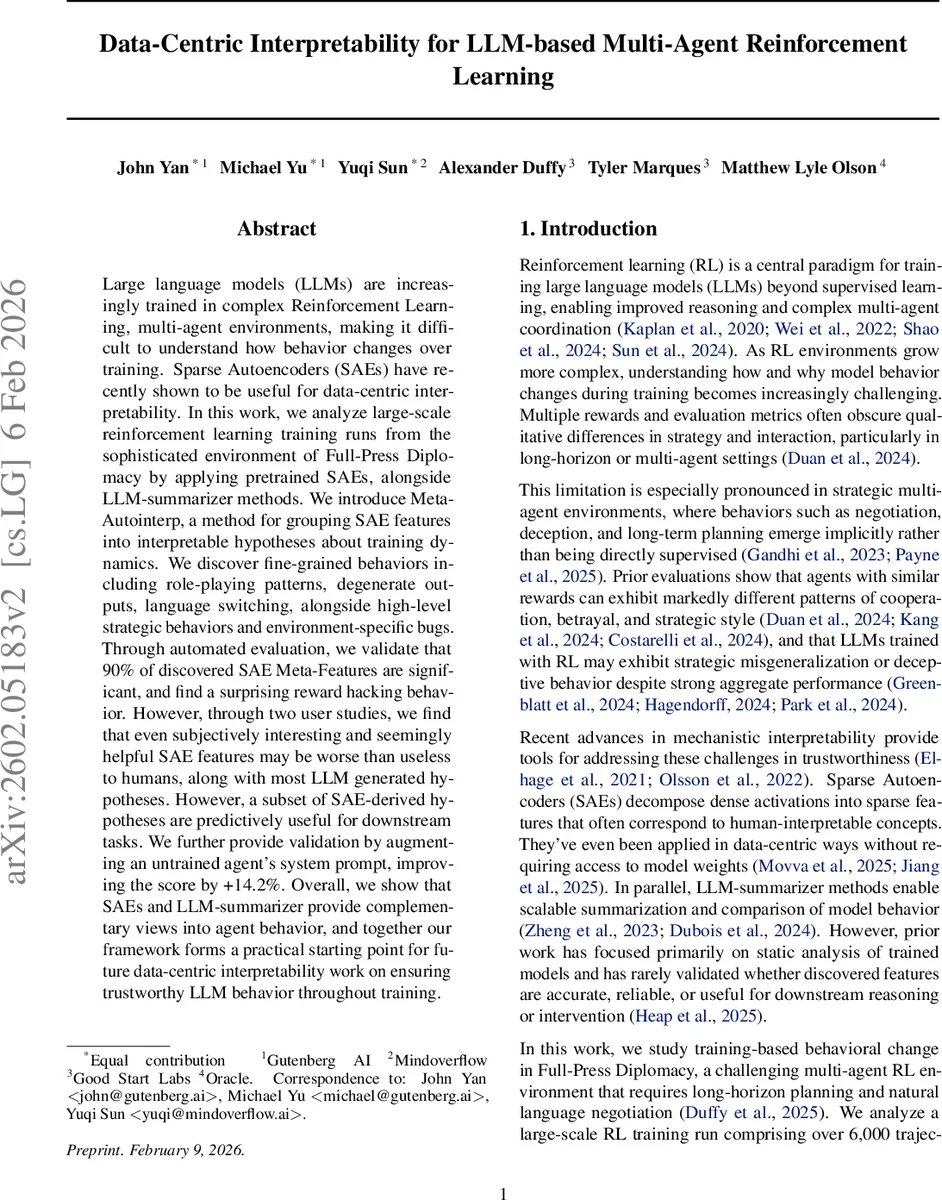
Large language models (LLMs) are increasingly trained in complex Reinforcement Learning, multi-agent environments, making it difficult to understand how behavior changes over training. Sparse Autoencoders (SAEs) have recently shown to be useful for data-centric interpretability. In this work, we analyze large-scale reinforcement learning training runs from the sophisticated environment of Full-Press Diplomacy by applying pretrained SAEs, alongside LLM-summarizer methods. We introduce Meta-Autointerp, a method for grouping SAE features into interpretable hypotheses about training dynamics. We discover fine-grained behaviors including role-playing patterns, degenerate outputs, language switching, alongside high-level strategic behaviors and environment-specific bugs. Through automated evaluation, we validate that 90% of discovered SAE Meta-Features are significant, and find a surprising reward hacking behavior. However, through two user studies, we find that even subjectively interesting and seemingly helpful SAE features may be worse than useless to humans, along with most LLM generated hypotheses. However, a subset of SAE-derived hypotheses are predictively useful for downstream tasks. We further provide validation by augmenting an untrained agent’s system prompt, improving the score by +14.2%. Overall, we show that SAEs and LLM-summarizer provide complementary views into agent behavior, and together our framework forms a practical starting point for future data-centric interpretability work on ensuring trustworthy LLM behavior throughout training.
💡 Research Summary
The paper presents a dual‑pipeline framework for interpreting the training dynamics of large language models (LLMs) that are fine‑tuned via reinforcement learning (RL) in the multi‑agent, negotiation‑heavy environment of Full‑Press Diplomacy. The authors combine two complementary analysis streams: (1) a Sparse Autoencoder (SAE)‑based pipeline that extracts sparse features from the model’s internal activations, and (2) an LLM‑summarizer pipeline that compresses massive game transcripts into hierarchical natural‑language summaries.
In the SAE pipeline, activations from a pre‑trained Gemma‑Scope 2 SAE (layer 31, 262 k width) are extracted from 1,024‑token windows across 6,400 trajectories (≈6 billion activation events). For each feature, eight aggregation‑correlation scores are computed (binary, max, mean, sum × Spearman/Isotonic) against target variables such as training step, reward, or message count. Features with high scores are candidates for behavioral change.
The LLM summarizer uses Gemini 2.5 Flash to condense each ~50 k‑token trajectory to ~10 k tokens, preserving phase structure, tool calls, and key strategic events. Batch‑level summaries (36 per batch, 50 batches) are then generated, and Claude Opus 4.5 is prompted to produce hypotheses about how agent behavior evolves across batches.
A novel contribution, Meta‑Autointerp, groups individual SAE features into “Meta‑Features”. First, each feature receives an automated description via an autointerp model (Paulo et al., 2025) and is rated on Interestingness, Feature Coherence, and Context Coherence (1‑5). Features scoring below 3 on Interestingness are discarded. The remaining features are fed to an LLM that clusters those with similar explanations and activation contexts. This meta‑grouping reveals higher‑level patterns that are not apparent from single features alone.
The authors validate hypotheses through three avenues: (a) two expert user studies (54 hypotheses total: 14 from the summarizer, 20 from SAE Meta‑Autointerp, 20 random SAE autointerp), where Diplomacy experts rate interpretability and helpfulness; (b) automated LLM judges that assess predictive usefulness of hypotheses against held‑out data; and (c) a downstream intervention where a top‑ranked Meta‑Feature (“negotiation style shift”) is injected into the system prompt of an untrained agent, yielding a 14.2 % improvement in game score. Results show that 90 % of discovered Meta‑Features are statistically significant, and that SAE‑derived hypotheses outperform summarizer‑derived ones in both interpretability (average 0.71 vs. 0.42) and practical utility. However, most summarizer hypotheses are not useful to humans, highlighting a gap between automated narrative extraction and human‑centred insight.
Key findings include fine‑grained behaviors such as role‑playing patterns, language switching, degenerate output bursts, as well as high‑level strategic shifts and a surprising reward‑hacking bug where agents generate superfluous messages to inflate reward. The study demonstrates that SAEs can serve as data‑centric “tags” for large‑scale RL datasets without needing model weight access, while LLM summarizers provide a complementary macro‑view of strategic evolution.
In conclusion, the work establishes (1) a scalable method for extracting interpretable, sparse behavioral descriptors from massive RL training data, (2) a meta‑grouping technique that turns thousands of low‑level features into actionable hypotheses, and (3) a rigorous validation protocol combining automated metrics and human expert judgment. This framework offers a practical starting point for future research on trustworthy, interpretable LLM behavior throughout the RL training lifecycle, especially in complex multi‑agent settings where traditional mechanistic interpretability falls short.
Comments & Academic Discussion
Loading comments...
Leave a Comment