Dead ends in square-free digit walks
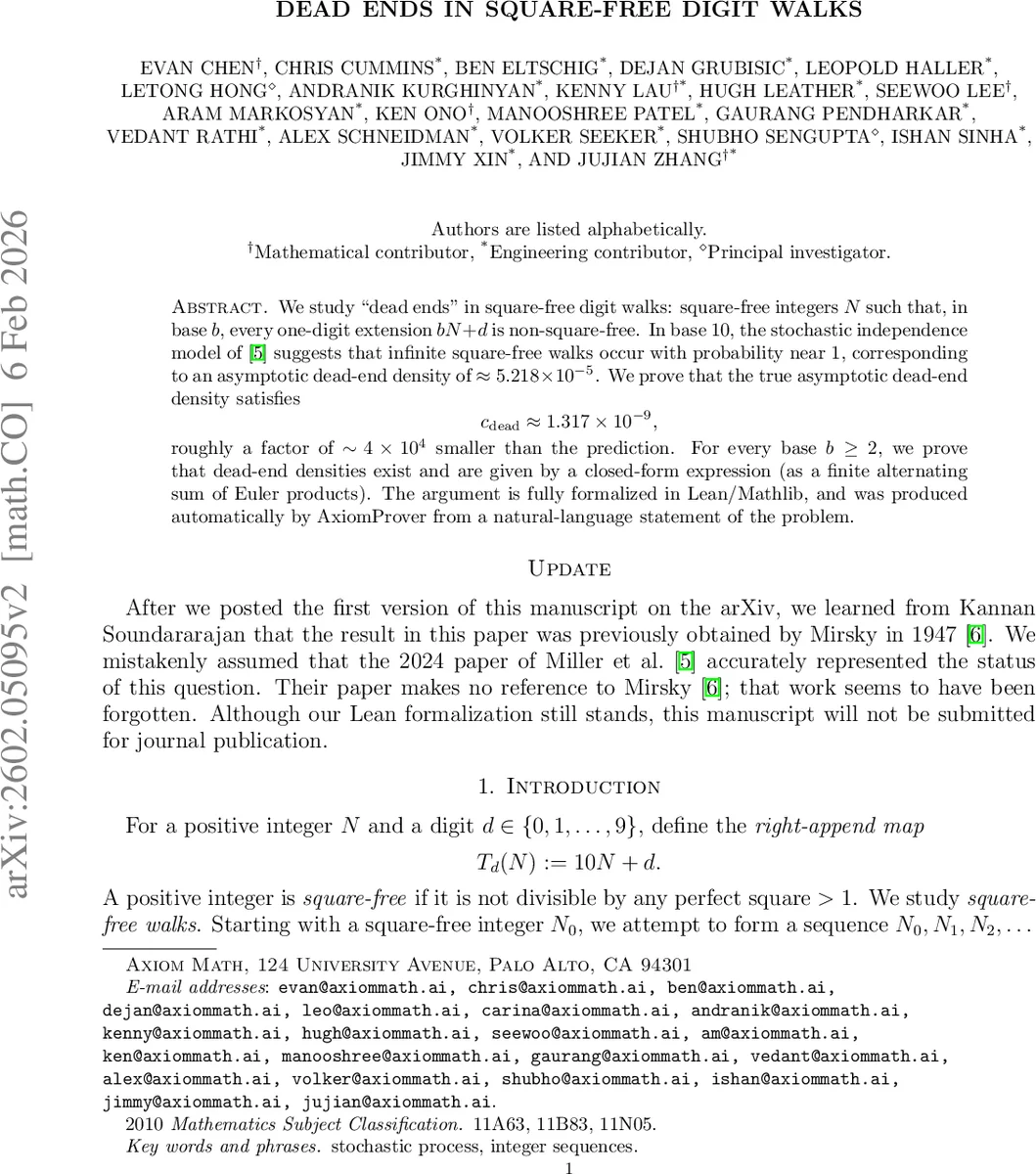
We study “dead ends” in square-free digit walks: square-free integers $N$ such that, in base $b$, every one-digit extension $bN+d$ is non-square-free. In base $10$, the stochastic independence model of Miller et al. suggests that infinite square-free walks occur with probability near $1$, corresponding to an asymptotic dead-end density of $\approx 5.218\times 10^{-5}$. We prove that the true asymptotic dead-end density satisfies [ c_{\mathrm{dead}} \approx 1.317\times 10^{-9}, ] roughly a factor of $\sim 4\times 10^4$ smaller than the prediction. For every base $b\geq 2$, we prove that dead-end densities exist and are given by a closed-form expression (as a finite alternating sum of Euler products). The argument is fully formalized in Lean/Mathlib, and was produced automatically by AxiomProver from a natural-language statement of the problem.
💡 Research Summary
The paper investigates “dead ends” in square‑free digit walks. A positive integer N is called a dead end in base b if N is square‑free and, for every digit d∈{0,…,b−1}, the number bN+d fails to be square‑free. The problem originates from a question raised by Miller, et al. (2024) who, using a stochastic independence model, predicted that the asymptotic density of dead ends in base 10 should be about 5.218 × 10⁻⁵, implying that almost every starting point yields an infinite square‑free walk.
The authors show that this probabilistic prediction is dramatically off. By exploiting the arithmetic constraints imposed by prime squares, they prove that the true density is far smaller: \
Comments & Academic Discussion
Loading comments...
Leave a Comment