Ultrastable 2D glasses and packings explained by local centrosymmetry
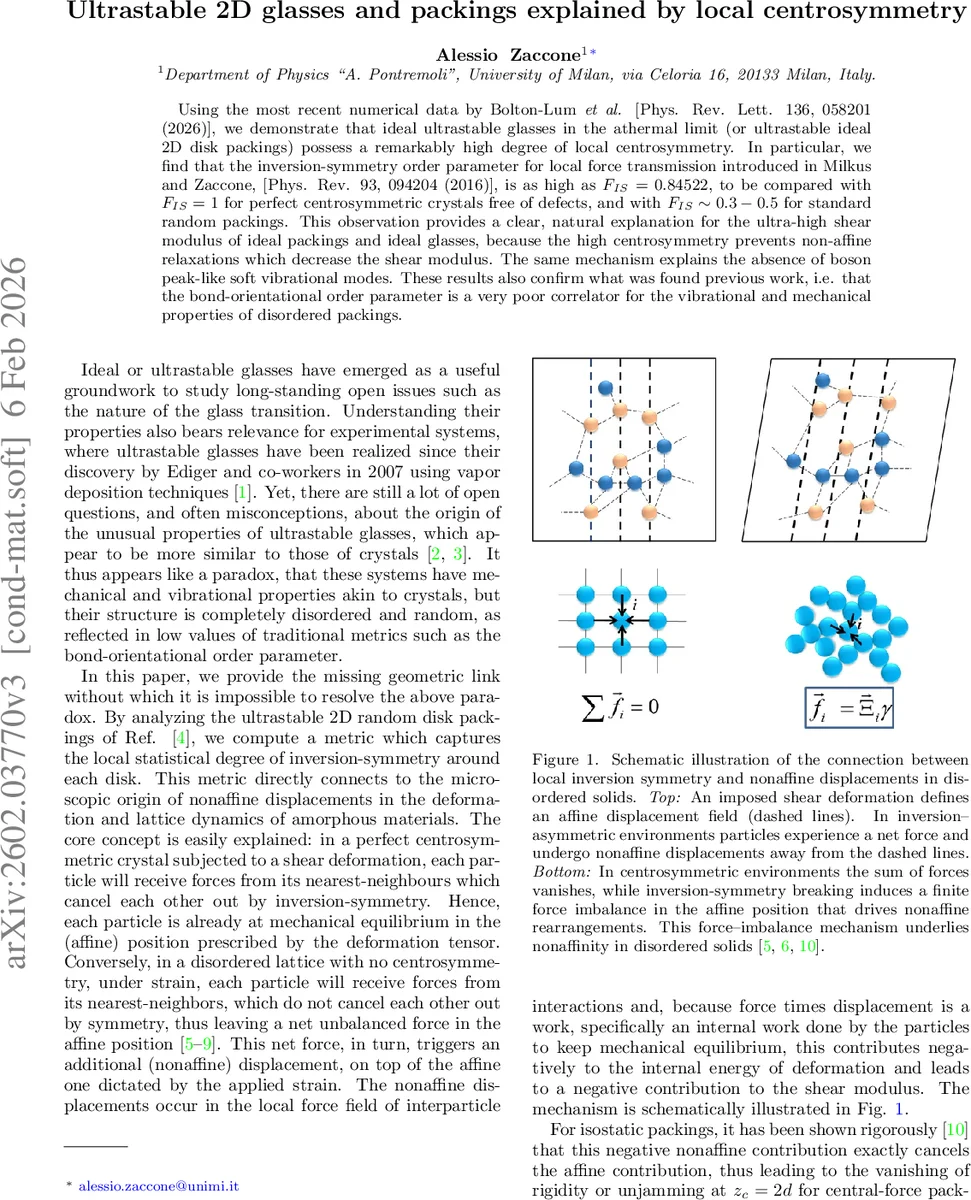
Using the most recent numerical data by Bolton-Lum \emph{et al.} [Phys. Rev. Lett. 136, 058201 (2026)], we demonstrate that ideal ultrastable glasses in the athermal limit (or ultrastable ideal 2D disk packings) possess a remarkably high degree of local centrosymmetry. In particular, we find that the inversion-symmetry order parameter for local force transmission introduced in Milkus and Zaccone, [Phys. Rev. 93, 094204 (2016)], is as high as $F_{IS}= 0.84522$, to be compared with $F_{IS}=1$ for perfect centrosymmetric crystals free of defects, and with $F_{IS} \sim 0.3-0.5$ for standard random packings. This observation provides a clear, natural explanation for the ultra-high shear modulus of ideal packings and ideal glasses, because the high centrosymmetry prevents non-affine relaxations which decrease the shear modulus. The same mechanism explains the absence of boson peak-like soft vibrational modes. These results also confirm what was found previous work, i.e. that the bond-orientational order parameter is a very poor correlator for the vibrational and mechanical
💡 Research Summary
The paper investigates why ultrastable two‑dimensional (2D) glasses and ideal 2D disk packings display crystal‑like mechanical and vibrational properties despite being structurally disordered. Using the latest numerical data from Bolton‑Lum et al. (Phys. Rev. Lett. 136, 058201, 2026), the authors compute the inversion‑symmetry order parameter F_IS, originally introduced by Milkus and Zaccone (Phys. Rev. B 93, 094204, 2016). F_IS quantifies how well the forces transmitted through a particle’s nearest‑neighbor network cancel by inversion symmetry; it equals 1 for a perfectly centrosymmetric crystal and approaches 0 when inversion symmetry is completely broken.
To evaluate F_IS, the authors first construct a Delaunay triangulation of the 288 disk centers shown in Bolton‑Lum’s Fig. 2, then extract the Gabriel graph to define neighbor pairs without imposing an arbitrary distance cutoff. After discarding particles near the boundaries (33 out of 288, leaving N = 255 bulk particles), they calculate the affine force field Ξ_i for each particle, which depends only on the static contact geometry (spring constant κ, inter‑particle distances R_ij, and unit‑vector components n_x, n_y). The normalized order parameter is then
\
Comments & Academic Discussion
Loading comments...
Leave a Comment