Distributed Uplink Anti-Jamming in LEO Mega-Constellations via Game-Theoretic Beamforming
Low-Earth-Orbit (LEO) satellite constellations have become vital in emerging commercial and defense Non-Terrestrial Networks (NTNs). However, their predictable orbital dynamics and exposed geometries make them highly susceptible to ground-based jamming. Traditional single-satellite interference mitigation techniques struggle to spatially separate desired uplink signals from nearby jammers, even with large antenna arrays. This paper explores a distributed multi-satellite anti-jamming strategy leveraging the dense connectivity and high-speed inter-satellite links of modern LEO mega-constellations. We model the uplink interference scenario as a convex-concave game between a desired terrestrial transmitter and a jammer, each optimizing their spatial covariance matrices to maximize or minimize achievable rate. We propose an efficient min-max solver combining alternating best-response updates with projected gradient descent, achieving fast convergence of the beamforming strategy to the Nash equilibrium. Using realistic Starlink orbital geometries and Sionna ray-tracing simulations, we demonstrate that while close-proximity jammers can cripple single-satellite links, distributed satellite cooperation significantly enhances resilience, shifting the capacity distribution upward under strong interference.
💡 Research Summary
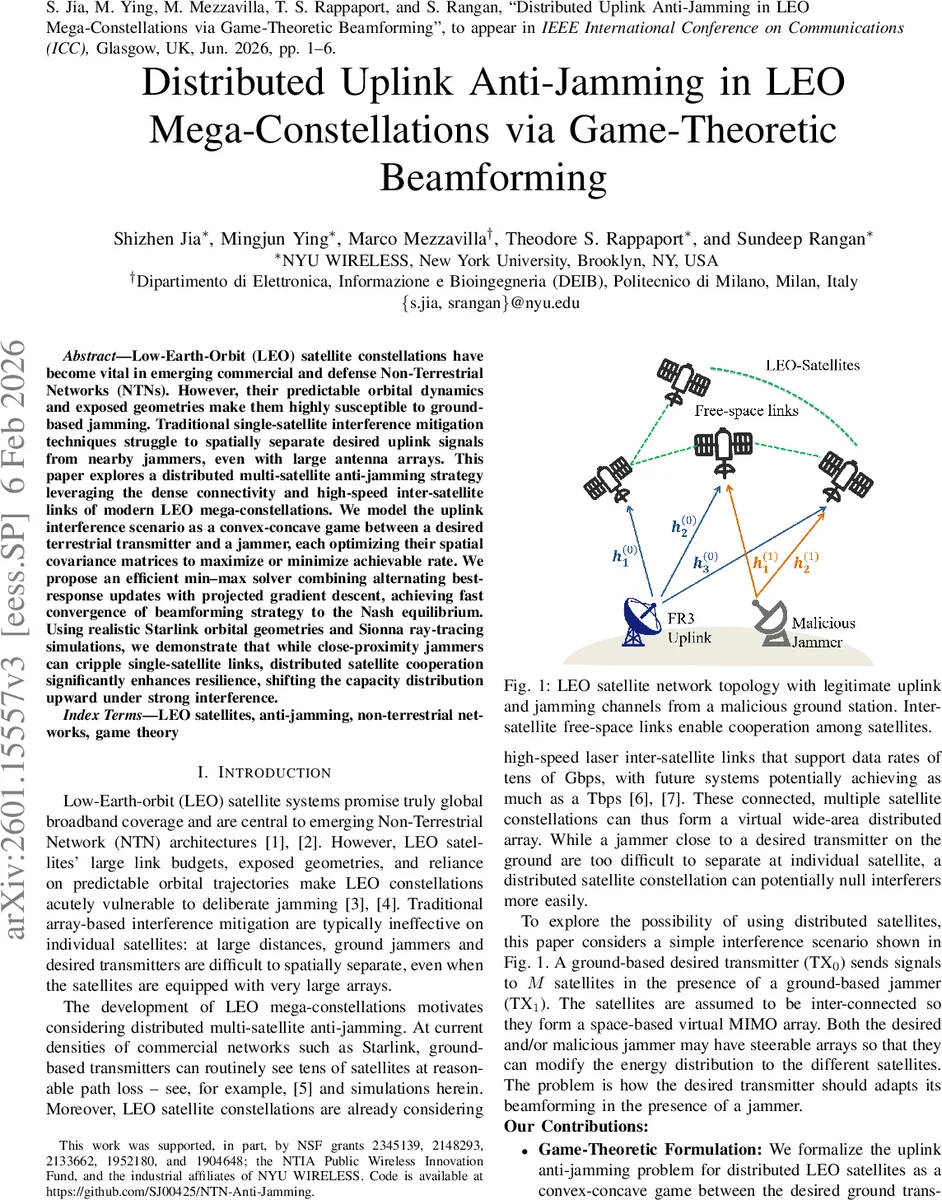
The paper addresses the vulnerability of Low‑Earth‑Orbit (LEO) mega‑constellations to ground‑based jamming, a problem that becomes acute because the satellites follow predictable orbits and are exposed to line‑of‑sight attacks. Traditional interference mitigation that relies on a single satellite’s large antenna array often fails when the jammer is close to the legitimate transmitter, because the angular separation is too small to place a deep null without destroying the main‑lobe gain. To overcome this limitation, the authors propose a distributed anti‑jamming strategy that treats the entire set of visible satellites as a virtual, wide‑area MIMO array linked by high‑speed laser inter‑satellite links.
The core technical contribution is a convex‑concave (min‑max) game formulation. The legitimate ground transmitter (TX 0) and the jammer (TX 1) each select a spatial covariance matrix, Q₀ and Q₁, subject to power constraints tr(Q₀)≤E₀ and tr(Q₁)≤E₁. The achievable uplink rate is expressed as J(Q₀,Q₁)=log₂ det(I+H₀ Q₀ H₀ᴴ P⁻¹), where H₀ and H₁ are the stacked channel matrices from the transmitter and jammer to all M satellites, and P=H₁ Q₁ H₁ᴴ+κI captures interference plus noise. J is concave in Q₀ and convex in Q₁, guaranteeing the existence of a Nash equilibrium and allowing the min‑max order to be interchanged.
To compute the equilibrium, the authors develop an alternating best‑response algorithm (Algorithm 1). In each iteration, (i) with Q₁ fixed, Q₀ is optimized via a classic water‑filling solution on the effective matrix A=H₀ᴴ P⁻¹ H₀; the eigen‑decomposition of A yields water‑levels p_i=(μ−1/λ_i)⁺ that satisfy the power budget. (ii) With the new Q₀, Q₁ is updated by projected gradient descent. The gradient G₁=H₁ᴴ
Comments & Academic Discussion
Loading comments...
Leave a Comment