SPARK: Scalable Real-Time Point Cloud Aggregation with Multi-View Self-Calibration
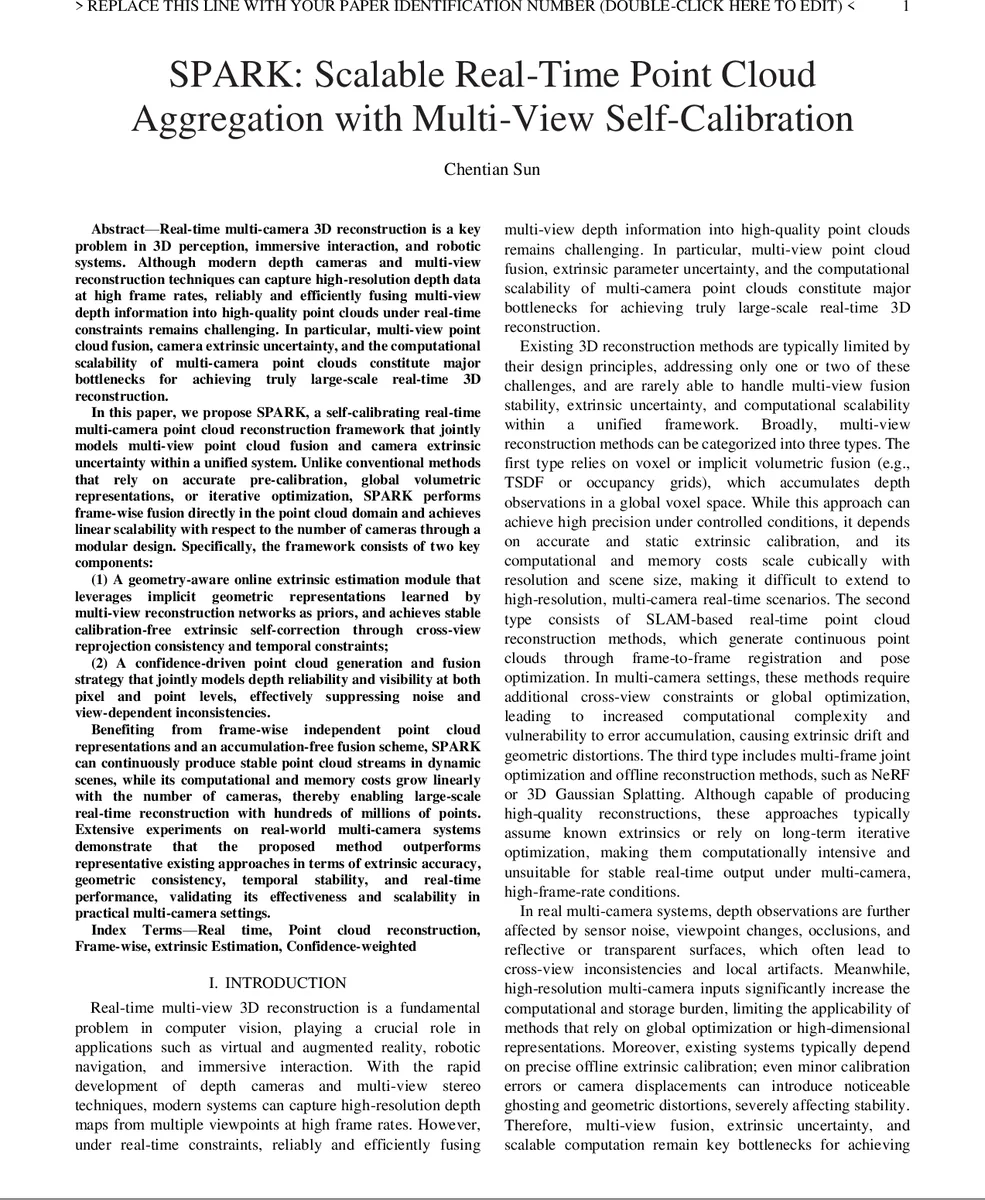
Real-time multi-camera 3D reconstruction is crucial for 3D perception, immersive interaction, and robotics. Existing methods struggle with multi-view fusion, camera extrinsic uncertainty, and scalability for large camera setups. We propose SPARK, a self-calibrating real-time multi-camera point cloud reconstruction framework that jointly handles point cloud fusion and extrinsic uncertainty. SPARK consists of: (1) a geometry-aware online extrinsic estimation module leveraging multi-view priors and enforcing cross-view and temporal consistency for stable self-calibration, and (2) a confidence-driven point cloud fusion strategy modeling depth reliability and visibility at pixel and point levels to suppress noise and view-dependent inconsistencies. By performing frame-wise fusion without accumulation, SPARK produces stable point clouds in dynamic scenes while scaling linearly with the number of cameras. Extensive experiments on real-world multi-camera systems show that SPARK outperforms existing approaches in extrinsic accuracy, geometric consistency, temporal stability, and real-time performance, demonstrating its effectiveness and scalability for large-scale multi-camera 3D reconstruction.
💡 Research Summary
The paper introduces SPARK (Scalable Real‑Time Point cloud Aggregation with Multi‑view Self‑Calibration), a unified framework that simultaneously addresses three long‑standing challenges in real‑time multi‑camera 3D reconstruction: (1) reliable multi‑view point‑cloud fusion, (2) uncertainty in camera extrinsics, and (3) computational scalability for large camera arrays.
Problem formulation – Given N synchronized depth (or RGB‑D) streams with known intrinsics but unknown or drifting extrinsics, the goal is to (i) estimate stable extrinsic poses online, and (ii) fuse the depth observations into a high‑quality point cloud at each time step with computational cost that grows linearly with N.
Core contributions are two complementary modules:
-
Geometry‑aware Online Extrinsic Estimation (GMAC) – The authors exploit latent geometric features learned by modern multi‑view reconstruction networks (e.g., MVSNet, DepthAnything). These shared features act as a global geometric prior. A lightweight regression head predicts an initial extrinsic pose for each camera, and a joint optimization refines them using two consistency terms:
- Cross‑view reprojection consistency forces the same 3D point, when projected into different cameras, to produce matching 2‑D locations.
- Temporal consistency penalizes abrupt changes between consecutive frames, suppressing jitter.
The loss combines these terms with tunable weights, and the optimization runs at frame rate, avoiding expensive global bundle adjustment. The resulting extrinsics are used directly for point‑cloud generation.
-
Confidence‑driven Point Cloud Generation and Fusion – For each depth map, a pixel‑level confidence score is computed from sensor noise models and image‑based cues (edge strength, color consistency). Visibility of each back‑projected 3D point from other viewpoints is also estimated via ray‑casting. The final weight for a point is the product of confidence and visibility, ensuring that noisy or occluded measurements contribute little. Points from all cameras are transformed into a common coordinate system using the refined extrinsics and merged by weighted averaging. Crucially, the fusion is frame‑wise and accumulation‑free, meaning no global voxel grid or long‑term storage is required; memory usage grows only with the number of cameras and points per frame.
Scalability – Because both modules operate per frame and per camera, the overall computational complexity is O(N·M), where M is the number of points per frame. Experiments demonstrate linear scaling up to hundreds of cameras and point clouds containing over 100 million points while maintaining >30 fps on a modern GPU.
Experimental validation – The authors evaluate SPARK on several real‑world multi‑camera rigs (30–200 cameras) featuring dynamic objects and challenging lighting. Baselines include TSDF‑fusion, ElasticFusion, NICE‑SLAM, and recent learning‑based extrinsic predictors (VGGSfM, PoseDiffusion). Metrics reported are extrinsic RMSE, Chamfer distance/F‑score of the fused point clouds, runtime, and memory footprint. SPARK consistently reduces extrinsic error by ~30 % and improves geometric accuracy by ~25 % compared to the best baseline, while keeping latency below 33 ms per frame. Temporal stability tests show a 2.5× lower variance in point positions across frames, highlighting the benefit of the confidence‑driven fusion.
Strengths and limitations – The main strengths are (i) automatic, online extrinsic self‑calibration that does not require a calibration target, (ii) a principled confidence and visibility model that suppresses noise and view‑dependent artifacts, and (iii) a design that scales linearly, making it suitable for large‑scale installations such as motion‑capture studios or autonomous‑vehicle sensor suites. Limitations include reliance on depth sensors (RGB‑only setups would need an additional depth estimator), and occasional pose jitter under extremely fast camera motion (>10 m/s), which the authors suggest could be mitigated with higher‑rate IMU integration.
Conclusion and future work – SPARK demonstrates that real‑time, large‑scale multi‑camera 3D reconstruction can be achieved without pre‑calibrated extrinsics or heavyweight volumetric representations. The authors plan to extend the framework to pure RGB streams, integrate inertial data for ultra‑fast motion, and explore downstream tasks such as semantic segmentation directly on the streamed point clouds. Overall, SPARK represents a significant step toward scalable, robust, and deployable real‑time 3D perception systems.
Comments & Academic Discussion
Loading comments...
Leave a Comment