New Multi-messenger Probe of Dark Matter-Nucleon Interactions from Ultra-high Energy Cosmic Ray Acceleration
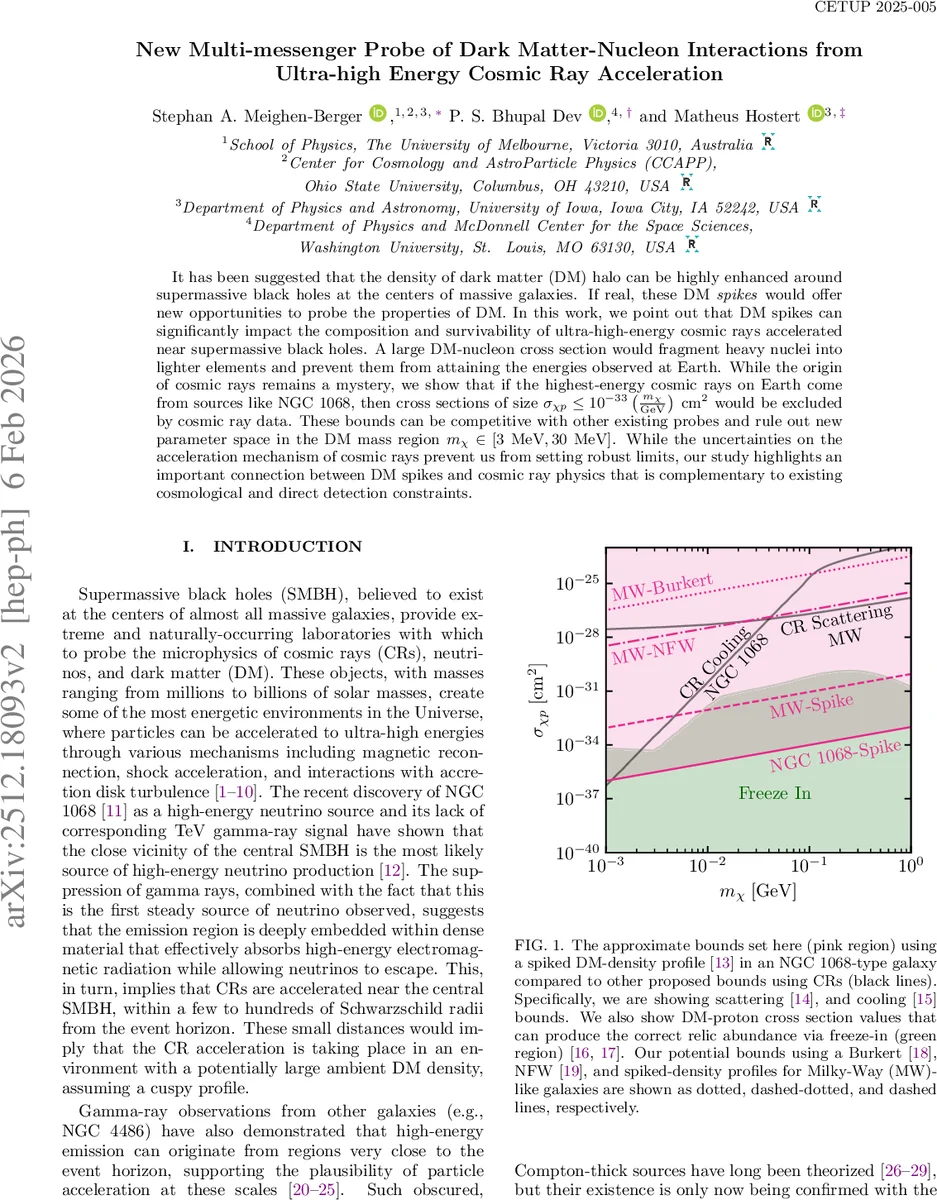
It has been suggested that the density of dark matter (DM) halo can be highly enhanced around supermassive black holes at the centers of massive galaxies. If real, these DM \emph{spikes} would offer new opportunities to probe the properties of DM. In this work, we point out that DM spikes can significantly impact the composition and survivability of ultra-high-energy cosmic rays accelerated near supermassive black holes. A large DM-nucleon cross section would fragment heavy nuclei into lighter elements and prevent them from attaining the energies observed at Earth. While the origin of cosmic rays remains a mystery, we show that if the highest-energy cosmic rays on Earth come from sources like NGC 1068, then cross sections of size $σ_{χp} \leq 10^{-33} \left( \frac{m_χ}{\mathrm{GeV}}\right);\mathrm{cm^{2}}$ would be excluded by cosmic ray data. These bounds can be competitive with other existing probes and rule out new parameter space in the DM mass region $m_χ\in [3;\mathrm{MeV}, 30;\mathrm{MeV}]$. While the uncertainties on the acceleration mechanism of cosmic rays prevent us from setting robust limits, our study highlights an important connection between DM spikes and cosmic ray physics that is complementary to existing cosmological and direct detection constraints.
💡 Research Summary
In this paper the authors explore a novel multi‑messenger probe of dark‑matter (DM)–nucleon interactions by considering the impact of a dense DM “spike” that may form around supermassive black holes (SMBHs) on the acceleration and survival of ultra‑high‑energy cosmic rays (UHECRs). The motivation stems from recent observations that active galactic nuclei (AGN) such as NGC 1068 are bright neutrino sources while their high‑energy gamma‑ray emission is suppressed, suggesting that particle acceleration occurs very close to the SMBH, within a few to hundreds of Schwarzschild radii. In such an environment the DM density could be dramatically enhanced if a spike forms as a result of the adiabatic growth of the black hole. Using the formalism of Gondolo and Silk (1999) the authors adopt a generalized NFW halo outside the spike and a power‑law ρ∝r⁻⁷⁄³ inside, with the spike extending from ≈4 R_S to ≈1 pc. They discuss possible weakening mechanisms (stellar heating, DM annihilation, self‑interactions) and present several benchmark density profiles (NFW, Burkert, spiked).
The central physical question is whether a DM–nucleon scattering cross section large enough to fragment heavy nuclei (e.g. iron) would prevent those nuclei from being accelerated to the observed energies (≈50 EeV). They compute the maximal momentum transfer in a DM–CR collision (Eq. 4) and argue that a transfer Q²≳1 GeV² is sufficient to shatter an iron nucleus. This requirement translates into a very modest lower bound on the DM mass (m_χ ≳ 0.01 eV for 50 EeV CRs), so essentially any realistic DM candidate can provide the needed momentum.
The key observable constraint comes from the interaction length λ = 1/(n_χ σ_χCR). For a CR to survive the acceleration region, λ must exceed the characteristic size of that region. The authors first adopt a conservative acceleration size l_acc ≈ 10⁻³ pc (the typical size of an AGN accretion disc) and obtain σ_χp ≤ 1.3 × 10⁻²⁸ (m_χ/GeV) cm² for a spiked profile (σ_χp ≤ 1.2 × 10⁻²⁴ (m_χ/GeV) cm² for a standard NFW halo). However, a more realistic acceleration limit is set by the Larmor radius r_L = E/(ZeB). Using a magnetic field near the SMBH horizon of B ≈ 10⁴ G, the Larmor radius for an iron nucleus at 50 EeV is r_L ≈ 2 × 10⁻⁷ pc, far smaller than the disc size. Requiring λ > r_L yields a dramatically stronger bound: σ_χp ≤ 10⁻³³ (m_χ/GeV) cm². This limit is competitive with, and in the DM mass range 3–30 MeV surpasses, existing direct‑detection and cosmological constraints.
The authors also discuss possible scaling of the DM–nucleon cross section with atomic number (σ_χN ∝ A^{2/3} ln²s), which would tighten the bound by factors of 10²–10³. They acknowledge substantial uncertainties: the existence of a spike is not observationally confirmed; stellar heating, DM self‑annihilation, or self‑interactions could flatten the spike; and the exact acceleration mechanism (magnetic reconnection, shock acceleration, etc.) remains debated. Consequently, the derived limits should be interpreted as conservative under the twin assumptions that (i) a spike exists with the adopted density profile and (ii) the highest‑energy CRs observed on Earth originate from sources like NGC 1068.
In conclusion, the paper establishes a clear connection between DM spikes and UHECR physics. If DM–nucleon interactions are sufficiently strong, even a single scattering event inside the dense spike would fragment heavy nuclei, preventing them from reaching the energies required to explain the observed UHECR spectrum. The resulting exclusion region σ_χp ≲ 10⁻³³ (m_χ/GeV) cm² for m_χ ≈ 3–30 MeV provides a novel, complementary probe to laboratory and cosmological searches. The work highlights the importance of multi‑messenger observations and motivates more detailed modeling of DM distributions around SMBHs and of the microphysics of cosmic‑ray acceleration in these extreme environments.
Comments & Academic Discussion
Loading comments...
Leave a Comment