An Evaluation of Hybrid Annotation Workflows on High-Ambiguity Spatiotemporal Video Footage
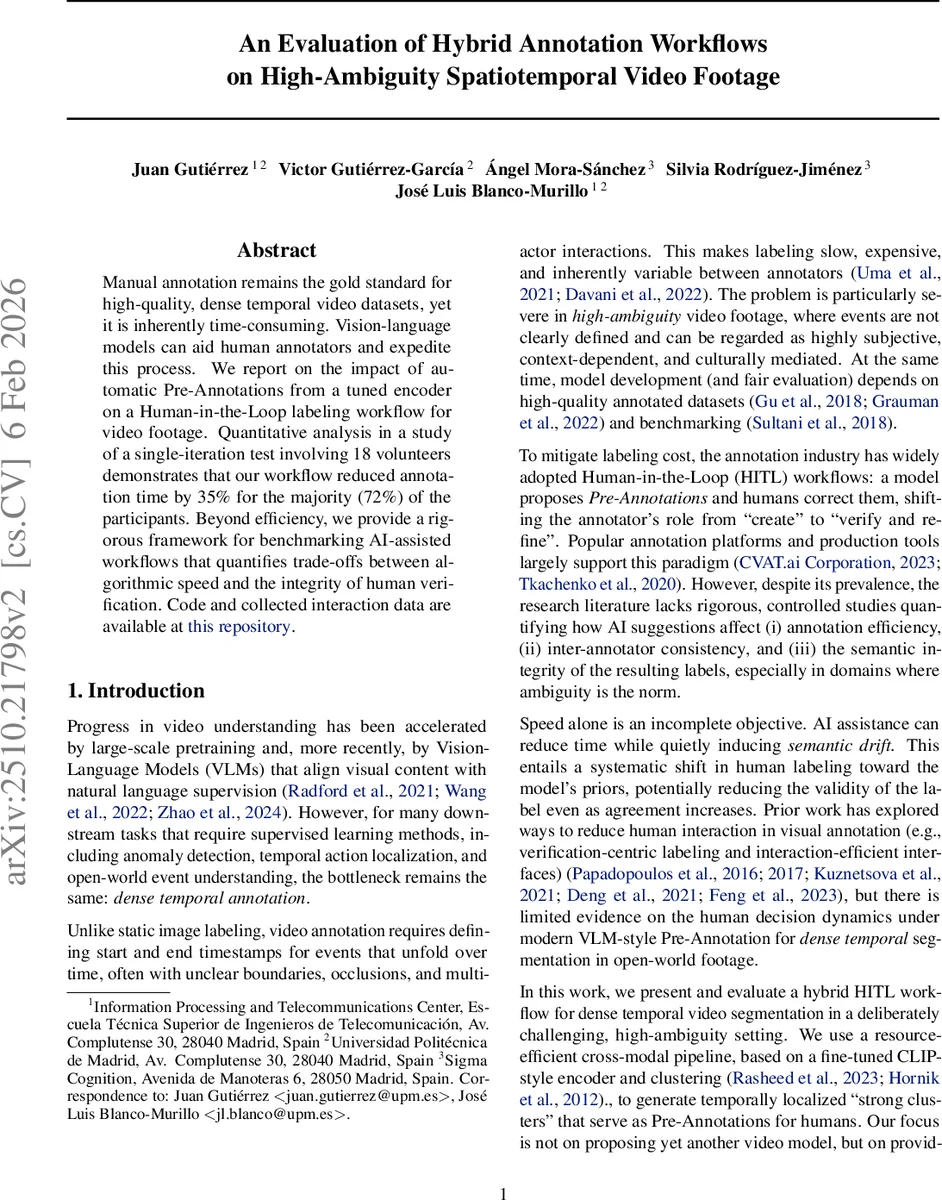
Manual annotation remains the gold standard for high-quality, dense temporal video datasets, yet it is inherently time-consuming. Vision-language models can aid human annotators and expedite this process. We report on the impact of automatic Pre-Annotations from a tuned encoder on a Human-in-the-Loop labeling workflow for video footage. Quantitative analysis in a study of a single-iteration test involving 18 volunteers demonstrates that our workflow reduced annotation time by 35% for the majority (72%) of the participants. Beyond efficiency, we provide a rigorous framework for benchmarking AI-assisted workflows that quantifies trade-offs between algorithmic speed and the integrity of human verification.
💡 Research Summary
This paper investigates how vision‑language models can be leveraged to accelerate dense temporal annotation of high‑ambiguity video footage while preserving label quality. The authors design a hybrid Human‑in‑the‑Loop (HITL) workflow that combines a lightweight, fine‑tuned CLIP‑style encoder with hierarchical spherical k‑means clustering to generate “strong clusters” as pre‑annotations. Video‑text pairs are used to train the encoder via contrastive learning with a symmetric cross‑entropy loss, and temporal average pooling compresses frame‑level features into a single video embedding. Hierarchical clustering proceeds up to three levels, stopping when intra‑cluster cosine similarity exceeds 0.85, thereby producing temporally coherent segments that serve as candidate annotations.
These pre‑annotations are injected into a customized Label Studio interface. The UI displays the video alongside a dual timeline: one for playback and one for annotation. In the assisted condition, the pre‑annotations appear as read‑only segments; annotators duplicate them into an editable workspace and then verify or refine boundaries and class labels. Keyboard shortcuts and playback‑speed controls further reduce cognitive load, shifting the annotator’s role from “create” to “verify and edit.”
To evaluate the workflow, the authors conduct a controlled, counter‑balanced A/B study with 18 university volunteers. Each participant annotates ten videos (five assisted, five unassisted) drawn from open‑world datasets, with condition order randomized. Every video is annotated by six different participants (three assisted, three unassisted) to enable a 6‑vote overlap consensus ground truth. Rich interaction telemetry—annotation time, edit counts, label changes, and cluster modifications—is recorded.
Results show that 72 % of participants achieve an average 35 % reduction in annotation time under the assisted condition, a statistically significant improvement (p < 0.05). Inter‑annotator agreement (Cohen’s κ) modestly increases, suggesting that pre‑annotations can help align annotators on ambiguous boundaries. However, a latent‑space validity analysis reveals a subtle semantic drift: in some cases annotators overly conform to the model’s suggested segment boundaries, reducing the diversity of semantic interpretations. The magnitude of this drift correlates with the cohesion of the underlying clusters—low‑cohesion clusters incur more human corrections.
The study contributes a reproducible benchmarking framework: all code, pre‑annotation pipelines, and anonymized interaction logs are publicly released, and the authors provide a complete CrowdWorkSheets report detailing recruitment, compensation, and ethical considerations. Limitations include the modest size and domain specificity of the video set, the reliance on a manually defined “abnormal event” taxonomy, and the computational overhead of the CLIP‑based encoder, which, while lightweight, still requires GPU resources.
Future work is outlined along three axes: (1) enhancing prompt engineering to better steer the vision‑language model toward task‑specific semantics; (2) integrating a real‑time feedback loop where annotator corrections immediately fine‑tune the model, creating an adaptive HITL system; and (3) extending the methodology to other high‑ambiguity domains such as medical imaging or traffic surveillance to validate the generality of the speed‑quality trade‑off.
In summary, the paper demonstrates that AI‑generated pre‑annotations can substantially speed up dense temporal labeling of ambiguous video content, but it also highlights the necessity of monitoring semantic drift and inter‑annotator agreement. By providing a comprehensive evaluation protocol and open resources, the work establishes a solid baseline for future human‑centric dataset construction research.
Comments & Academic Discussion
Loading comments...
Leave a Comment