Entanglement phases and phase transitions in monitored free fermion system due to localizations
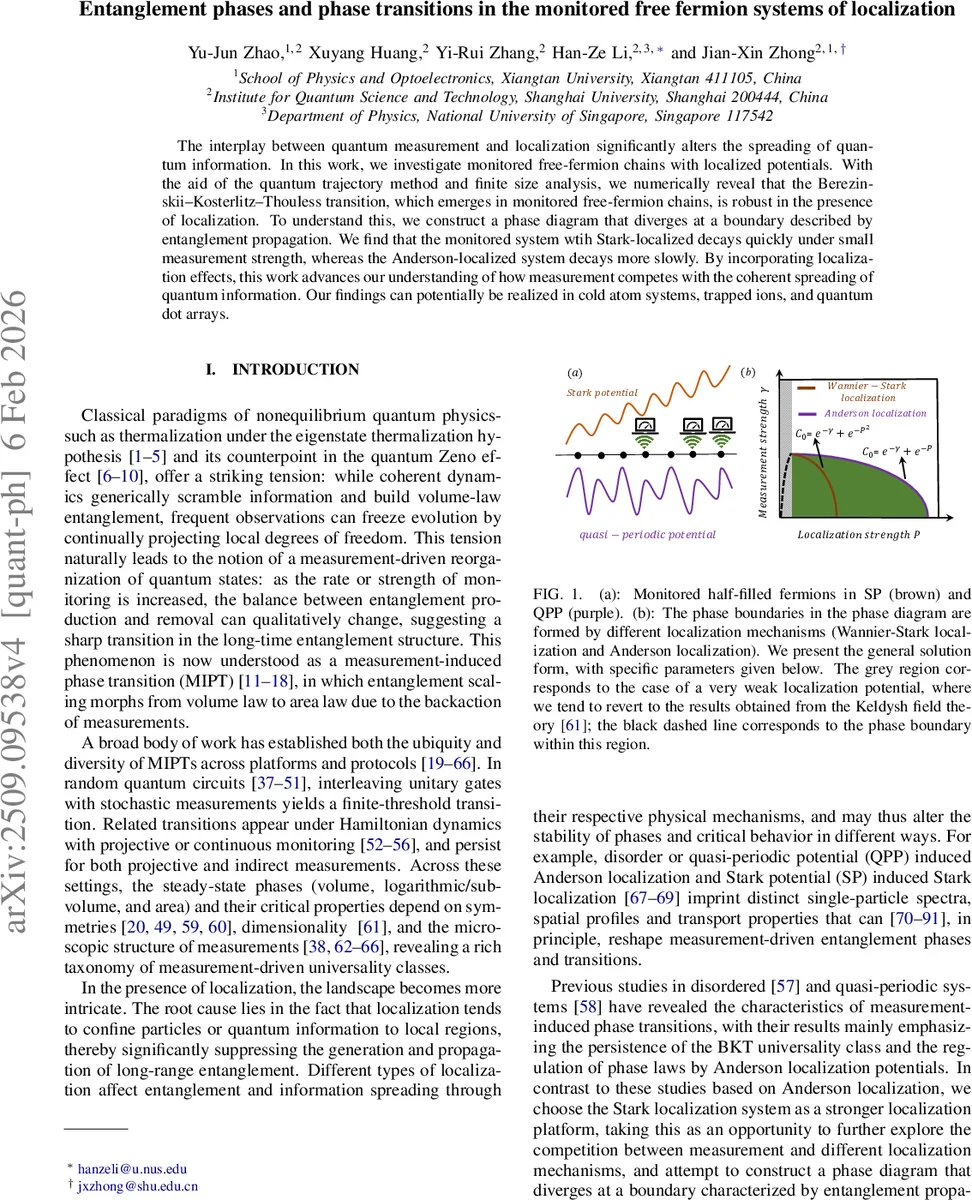
In recent years, the presence of local potentials has significantly enriched and diversified the entanglement patterns in monitored free fermion systems. In our approach, we employ the stochastic Schrödinger equation to simulate a one-dimensional spinless fermion system under continuous measurement and local potentials. By averaging the steady-state entanglement entropy over many quantum trajectories, we investigate its dependence on measurement and localization parameters. We used a phenomenological model to interpret the numerical results, and the results show that the introduction of local potentials does not destroy the universality class of the entanglement phase transition, and that the phase boundary is jointly characterized by the measurement process and the localization mechanism. This work offers a new perspective on the characterization of the entanglement phase boundary arising from the combined effects of measurement and localization, and provides criteria for detecting this novel phase transition in cold atom systems, trapped ions, and quantum dot arrays.
💡 Research Summary
In this work the authors investigate how continuous quantum measurement and single‑particle localization jointly shape the entanglement structure of a one‑dimensional spinless free‑fermion chain. Two distinct localization mechanisms are considered: Stark (linear potential) localization, which produces a deterministic gradient‑induced confinement, and quasi‑periodic (QPP) or Anderson‑type localization, which arises from a cosine‑modulated or random on‑site potential. The Hamiltonian consists of nearest‑neighbor hopping (J = 1) together with a site‑dependent potential Pj that can be tuned by the Stark strength Δ, the QPP amplitude V, or a disorder width W. The system is initialized in a Néel product state and evolves under open boundary conditions while every site is continuously monitored for its occupation number with measurement rate γ. The measurement process is implemented via the quantum‑jump trajectory formalism, leading to a stochastic Schrödinger equation (Eq. 3) that generates an ensemble of quantum trajectories. A total of 500 independent trajectories are simulated for each set of parameters, and observables are obtained by averaging over this ensemble without post‑selection.
The primary observable is the steady‑state bipartite entanglement entropy S¯(ℓ) of a subsystem of length ℓ, in particular the half‑chain entropy S¯(L/2). By fitting S¯(ℓ) to the conformal‑field‑theory form S≈(c¯eff/3) log
Comments & Academic Discussion
Loading comments...
Leave a Comment