$ extit{Ab initio}$ Theory of Eliminating Surface Oxides of Superconductors with Noble-Metal Encapsulation
Nanometer-scale surface chemistry limits the performance of SRF cavities and quantum circuits. We present an ab initio framework connecting DFT interfacial energetics with strong-coupling Eliashberg theory for capped Nb and Ta surfaces. This approach identifies Au and Au-based alloys (AuPd, AuPt) as effective passivation layers. Our model further predicts that combining a noble-metal capping layer with an appropriate wetting/adhesion layer (WAL) yields far more robust adhesion than a capping layer alone under realistic conditions, enabling thinner caps, and thereby addressing a central challenge in superconducting surface passivation.
💡 Research Summary
The authors address a critical bottleneck in superconducting radio‑frequency (SRF) cavities and quantum circuits: nanometer‑scale surface oxides, hydrogen, and nitrogen that generate two‑level systems (TLS) and increase surface resistance, limiting quality factor (Q) and qubit coherence. They develop a unified first‑principles framework that couples density‑functional theory (DFT) calculations of interfacial energetics with strong‑coupling Eliashberg theory for proximity‑coupled bilayers. The workflow proceeds in several stages.
First, they compute bulk interstitial formation energies (E_inter) for O, N, and H in 25 elemental metals spanning the 3d–5d series and selected groups. Late‑transition and noble metals (Au, Ag, Pd, Pt) exhibit positive E_inter, indicating that these species are energetically rejected from the bulk and therefore act as inert “passivation” candidates. Early transition metals (Ti, Zr, Hf, etc.) show strongly negative values, making them effective getters but unsuitable as surface terminations.
Second, they evaluate surface and interface energies for each metal on Nb(110) and Ta(110) substrates. Using the spreading parameter S = γ_int + γ_cap − γ_sub, they identify Au, Ag, Pd, Pt and their 1:1 alloys (AuPd, AuPt, AgPd, AgPt) as falling within the wetting regime (S < 0) for both substrates. The alloys self‑segregate into a Pd/Pt‑rich interfacial monolayer and an Au/Ag‑rich outer monolayer, further lowering both γ_int and γ_cap and expanding the wetting window relative to pure Au.
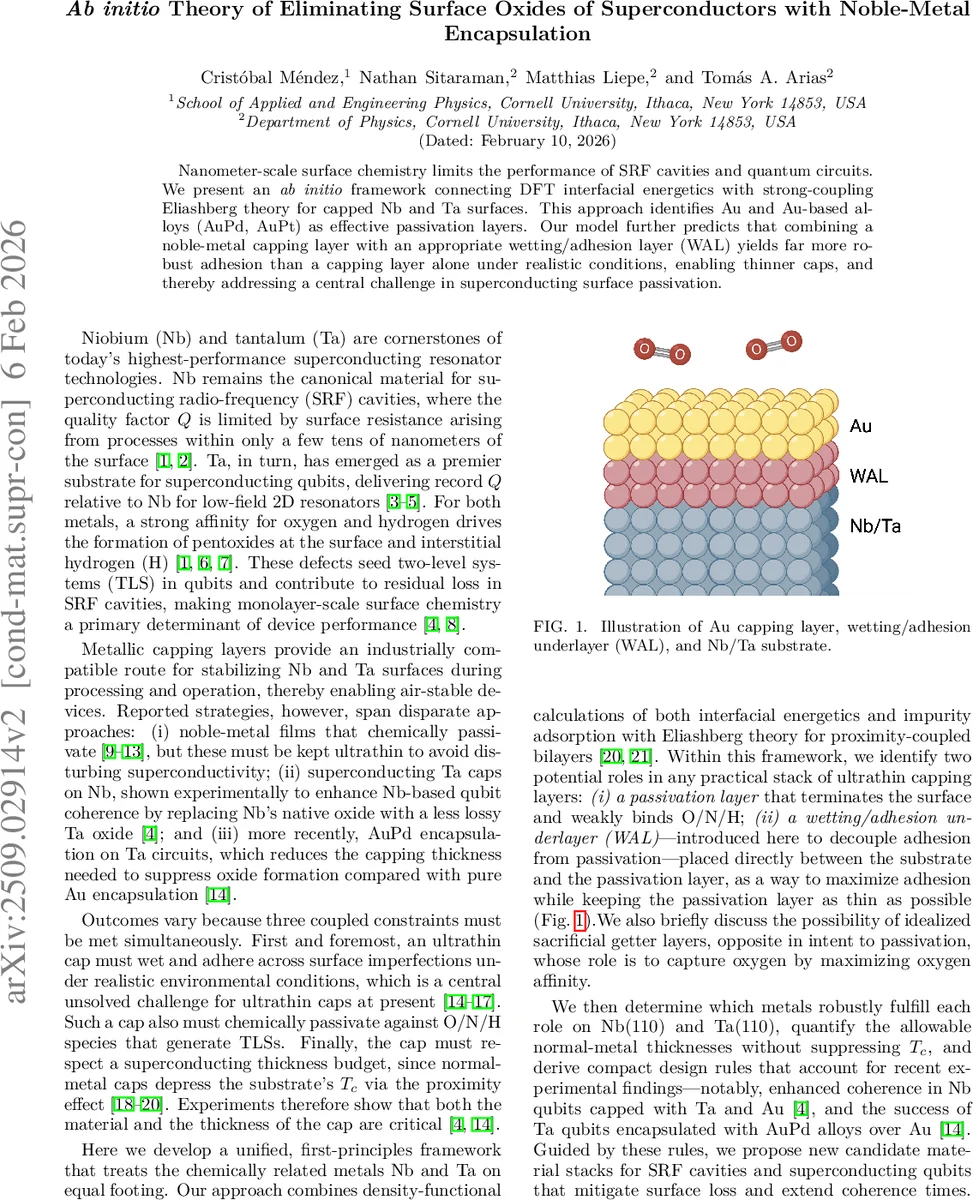
Third, they incorporate realistic surface imperfections: clean terraces, 3 × 1 vicinal steps, and a monolayer of adsorbed oxygen. Under these conditions pure Au tends to dewet, forming pinholes that allow oxygen ingress. To decouple adhesion from passivation, the authors propose a wetting/adhesion layer (WAL) inserted between the substrate and the Au‑based cap. They screen several WAL candidates (Cu, Pd, Pt, Zr) and find that a thin (1–2 ML) Cu layer simultaneously yields low substrate‑WAL interface energy and the smallest WAL‑Au interface energy, even on oxygen‑decorated surfaces. Cu therefore stabilizes Au wetting while tolerating surface oxygen.
Fourth, they assess mechanical compatibility by calculating epitaxial strain energy (ε_strain) for each metal/substrate pair, including possible Bain‑type tetragonal distortions for fcc overlayers on bcc substrates. Combining ε_strain with the spreading parameter gives an estimate of the maximum coherent thickness N_ML ≈ |S|/(a_∥ ε_strain). AuPd can remain coherent for ~13–16 ML, Au for ~44–49 ML, but superconducting proximity effects impose a much stricter thickness budget (≤5–10 nm). Consequently, the optimal design uses a 2–3 ML Au or Au‑based alloy cap, sufficient to reach the plateau in O/N/H adsorption energies (passivation saturates at ~2 ML).
Finally, they integrate the DFT‑derived interface parameters into Eliashberg strong‑coupling calculations to quantify the impact of the normal‑metal cap on the substrate’s critical temperature (T_c). The proximity‑induced suppression scales with cap thickness; a 2–3 ML Au‑based cap with a Cu WAL reduces the electron‑phonon coupling constant λ only marginally, preserving T_c while providing robust chemical passivation. This theoretical prediction aligns with recent experimental observations: Nb cavities capped with a thin Ta layer and Au‑capped Ta qubits show enhanced Q, and AuPd‑capped Ta circuits achieve oxide suppression with thinner caps than pure Au.
In summary, the paper delivers a comprehensive design rule set: (1) select late‑transition/noble metals with positive O/N/H interstitial energies for the outer passivation layer; (2) ensure S < 0 and ε_strain compatible with the substrate to guarantee wetting and coherent growth; (3) introduce a Cu (or similar) WAL to secure adhesion on realistic, oxygen‑containing surfaces; and (4) limit the total normal‑metal thickness to the few‑monolayer regime to avoid detrimental proximity‑effect T_c suppression. This integrated ab‑initio‑Eliashberg framework provides a clear pathway to engineer ultrathin, air‑stable, low‑loss superconducting surfaces for next‑generation SRF cavities and quantum processors.
Comments & Academic Discussion
Loading comments...
Leave a Comment