The New Status Qvo? SN 2021qvo is Another 2003fg-like Type Ia Supernova with a Rising Light-Curve Bump
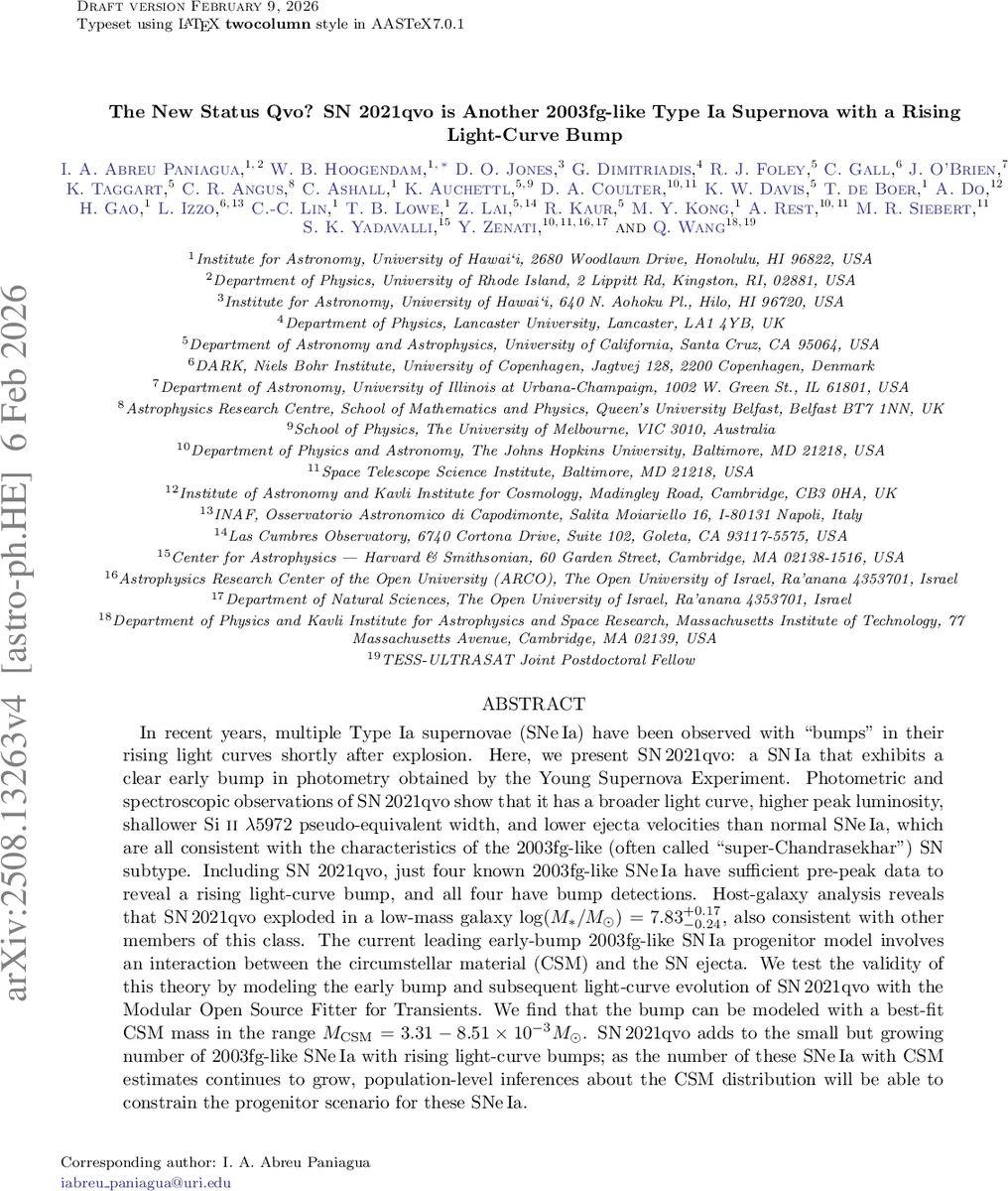
In recent years, multiple Type Ia supernovae (SNe Ia) have been observed with ‘‘bumps’’ in their rising light curves shortly after explosion. Here, we present SN 2021qvo: a SN Ia that exhibits a clear early bump in photometry obtained by the Young Supernova Experiment. Photometric and spectroscopic observations of SN 2021qvo show that it has a broader light curve, higher peak luminosity, shallower Si II $λ$5972 pseudo-equivalent width, and lower ejecta velocities than normal SNe Ia, which are all consistent with the characteristics of the 2003fg-like (often called ‘‘super-Chandrasekhar") SN subtype. Including SN 2021qvo, just four known 2003fg-like SNe Ia have sufficient pre-peak data to reveal a rising light-curve bump, and all four have bump detections. Host-galaxy analysis reveals that SN 2021qvo exploded in a low-mass galaxy ${\rm log}(M_{\ast}/M_{\odot}) = 7.83^{+0.17}{-0.24}$, also consistent with other members of this class. The current leading early-bump 2003fg-like SN Ia progenitor model involves an interaction between the circumstellar material (CSM) and the SN ejecta. We test the validity of this theory by modeling the early bump and subsequent light-curve evolution of SN 2021qvo with the Modular Open Source Fitter for Transients. We find that the bump can be modeled with a best-fit CSM mass in the range $M\mathrm{CSM}=3.31-8.51 \times 10^{-3} M_\odot$. SN 2021qvo adds to the small but growing number of 2003fg-like SNe Ia with rising light-curve bumps; as the number of these SNe Ia with CSM estimates continues to grow, population-level inferences about the CSM distribution will be able to constrain the progenitor scenario for these SNe Ia.
💡 Research Summary
This paper presents a comprehensive analysis of SN 2021qvo, a Type Ia supernova (SN Ia) discovered by the Young Supernova Experiment (YSE), which exhibits a distinct early-time bump in its rising light curve. The study positions SN 2021qvo within the peculiar “2003fg-like” subclass, often associated with potential super-Chandrasekhar mass progenitors.
The analysis is based on extensive photometric data from ATLAS and Pan-STARRS (YSE), spanning from roughly 17 days before maximum light to over 500 days after, and spectroscopic data from multiple telescopes (NOT, Lick, Gemini, Keck) covering phases from -13 to +123 days relative to B-band maximum. The photometry reveals that SN 2021qvo has a higher peak luminosity (M_B ≈ -19.8 mag) and a broader light curve (Δm15(B) ≈ 0.72 mag) compared to normal SNe Ia, consistent with the 2003fg-like classification. The most striking feature is a clear bump in the g- and r-band light curves approximately 15 days before peak brightness.
Spectroscopic observations confirm its peculiar nature. Early-time spectra show prominent carbon (C II) and oxygen (O I) features, a shallow Si II λ5972 absorption line, and lower ejecta velocities (~9,000 km/s) than typical SNe Ia. Host-galaxy analysis indicates SN 2021qvo exploded in a low-mass, low-metallicity dwarf galaxy (log(M*/M⊙) = 7.83), an environment common to other 2003fg-like SNe.
The core of the paper focuses on investigating the origin of the early light-curve bump. The authors test several theoretical models using the Modular Open Source Fitter for Transients (MOSFiT). Models involving interaction with a non-degenerate companion, surface nickel-56, or a surface helium detonation are disfavored by the data, particularly the early blue colors. Instead, the bump and subsequent light-curve evolution are best explained by the interaction of the SN ejecta with circumstellar material (CSM). The modeling yields a best-fit CSM mass in the range of 3.31e-3 to 8.51e-3 solar masses.
With the inclusion of SN 2021qvo, there are now four known 2003fg-like SNe Ia with sufficient early data to reveal a rising bump, and all four show this feature. This suggests such bumps may be common or even ubiquitous in this subclass. The consistency of the CSM interaction model across these events points towards a progenitor system that experienced significant mass loss prior to explosion, strengthening the case for a single-degenerate progenitor channel for at least these peculiar 2003fg-like SNe Ia. The paper concludes that as the sample of these well-observed events grows, population-level studies of their CSM properties will provide crucial constraints to finally pinpoint their progenitor scenario.
Comments & Academic Discussion
Loading comments...
Leave a Comment