Tracing Missing Baryons in the Cosmic Filaments with tSZ and CMB-Lensing Stacking
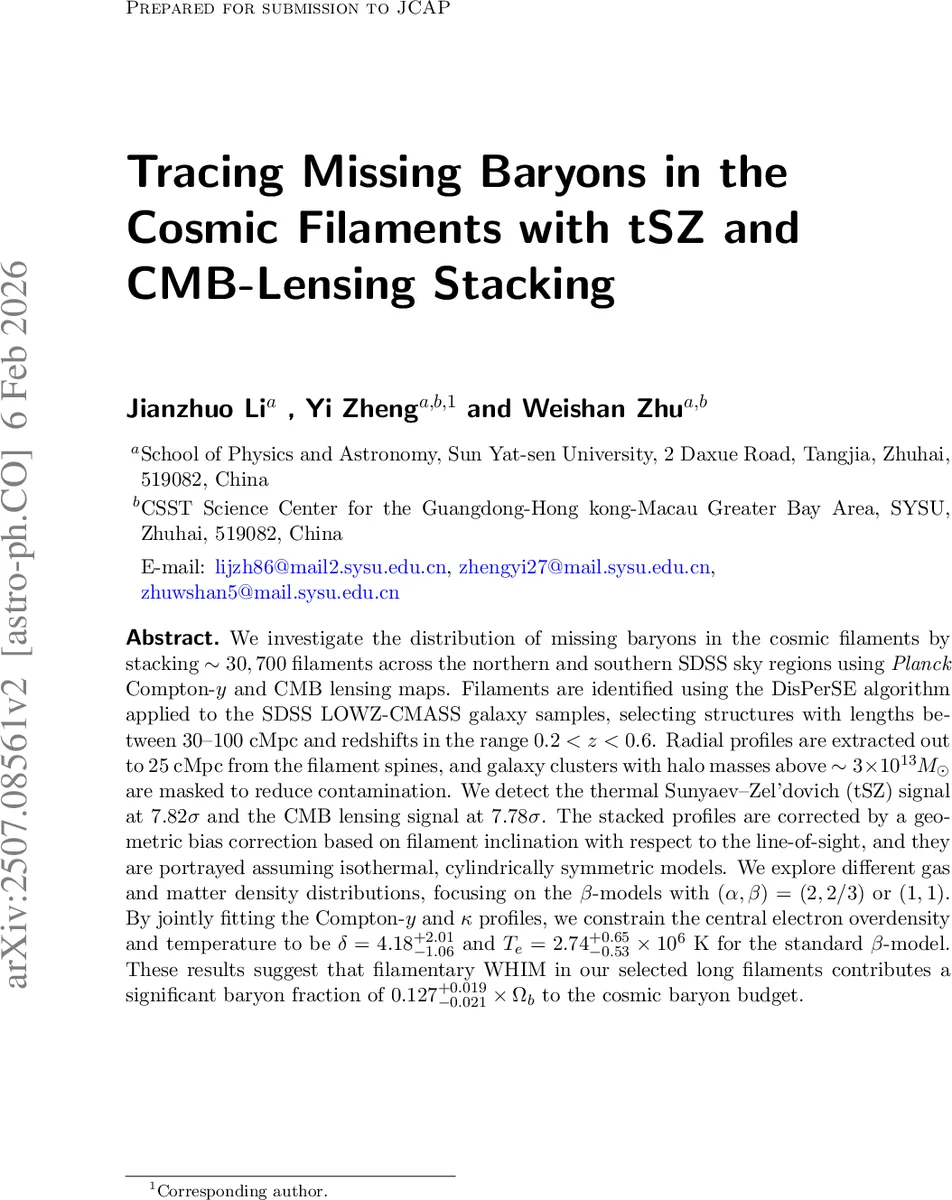
We investigate the distribution of missing baryons in the cosmic filaments by stacking $\sim 30,700$ filaments across the northern and southern SDSS sky regions using Planck Compton-$y$ and CMB lensing maps. Filaments are identified using the DisPerSE algorithm applied to the SDSS LOWZ-CMASS galaxy samples, selecting structures with lengths between 30-100 cMpc and redshifts in the range $0.2 < z < 0.6$. Radial profiles are extracted out to 25 cMpc from the filament spines, and galaxy clusters with halo masses above $\sim 3 \times 10^{13} M_\odot$ are masked to reduce contamination. We detect the thermal Sunyaev-Zeldovich (tSZ) signal at $7.82σ$ and the CMB lensing signal at $7.78σ$. The stacked profiles are corrected by a geometric bias correction based on filament inclination with respect to the line-of-sight, and they are portrayed assuming isothermal, cylindrically symmetric models. We explore different gas and matter density distributions, focusing on the $β$-models with $(α,β) = (2,2/3)$ or $(1,1)$. By jointly fitting the Compton-$y$ and $κ$ profiles, we constrain the central electron overdensity and temperature to be $δ= 4.18^{+2.01}{-1.06}$ and $T_e = 2.74^{+0.65}{-0.53}\times 10^6 \mathrm{K}$ for the standard $β$-model. These results suggest that filamentary WHIM in our selected long filaments contributes a significant baryon fraction of $0.127^{+0.019}_{-0.021}\times Ω_b$ to the cosmic baryon budget.
💡 Research Summary
This paper presents a comprehensive statistical detection of the warm‑hot intergalactic medium (WHIM) residing in cosmic filaments by jointly stacking thermal Sunyaev‑Zel’dovich (tSZ) and CMB lensing convergence (κ) maps from the Planck satellite. The authors first construct a filament catalogue using the DisPerSE algorithm applied to the SDSS DR12 LOWZ‑CMASS galaxy samples. After imposing a length cut of 30–100 cMpc and a redshift range of 0.2–0.6, and after removing unreliable structures, they retain 37 054 long filaments (26 713 in the northern sky and 10 341 in the southern sky).
To isolate the faint filament signal, massive clusters (M > 3 × 10¹³ M⊙) are masked out to 3 R₅₀₀, and a geometric bias correction is applied to account for filament inclination relative to the line of sight. The Planck PR4 (NILC) y‑map and the 2018 CMB lensing κ‑map are both masked (combined sky fractions of ≈ 56 % for y and 67 % for κ) and smoothed to a common 10′ beam. Radial profiles are extracted out to 25 cMpc from each filament spine, and extensive validation tests (random stacks, mask variations, FoG corrections) confirm the robustness of the measurements.
The stacked tSZ signal is detected at 7.82 σ and the lensing signal at 7.78 σ. The authors model the filament gas as an isothermal, cylindrically symmetric β‑profile, exploring two parameterizations: (α, β) = (2, 2/3) (the “standard” model) and (1, 1). The tSZ observable probes the line‑of‑sight integral of electron pressure (∝ nₑ Tₑ), while κ probes the projected total matter density (∝ ρₘ). By jointly fitting the two observables with a Markov Chain Monte Carlo (MCMC) approach, they obtain a central electron overdensity δ = 4.18^{+2.01}{-1.06}, a temperature Tₑ = 2.74^{+0.65}{-0.53} × 10⁶ K, and a core radius of roughly 0.8 cMpc.
Using these parameters, the authors estimate the baryonic mass contained in the selected filaments. Integrating the density profile over the filament volume yields a contribution of 0.127^{+0.019}_{-0.021} × Ω_b, i.e., about 13 % of the total cosmic baryon budget resides in the WHIM of these long filaments. This fraction is significantly larger than previous estimates based on smaller samples or on pair‑wise stacking of galaxies, highlighting the power of the large sky coverage and the combined tSZ‑lensing analysis.
Systematic uncertainties are thoroughly examined. The impact of cluster masking, filament inclination correction, and the treatment of the Fingers‑of‑God (FoG) effect are quantified, showing that the main results are stable within 1 σ. The derived temperature and overdensity are consistent with predictions from hydrodynamical simulations (e.g., IllustrisTNG, MTNG) for gas in filamentary environments.
In the discussion, the authors compare their findings with earlier works (e.g., Tanimura et al. 2019, 2020; de Graaff et al. 2020) and note that the joint tSZ‑lensing approach breaks the degeneracy between gas density and temperature that plagues single‑observable studies. They also outline prospects for future improvements: higher‑resolution CMB experiments (Simons Observatory, CMB‑S4) will provide sharper tSZ and lensing maps; deeper spectroscopic surveys (DESI, Euclid) will enable more accurate filament identification; and complementary X‑ray or UV absorption measurements could directly probe the ionization state of the WHIM.
In conclusion, this work establishes a robust methodology for measuring the thermodynamic properties of filamentary WHIM and demonstrates that long cosmic filaments host a substantial fraction of the Universe’s missing baryons. The joint stacking of tSZ and CMB lensing signals, combined with careful geometric corrections and extensive systematic tests, represents a significant step forward in resolving the long‑standing missing‑baryon problem.
Comments & Academic Discussion
Loading comments...
Leave a Comment