Structure of the Cayley-Dickson algebras
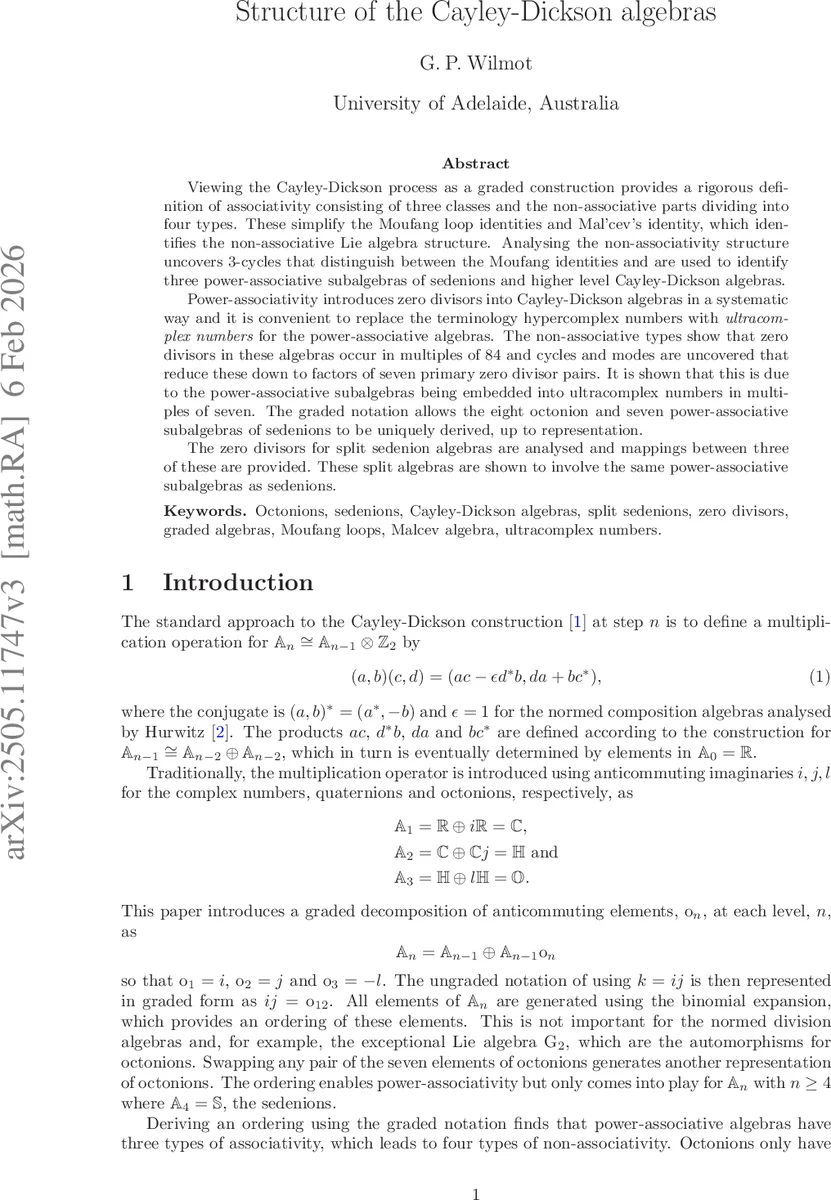
Viewing the Cayley-Dickson process as a graded construction provides a rigorous definition of associativity consisting of three classes and the non-associative parts dividing into four types. These simplify the Moufang loop identities and Mal’cev’s identity, which identifies the non-associative Lie algebra structure. Analysing the non-associativity structure uncovers 3-cycles that distinguish between the Moufang identities and are used to identify three power-associative subalgebras of sedenions and higher level Cayley-Dickson algebras. Power-associativity introduces zero divisors into Cayley-Dickson algebras in a systematic way and it is convenient to replace the terminology hypercomplex numbers with {\it ultracomplex numbers} for the power-associative algebras. The non-associative types show that zero divisors in these algebras occur in multiples of 84 and cycles and modes are uncovered that reduce these down to factors of seven primary zero divisor pairs. It is shown that this is due to the power-associative subalgebras being embedded into ultracomplex numbers in multiples of seven. The graded notation allows the eight octonion and seven power-associative subalgebras of sedenions to be uniquely derived, up to representation. The zero divisors for split sedenion algebras are analysed and mappings between three of these are provided. These split algebras are shown to involve the same power-associative subalgebras as sedenions.
💡 Research Summary
The paper presents a novel graded formulation of the Cayley‑Dickson construction, replacing the traditional recursive “doubling” definition with a systematic grading of basis elements. Each algebra (A_n) is expressed as a direct sum of two copies of (A_{n-1}) and its basis elements are indexed by subsets of ({1,\dots ,n}). Multiplication of basis elements reduces to the XOR of their index sets, which mirrors the binomial expansion of Pascal’s triangle and guarantees that (|A_n|=2^n).
Using this graded language the author classifies associativity into three distinct “classes” (traditional, semi‑traditional, and non‑traditional) and non‑associativity into four “types”. The four Moufang loop identities, which are normally used to describe the limited associativity of octonions, are shown to split according to these types: octonions exhibit a single symmetric type, sedenions introduce two additional types that separate two of the Moufang identities, and the next level (trigintaduonions) adds a final type that isolates the remaining identity. This taxonomy simplifies the analysis of Mal’cev algebras and clarifies the underlying Lie‑algebraic structure.
A central result is the “Cycle Theorem”. For every level (n\ge3) the graded construction yields eight 3‑cycles. Each cycle generates twelve zero‑divisors, and together they account for the well‑known 84 zero‑divisors of the sedenions. The paper demonstrates that these 84 elements decompose into seven primary zero‑divisor pairs, each pair being associated with three cycles and four modes. Consequently, zero‑divisors always appear in multiples of 84, a fact that follows from the embedding of seven power‑associative subalgebras (called “ultracomplex numbers”) into the full algebra. The term “ultracomplex” is introduced to denote power‑associative Cayley‑Dickson algebras, distinguishing them from the older “hyper‑complex” terminology.
The analysis is extended to split algebras. By setting the sign parameter (\varepsilon=-1) the author constructs split‑octonions and split‑sedenions. Although the sign change alters the explicit form of the basis products, the same four non‑associative types persist, and the zero‑divisor structure remains a 7‑fold multiple. The paper provides explicit mappings between three split algebras, showing that they are mutually isomorphic up to a change of basis and that their zero‑divisor configurations correspond under these maps.
Beyond the structural classification, the graded formulation offers practical advantages. It yields a clear, algorithmic specification suitable for computer implementation, making it easier to generate multiplication tables for high‑dimensional Cayley‑Dickson algebras. Moreover, the identification of power‑associative subalgebras and their systematic embedding suggests new avenues for applying these algebras in theoretical physics, particularly in models that require non‑associative but power‑associative structures (e.g., certain extensions of supersymmetry or exceptional Lie‑group based particle classifications).
In summary, the paper re‑examines the Cayley‑Dickson hierarchy through a graded lens, provides a refined taxonomy of associativity and non‑associativity, elucidates the cyclic origin of zero‑divisors, introduces the concept of ultracomplex numbers, and demonstrates that split versions share the same underlying non‑associative pattern. These insights both deepen the mathematical understanding of high‑dimensional algebras and open potential pathways for their use in physics and computer algebra systems.
Comments & Academic Discussion
Loading comments...
Leave a Comment