Structure groupoids of quiver-theoretic Yang-Baxter maps
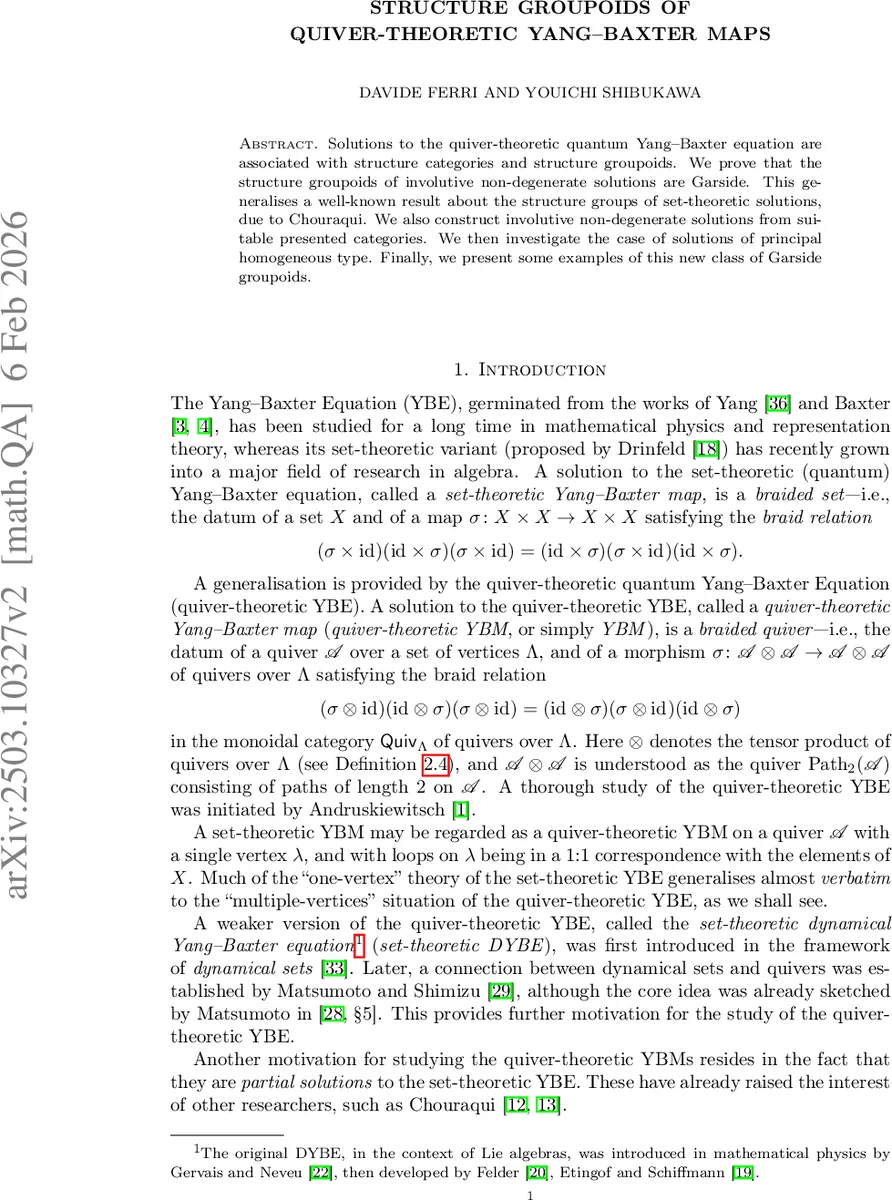
Solutions to the quiver-theoretic quantum Yang-Baxter equation are associated with structure categories and structure groupoids. We prove that the structure groupoids of involutive non-degenerate solutions are Garside. This generalises a well-known result about the structure groups of set-theoretic solutions, due to Chouraqui. We also construct involutive non-degenerate solutions from suitable presented categories. We then investigate the case of solutions of principal homogeneous type. Finally, we present some examples of this new class of Garside groupoids.
💡 Research Summary
This paper investigates the algebraic and categorical structures underlying solutions of the quiver‑theoretic quantum Yang‑Baxter equation (QYBE). A quiver‑theoretic Yang‑Baxter map (YBM) is defined as a braid‑type morphism σ : A ⊗ A → A ⊗ A on a quiver A over a vertex set Λ, satisfying the braid relation (σ⊗id)(id⊗σ)(σ⊗id) = (id⊗σ)(σ⊗id)(id⊗σ) in the monoidal category of quivers. The authors focus on involutive (σ² = id) and non‑degenerate (σ is a bijection on each pair of composable arrows) YBMs.
For any such σ they introduce the structure category C(σ) and the structure groupoid G(σ). C(σ) is the category generated by the arrows of A, subject to the relations x|y ∼ σ(x|y) for every composable pair x|y (i.e., a path of length two). G(σ) is the enveloping groupoid of C(σ), obtained by formally inverting all morphisms. These objects generalize the well‑known structure monoid and structure group attached to set‑theoretic YBMs.
The central result is that G(σ) is a Garside groupoid whenever σ is involutive and non‑degenerate. This extends Chouraqui’s theorem that the structure group of an involutive non‑degenerate set‑theoretic solution is a Garside group. The proof proceeds by linking YBMs with weak RC‑systems, a class of algebraic systems introduced by Dehornoy et al. A weak RC‑system consists of a set X equipped with a binary operation ⋆ satisfying a weakened right‑cycle identity (x⋆y)⋆z = (x⋆z)⋆(y⋆z) under suitable domain restrictions. The authors show:
- From any involutive non‑degenerate YBM σ one can construct a left‑non‑degenerate weak RC‑system (R,⋆) by defining a left action of arrows on each other using the first component of σ.
- Conversely, given a weak RC‑system whose defining relations contain the RC‑law, one can build a presented category whose structure category coincides with that of a YBM.
Through this bi‑directional correspondence they prove that C(σ) is isomorphic to the structure category of a suitable weak RC‑system. Since weak RC‑systems are known to give rise to perfect Garside categories (they are left‑ and right‑cancellative, admit conditional left/right lcm’s, have a finite atom set, and possess a Garside family), it follows that C(σ) is a perfect Garside category. Consequently, its enveloping groupoid G(σ) inherits a Garside structure, making it a Garside groupoid.
The paper also develops a construction method for new YBMs from presented categories. By choosing generators and relations that encode the RC‑law, one obtains a category whose structure groupoid is automatically Garside. This yields a rich supply of examples, including:
- Cyclic quivers where σ swaps the two arrows of a length‑two path.
- Complete bipartite quivers with a “swap‑and‑permute” σ.
- Quivers arising from algebraic trees or from certain combinatorial configurations.
Each example is examined in detail, with explicit descriptions of the atoms, the Garside element, and normal forms.
In the final section the authors focus on principal homogeneous (PH) type solutions. A PH‑type YBM has the form σ(x,y) = (f(y), g(x)) where f and g are bijections on the vertex set. They prove that the structure groupoid of such a σ is essentially the groupoid of pairs equipped with a distinguished vertex, which is equivalent to an ordinary group on the vertex set. This establishes that PH‑type YBMs provide a bridge between the theory of groups and the theory of Garside groupoids, and their structure groupoids are again Garside.
Overall, the work achieves three major advances:
- Generalisation: It lifts the Garside property from set‑theoretic to quiver‑theoretic Yang‑Baxter maps, handling multiple vertices and richer combinatorial data.
- Conceptual bridge: It connects the categorical world of quiver‑theoretic YBMs with the algebraic world of weak RC‑systems, allowing techniques from one area to solve problems in the other.
- Concrete supply: It provides systematic methods to construct involutive non‑degenerate YBMs whose structure groupoids are Garside, enriching the catalogue of known Garside groupoids and opening avenues for applications in braid‑type groups, representation theory, and low‑dimensional topology.
The paper is self‑contained, with a thorough preliminaries section covering quivers, presented categories, and Garside theory, and it paves the way for future investigations into dynamic YBE, higher‑dimensional quiver constructions, and geometric applications such as hyperplane arrangements.
Comments & Academic Discussion
Loading comments...
Leave a Comment