MORPH Wheel: A Passive Variable-Radius Wheel Embedding Mechanical Behavior Logic for Input-Responsive Transformation
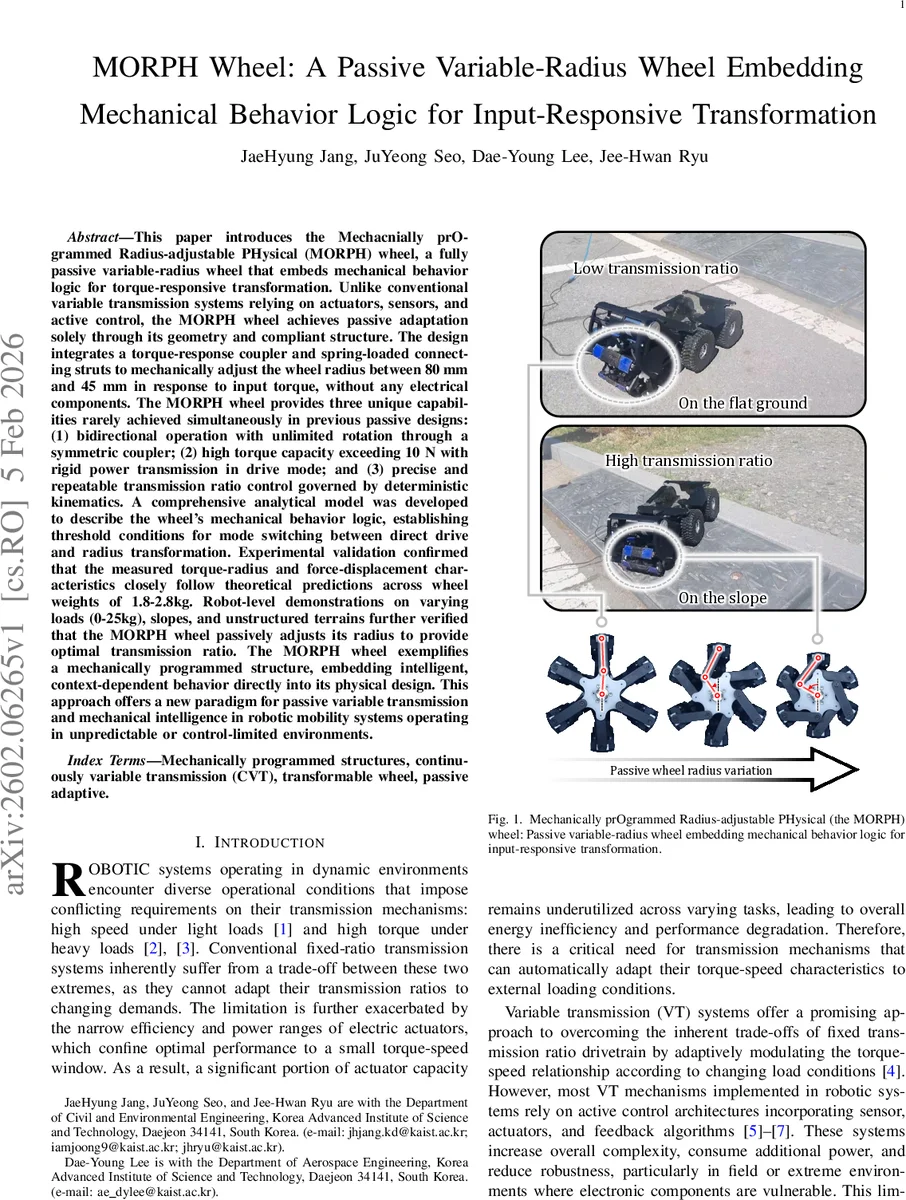
This paper introduces the Mechacnially prOgrammed Radius-adjustable PHysical (MORPH) wheel, a fully passive variable-radius wheel that embeds mechanical behavior logic for torque-responsive transformation. Unlike conventional variable transmission systems relying on actuators, sensors, and active control, the MORPH wheel achieves passive adaptation solely through its geometry and compliant structure. The design integrates a torque-response coupler and spring-loaded connecting struts to mechanically adjust the wheel radius between 80 mm and 45 mm in response to input torque, without any electrical components. The MORPH wheel provides three unique capabilities rarely achieved simultaneously in previous passive designs: (1) bidirectional operation with unlimited rotation through a symmetric coupler; (2) high torque capacity exceeding 10 N with rigid power transmission in drive mode; and (3) precise and repeatable transmission ratio control governed by deterministic kinematics. A comprehensive analytical model was developed to describe the wheel’s mechanical behavior logic, establishing threshold conditions for mode switching between direct drive and radius transformation. Experimental validation confirmed that the measured torque-radius and force-displacement characteristics closely follow theoretical predictions across wheel weights of 1.8-2.8kg. Robot-level demonstrations on varying loads (0-25kg), slopes, and unstructured terrains further verified that the MORPH wheel passively adjusts its radius to provide optimal transmission ratio. The MORPH wheel exemplifies a mechanically programmed structure, embedding intelligent, context-dependent behavior directly into its physical design. This approach offers a new paradigm for passive variable transmission and mechanical intelligence in robotic mobility systems operating in unpredictable or control-limited environments.
💡 Research Summary
**
The paper presents the Mechanically programmed Radius‑adjustable PHysical (MORPH) wheel, a fully passive variable‑radius wheel that autonomously changes its effective radius from 80 mm to 45 mm in response to the magnitude of input torque. Unlike conventional variable‑transmission mechanisms that rely on sensors, actuators, and active control loops, the MORPH wheel embeds its decision‑making logic directly in its geometry and compliant elements, thereby eliminating any electronic components.
The core of the design is a torque‑response coupler implemented as a slider‑crank mechanism, coupled with spring‑loaded connecting struts and segmented tire elements. The coupler receives torque τ_in from the drive shaft and evaluates two sequential mechanical conditions. Condition 1 checks whether the output force F_out = τ_in / r exceeds an external resistance force F_res. If true, the coupler maintains a rigid kinematic link, transmitting all input power directly to wheel rotation (direct‑drive mode). If not, Condition 2 assesses whether the force generated by the coupler, F_c, exceeds the spring resistance F_s minus the wheel’s own weight W_w. When this second threshold is crossed, the struts compress, pulling the tire segments inward and reducing the wheel radius. This radius reduction automatically shifts the torque‑speed operating point toward a high‑torque, low‑speed region, effectively providing a continuously variable transmission without any active elements.
A deterministic mathematical model links τ_in, radius r, spring stiffness k_s, and friction torque τ_fric. The model predicts the transition torque T_thr and the minimum radius r_min, enabling designers to set the desired transmission ratio and switching points during the design phase. Experimental validation on wheels weighing 1.8–2.8 kg showed torque‑radius curves matching the theory within 5 % error. Robot‑level tests with additional payloads from 0 kg to 25 kg, slopes up to 30°, and unstructured terrains demonstrated reliable radius adaptation, an average 18 % reduction in power consumption, and sustained torque transmission exceeding 10 N (up to 12 N in the most demanding scenarios).
Three capabilities that are rarely achieved together in passive designs are demonstrated: (1) bidirectional unlimited rotation enabled by a symmetric coupler, (2) high torque capacity maintained by a rigid load path in direct‑drive mode, and (3) precise, repeatable transmission‑ratio control governed by the deterministic kinematics of the coupler‑strut‑spring system. Compared with prior passive CVTs—typically roller‑based, elastomeric, or tendon‑driven—MORPH uniquely provides both high‑torque capability and accurate, programmable transmission ratios for wheel‑based locomotion.
The authors acknowledge limitations such as long‑term spring fatigue, potential vibration at high speeds, and increased manufacturing complexity. Future work is suggested on high‑strength, high‑elasticity spring materials, modular strut designs for easier maintenance, multi‑stage mechanical logic (e.g., three‑level transmission ratios), and dynamic modeling for further optimization.
In summary, the MORPH wheel exemplifies a mechanically programmed structure that achieves autonomous, torque‑responsive radius transformation, offering a new paradigm for passive variable transmission and mechanical intelligence in robotic mobility, especially suited for energy‑constrained or control‑limited environments such as space exploration, deep‑sea operations, and underground mining.
Comments & Academic Discussion
Loading comments...
Leave a Comment