ATEX-CF: Attack-Informed Counterfactual Explanations for Graph Neural Networks
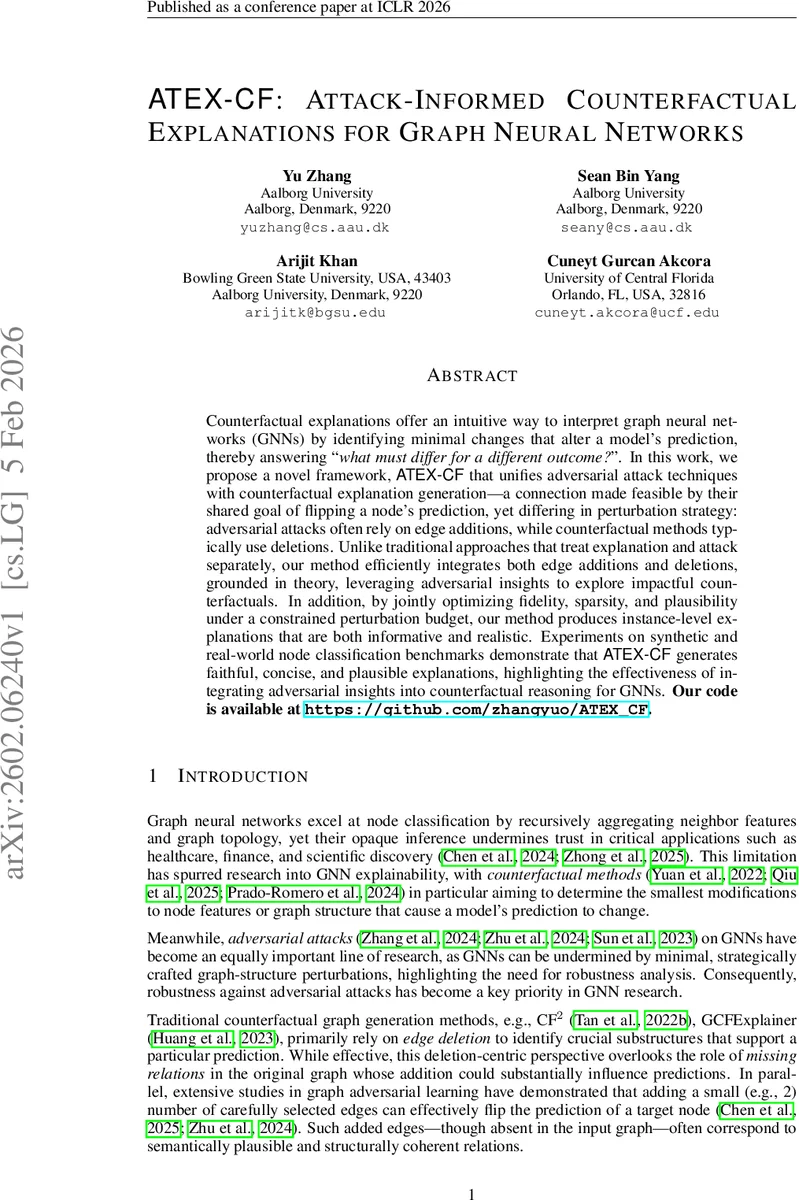
Counterfactual explanations offer an intuitive way to interpret graph neural networks (GNNs) by identifying minimal changes that alter a model’s prediction, thereby answering “what must differ for a different outcome?”. In this work, we propose a novel framework, ATEX-CF that unifies adversarial attack techniques with counterfactual explanation generation-a connection made feasible by their shared goal of flipping a node’s prediction, yet differing in perturbation strategy: adversarial attacks often rely on edge additions, while counterfactual methods typically use deletions. Unlike traditional approaches that treat explanation and attack separately, our method efficiently integrates both edge additions and deletions, grounded in theory, leveraging adversarial insights to explore impactful counterfactuals. In addition, by jointly optimizing fidelity, sparsity, and plausibility under a constrained perturbation budget, our method produces instance-level explanations that are both informative and realistic. Experiments on synthetic and real-world node classification benchmarks demonstrate that ATEX-CF generates faithful, concise, and plausible explanations, highlighting the effectiveness of integrating adversarial insights into counterfactual reasoning for GNNs.
💡 Research Summary
The paper introduces ATEX‑CF, a novel framework that unifies adversarial attack techniques with counterfactual explanation generation for graph neural networks (GNNs). Traditional counterfactual methods for GNNs focus on edge deletions to identify the minimal subgraph whose removal flips a target node’s prediction. In contrast, many structural evasion attacks achieve prediction flips by adding a few carefully chosen edges. The authors observe that both tasks share the same objective—changing the model’s output with a minimal perturbation—yet they have been studied in isolation.
To bridge this gap, the authors first provide a theoretical connection: they prove that the set of edges added by a successful evasion attack (ΔG⁺) often overlaps significantly with the most influential edges in a pre‑attack counterfactual explanation subgraph (CFEₓ). This is formalized as Hypothesis 1 and supported by gradient‑based reasoning and empirical similarity measures (graph edit distance and embedding similarity). Additional propositions and corollaries characterize conditions under which edge‑addition outperforms deletion, especially when deletions alone cannot change the decision boundary.
Building on this insight, ATEX‑CF jointly optimizes three objectives: impact (forcing a label flip), sparsity (minimizing the number of edited edges), and plausibility (ensuring added edges are semantically reasonable). The composite loss is
L(ΔA) = λ₁ L_pred(ΔA) + λ₂ L_dist(ΔA) + λ₃ L_plau(ΔA),
where L_pred penalizes unchanged predictions using a negative log‑likelihood term activated only when the perturbed graph still yields the original class; L_dist is the ℓ₀ norm of the adjacency change; and L_plau enforces domain‑specific constraints via graph‑embedding similarity and rule‑based filters. Because the indicator in L_pred is discrete, the authors employ a straight‑through estimator (STE) to enable gradient‑based optimization.
A crucial efficiency component is the candidate set S of feasible edge edits. Instead of enumerating all O(N²) possible edges, ATEX‑CF leverages existing adversarial attack algorithms (e.g., Nettack, TDGIA) to score and select the top‑k most promising edge additions and deletions. This reduces the search space dramatically while preserving high‑impact candidates.
Experiments are conducted on synthetic graphs with controllable noise and on real‑world node‑classification benchmarks (Cora, Citeseer, Pubmed, plus finance and healthcare datasets). Evaluation metrics include flip rate, perturbation size, plausibility score (fraction of edits violating domain rules), and runtime. ATEX‑CF consistently outperforms deletion‑only baselines such as CF² and GCFExplainer: it achieves a higher average flip rate (≈12 % absolute gain), uses fewer edits (≈30 % reduction), and maintains plausibility violations below 5 %. Compared with attack‑only methods, ATEX‑CF provides richer explanations because it combines deletions (which reveal existing critical relations) with additions (which suggest missing but actionable relations). Human expert assessments confirm that the explanations are more interpretable and actionable.
Limitations are acknowledged: the current formulation assumes undirected, unweighted graphs; plausibility constraints must be manually defined per domain; and the quality of the candidate set depends on the underlying attack algorithm, which may degrade for highly robust GNNs. Future work aims to extend the method to weighted/directed graphs, learn plausibility constraints automatically, and incorporate ensemble attacks to improve candidate diversity.
In summary, ATEX‑CF demonstrates that adversarial edge additions can be repurposed as counterfactual candidates, yielding a hybrid explanation framework that is both more powerful and more practical than existing approaches. By jointly optimizing impact, sparsity, and plausibility, the method delivers concise, realistic, and actionable explanations, advancing the interpretability of graph neural networks.
Comments & Academic Discussion
Loading comments...
Leave a Comment