On the radial velocity wave in the Galactic disk
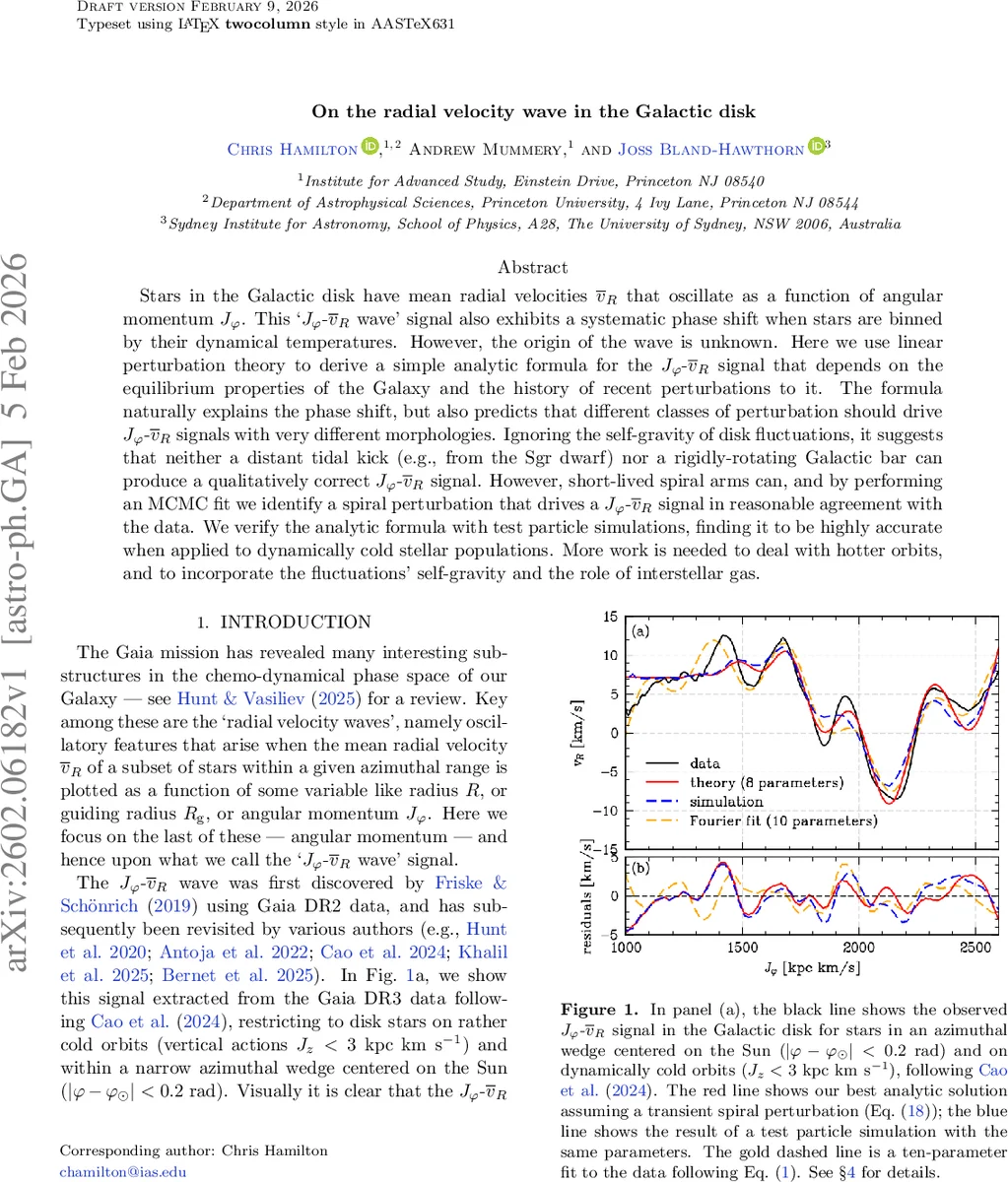
Stars in the Galactic disk have mean radial velocities $\overline{v}_R$ that oscillate as a function of angular momentum $J_φ$. This `$J_φ$-${\overline{v}}_R$ wave’ signal also exhibits a systematic phase shift when stars are binned by their dynamical temperatures. However, the origin of the wave is unknown. Here we use linear perturbation theory to derive a simple analytic formula for the $J_φ$-$\overline{v}_R$ signal that depends on the equilibrium properties of the Galaxy and the history of recent perturbations to it. The formula naturally explains the phase shift, but also predicts that different classes of perturbation should drive $J_φ$-$\overline{v}_R$ signals with very different morphologies. Ignoring the self-gravity of disk fluctuations, it suggests that neither a distant tidal kick (e.g., from the Sgr dwarf) nor a rigidly-rotating Galactic bar can produce a qualitatively correct $J_φ$-$\overline{v}_R$ wave signal. However, short-lived spiral arms can, and by performing an MCMC fit we identify a spiral perturbation that drives a $J_φ$-${\overline{v}}_R$ signal in reasonable agreement with the data. We verify the analytic formula with test particle simulations, finding it to be highly accurate when applied to dynamically cold stellar populations. More work is needed to deal with hotter orbits, and to incorporate the fluctuations’ self-gravity and the role of interstellar gas.
💡 Research Summary
The paper addresses a striking feature revealed by Gaia DR3: the mean radial velocity $v_R$ of disk stars oscillates as a function of their azimuthal angular momentum $J_\phi$, producing a “$J_\phi$–$v_R$ wave”. Moreover, the wave’s phase shifts systematically when the stellar sample is split by dynamical temperature (i.e., radial action or vertical action). The origin of this wave has been debated, with proposals ranging from a distant tidal impulse by the Sagittarius dwarf galaxy, to the response to the rotating Galactic bar, to transient spiral structure. None of the previous models could simultaneously reproduce the multiple comparable‑amplitude components and the observed phase shift.
The authors adopt a linear perturbation‑theory framework, restricting the analysis to a two‑dimensional, nearly‑epicyclic description of stellar orbits. They map positions and velocities $(\phi,R;v_\phi,v_R)$ to angle–action variables $(\theta_\phi,\theta_R; J_\phi,J_R)$ and assume an initial Schwarzschild distribution function $f_0(J)=\frac{1}{2\pi\langle J_R\rangle}F_0(J_\phi)\exp(-J_R/\langle J_R\rangle)$. The small‑parameter $\epsilon\equiv(\langle J_R\rangle/J_\phi)^{1/2}\ll1$ permits a long‑wavelength approximation. Linear response theory then yields an analytic expression for the mean radial velocity (their eqs. 3‑4):
\
Comments & Academic Discussion
Loading comments...
Leave a Comment