Hear You in Silence: Designing for Active Listening in Human Interaction with Conversational Agents Using Context-Aware Pacing
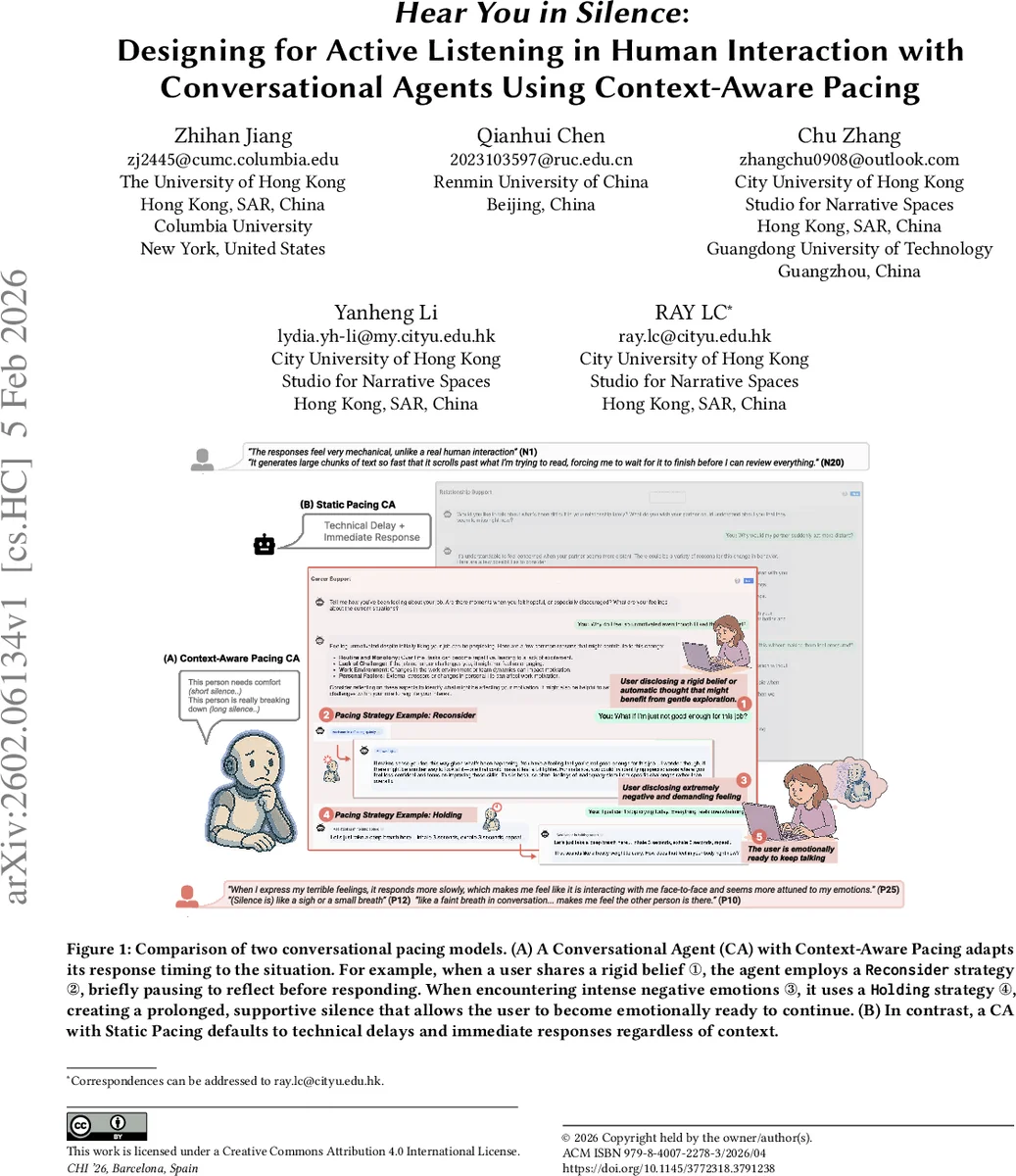
In human conversation, empathic dialogue requires nuanced temporal cues indicating whether the conversational partner is paying attention. This type of “active listening” is overlooked in the design of Conversational Agents (CAs), which use the same pacing for one conversation. To model the temporal cues in human conversation, we need CAs that dynamically adjust response pacing according to user input. We qualitatively analyzed ten cases of active listening to distill five context-aware pacing strategies: Reflective Silence, Facilitative Silence, Empathic Silence, Holding Space, and Immediate Response. In a between-subjects study (N=50) with two conversational scenarios (relationship and career-support), the context-aware agent scored higher than static-pacing control on perceived human-likeness, smoothness, and interactivity, supporting deeper self-disclosure and higher engagement. In the career support scenario, the CA yielded higher perceived listening quality and affective trust. This work shows how insights from human conversation like context-aware pacing can empower the design of more empathic human-AI communication.
💡 Research Summary
**
The paper “Hear You in Silence: Designing for Active Listening in Human Interaction with Conversational Agents Using Context‑Aware Pacing” addresses a largely overlooked aspect of human‑computer dialogue: the temporal dynamics of active listening. While prior work on conversational agents (CAs) has focused on verbal strategies such as paraphrasing, summarizing, or on minimizing technical latency, this study argues that the timing of responses—particularly the strategic use of silence—carries essential relational meaning.
To ground their design, the authors performed a qualitative analysis of ten video recordings of human‑to‑human active‑listening interactions. Through iterative coding they identified eight low‑level behaviors (Recognize, Reconfirm, Re‑engage, Reposition, Reconsider, Resonate, Holding, Resolve) that were then abstracted into five higher‑level “context‑aware pacing strategies”: Reflective Silence, Facilitative Silence, Empathic Silence, Holding Space, and Immediate Response. Each strategy is linked to a specific conversational situation (e.g., low‑intensity belief revision, high‑intensity negative affect) and prescribes a particular pause length and subsequent utterance type.
The authors implemented these strategies in a large‑language‑model (LLM) based chatbot. A “pacing module” first classifies the user’s input along dimensions of emotion intensity, topic, and dialogue stage, then selects the appropriate strategy via a rule‑based engine. For instance, when a user expresses a rigid belief, the system applies the Reconsider strategy, inserting a brief reflective pause before offering a reframed perspective. When intense distress is detected, the Holding strategy creates a prolonged silence to give the user space to process emotions.
A between‑subjects experiment compared the context‑aware pacing agent to a baseline agent with static, uniform technical delays. Fifty participants (25 per condition) engaged in two supportive scenarios: relationship advice and career counseling. Post‑interaction questionnaires measured perceived human‑likeness, smoothness, interactivity, listening quality, affective and cognitive trust, depth of self‑disclosure, and overall engagement.
Results showed that the context‑aware pacing agent outperformed the static baseline across all measured dimensions. The most pronounced gains appeared in the career‑support scenario, where listening quality and affective trust were significantly higher (p < .05). Participants also disclosed more personal information and reported higher engagement when the agent employed strategic silences. These findings support the hypothesis that intentional timing cues can convey attentiveness and empathy, thereby fostering deeper relational outcomes.
The paper contributes three main advances: (1) it systematically derives a taxonomy of pacing strategies from real human interaction, filling a gap in the active‑listening literature that has largely ignored temporal cues; (2) it demonstrates, through a controlled user study, that dynamic pacing improves a range of user‑experience metrics compared with conventional static‑delay designs; (3) it introduces a concrete design space—dynamic pacing modulation—with five implementable mechanisms, offering a practical blueprint for future empathic CA development.
Limitations include the exclusive focus on text‑based chat (no voice or multimodal cues), reliance on rule‑based strategy selection rather than learning from data, and a lack of cross‑cultural validation. Future work should explore adaptive pacing in spoken dialogue, incorporate machine‑learning approaches to infer optimal pause lengths, and examine how cultural norms around silence affect user perception. Overall, the study compellingly argues that “silence is not empty” but a powerful communicative tool that, when contextually applied, can make conversational agents feel more human, trustworthy, and supportive.
Comments & Academic Discussion
Loading comments...
Leave a Comment