A Nonequilibrium Equation of State for a Turbulent 2D Bose Gas
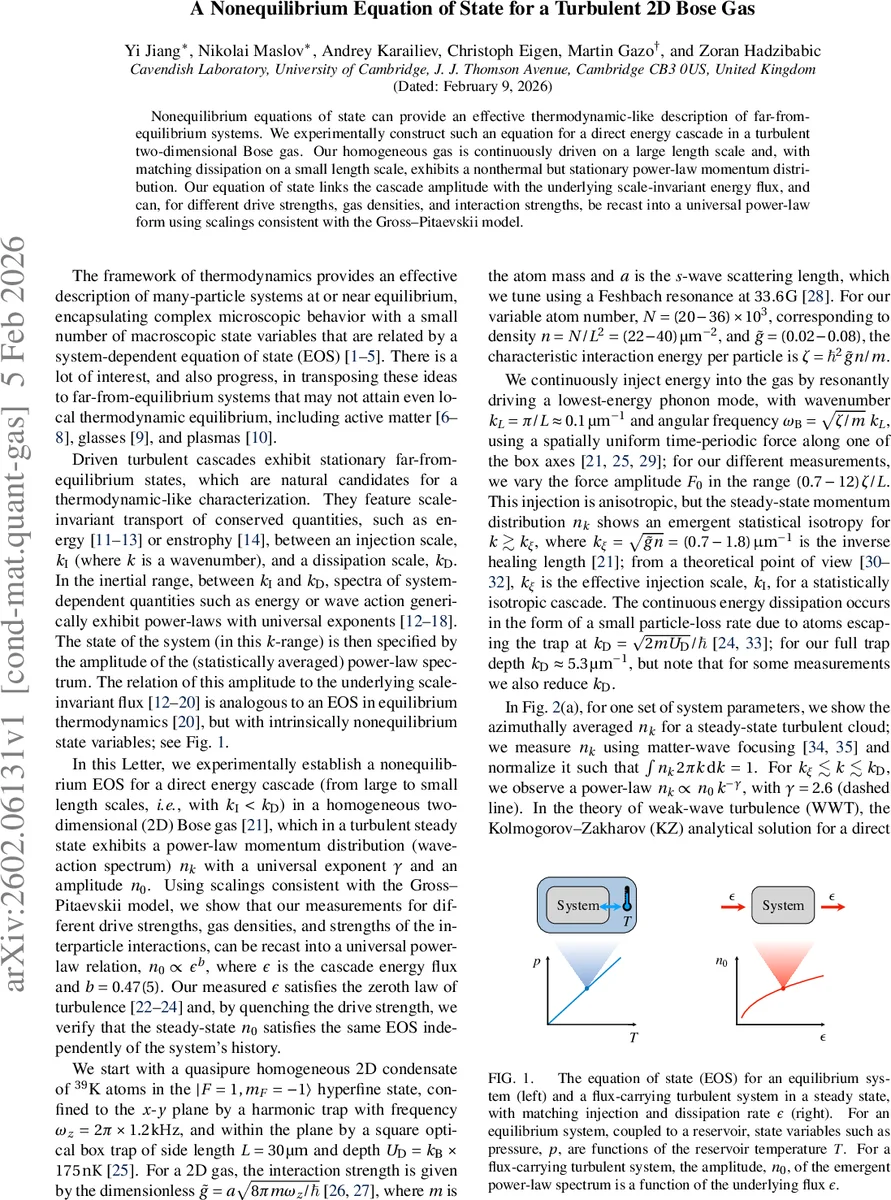
Nonequilibrium equations of state can provide an effective thermodynamic-like description of far-from-equilibrium systems. We experimentally construct such an equation for a direct energy cascade in a turbulent two-dimensional Bose gas. Our homogeneous gas is continuously driven on a large length scale and, with matching dissipation on a small length scale, exhibits a nonthermal but stationary power-law momentum distribution. Our equation of state links the cascade amplitude with the underlying scale-invariant energy flux, and can, for different drive strengths, gas densities, and interaction strengths, be recast into a universal power-law form using scalings consistent with the Gross-Pitaevskii model.
💡 Research Summary
The authors present the first experimental realization of a nonequilibrium equation of state (EOS) for a direct energy cascade in a homogeneous two‑dimensional (2D) Bose gas. By confining a quasi‑2D cloud of ^39K atoms in a square optical box (side length 30 µm, depth ≈ k_B·175 nK) and tuning the interaction strength ˜g between 0.02 and 0.08 via a Feshbach resonance, they create a uniform superfluid with atom numbers N = (2–3.6) × 10⁴ and densities n = (22–40) µm⁻². Energy is continuously injected on the largest length scale by resonantly driving the lowest‑energy phonon mode (wave number k_L = π/L ≈ 0.1 µm⁻¹) with a spatially uniform, time‑periodic force of amplitude F₀ ranging from 0.7 ζ/L to 12 ζ/L, where ζ = ħ²˜g n/m is the characteristic interaction energy. Although the drive is anisotropic, the momentum distribution becomes statistically isotropic for wave numbers above the inverse healing length k_ξ = √(˜g n) (0.7–1.8 µm⁻¹).
Dissipation occurs at a small scale set by the trap depth: atoms with wave numbers larger than k_D = √(2mU_D)/ħ (≈ 5.3 µm⁻¹ for the full depth) escape the trap, providing a particle loss rate Π = −Ṅ/N. By varying the trap depth, the authors measure Π for several k_D values and find Π ∝ k_D⁻², confirming the “zeroth law of turbulence” that the energy flux ε = Π ħ²k_D²/(2m) is independent of k_D.
In the inertial range k_ξ ≲ k ≲ k_D the steady‑state momentum distribution follows a power law n(k) ∝ n₀ k⁻ᵞ with an exponent γ ≈ 2.7, independent of ˜g, n, or ε. The amplitude n₀ is defined as a dimensionless quantity n₀ = k^{2‑γ} ξ^{‑γ} ⟨k^γ n(k)⟩, where the average is taken over k ∈
Comments & Academic Discussion
Loading comments...
Leave a Comment