Robust flat bands of the honeycomb wire network
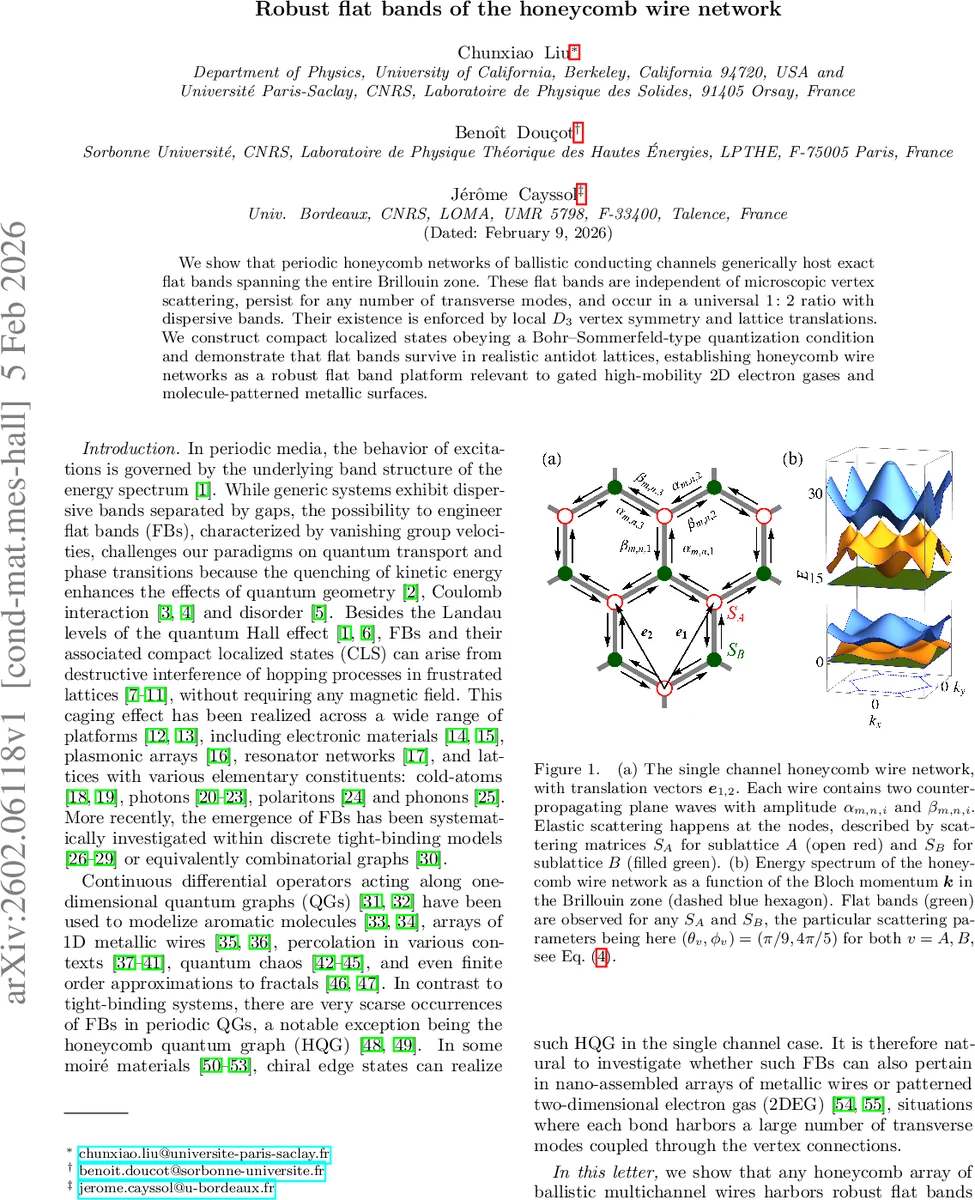
We show that periodic honeycomb networks of ballistic conducting channels generically host exact flat bands spanning the entire Brillouin zone. These flat bands are independent of microscopic vertex scattering, persist for any number of transverse modes, and occur in a universal $1\colon 2$ ratio with dispersive bands. Their existence is enforced by local $D_3$ vertex symmetry and lattice translations. We construct compact localized states obeying a Bohr-Sommerfeld-type quantization condition and demonstrate that flat bands survive in realistic antidot lattices, establishing honeycomb wire networks as a robust flat band platform relevant to gated high-mobility 2D electron gases and molecule-patterned metallic surfaces.
💡 Research Summary
In this work the authors demonstrate that a periodic honeycomb network of ballistic conducting channels inevitably hosts exact flat bands that extend over the entire Brillouin zone, regardless of the microscopic details of the vertex scattering. The system is modeled as a quantum graph: each bond is a one‑dimensional wire supporting counter‑propagating plane waves Ψₗ(s)=αₗe^{iqs}+βₗe^{-iqs} with energy E=q², while each vertex (sublattice A or B) is described by a 3×3 unitary scattering matrix S_A or S_B. Crucially, these matrices belong to the quotient group U(3)/D₃ and can be decomposed into a rank‑1 projector P∥ (eigenvalue e^{iθ_v}) and a rank‑2 projector P⊥ (eigenvalue e^{iϕ_v}).
After Bloch reduction, the eigenvalue problem becomes e^{2iq} D_k† S_B D_k S_A |α_k⟩ = |α_k⟩, where D_k encodes the Bloch phase factors associated with lattice translations. For a generic bipartite lattice this equation does not guarantee a k‑independent solution because S_A and S_B generally do not commute with D_k. However, the honeycomb geometry possesses a local D₃ symmetry that forces the existence of a subspace Im P⊥ invariant under D_k. By choosing |α_k⟩ ∈ Im P⊥, the equation reduces to a scalar condition e^{i(2q+ϕ_A+ϕ_B)}=1, i.e.
2q + ϕ_A + ϕ_B = 2π Z (∀ k).
Thus the longitudinal wave vector q, and consequently the energy E=q², become independent of the Bloch momentum. This is precisely a Bohr–Sommerfeld quantization condition for a closed semiclassical trajectory around a hexagon. The flat‑band energy depends only on the phase parameters ϕ_A and ϕ_B; the other parameters θ_A, θ_B affect only the dispersive bands. Consequently, an infinite set of exact flat bands appears, each separated from the next by a constant energy interval, and they coexist with dispersive bands in a universal 1:2 ratio.
The authors further construct compact localized states (CLS) explicitly. By setting all amplitudes to zero except on a single hexagon and imposing an alternating sign pattern (α,β)(−1)^b around the loop, the wavefunction lives entirely in Im P⊥. The vertex scattering then yields the same scalar condition β = e^{2iq+iϕ_A}α and α = e^{iϕ_B}β, reproducing the flat‑band quantization. Depending on (ϕ_A,ϕ_B) the CLS may possess nodes at vertices or on bonds, illustrating how the number and position of nodes encode the flat‑band index.
Beyond the ideal quantum‑graph limit, the paper presents numerical simulations of realistic antidot lattices where electrons are confined by hexagonal voids. Even when the strict one‑dimensional graph description breaks down, the flat bands persist, confirming the robustness of the mechanism. This suggests experimental realizations in high‑mobility two‑dimensional electron gases patterned by metallic honeycomb gates, or on Cu(111) surfaces where CO molecules are arranged in a honeycomb pattern using STM.
Importantly, the flat‑band protection does not rely on fine‑tuned hopping amplitudes or magnetic flux; it is guaranteed by the local D₃ symmetry of the honeycomb vertex and the translational symmetry of the lattice. Consequently, the phenomenon survives the presence of multiple transverse modes in each wire, making it applicable to multimode nanowire arrays and molecular‑scale metallic networks. The work opens a pathway to explore strong correlation effects, unconventional superconductivity, topological flat‑band physics, and nonlinear optical responses in a platform that is both theoretically clean and experimentally accessible.
Comments & Academic Discussion
Loading comments...
Leave a Comment