Categories graded by group homomorphisms
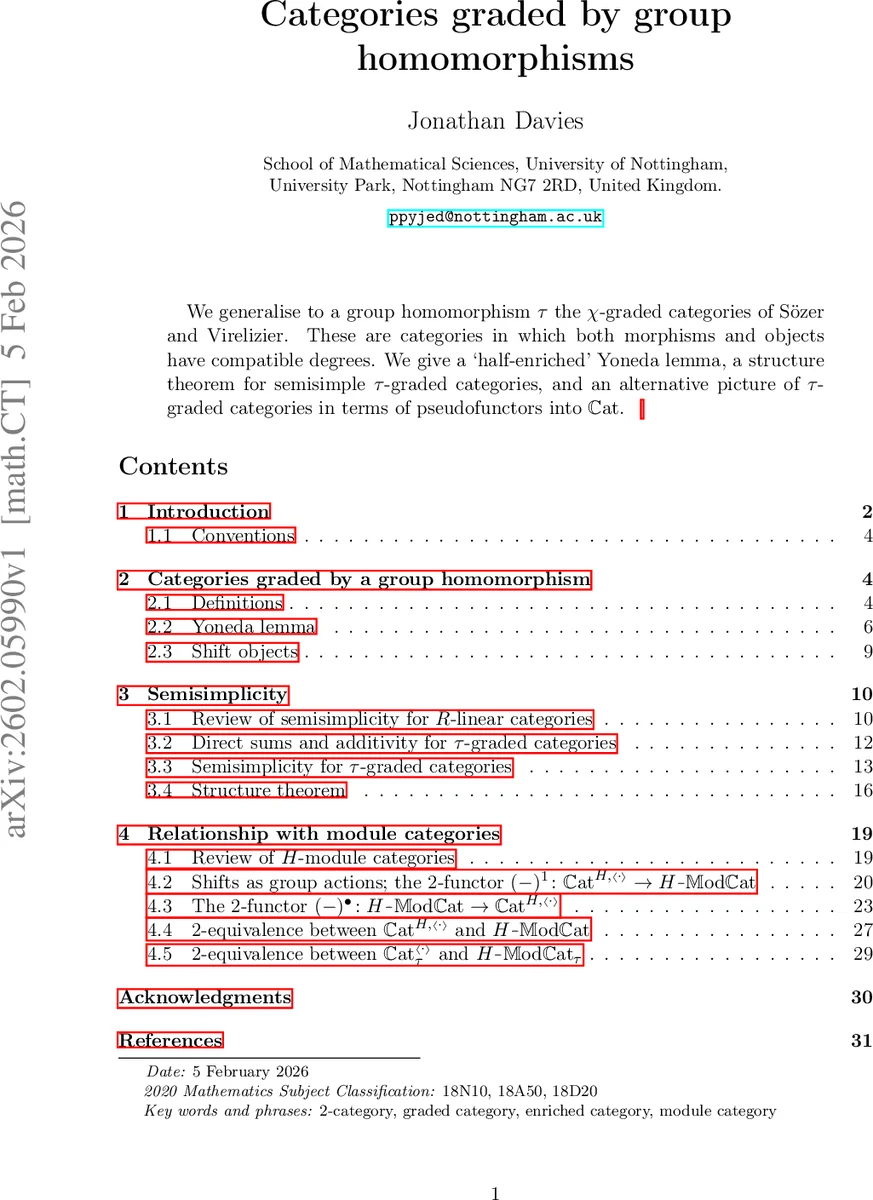
We generalise to a group homomorphism $τ$ the $χ$-graded categories of Sözer and Virelizier. These are categories in which both morphisms and objects have compatible degrees. We give a ‘half-enriched’ Yoneda lemma, a structure theorem for semisimple $τ$-graded categories, and an alternative picture of $τ$-graded categories in terms of pseudofunctors into $\mathbf{Cat}$.
💡 Research Summary
The paper introduces a new notion of “τ‑graded” categories, where a group homomorphism τ : H → G simultaneously governs the grading of objects and morphisms. This generalises the χ‑graded categories of Sözer and Virelizier, which required a crossed module (a group homomorphism together with an action) to handle monoidal coherence. By dropping the monoidal structure, the author shows that an ordinary group homomorphism suffices to encode compatible degrees.
Definition of τ‑graded categories.
A τ‑graded category C is an R‑linear category equipped with three compatible pieces of data: (1) it is H‑Hom‑graded, meaning each hom‑space Hom_h(X,Y) is an H‑graded R‑module and composition respects the H‑grading; (2) its subcategory C₁ consisting of degree‑1 morphisms is G‑graded, i.e. objects decompose into components indexed by G; (3) the grading condition forces Hom_h(X,Y) to be non‑zero only when the degree of Y equals τ(h)·degree of X. Thus τ translates the H‑degree of a morphism into a shift of the G‑degree of its source object.
The author builds a strict 2‑category Cat^τ whose 1‑morphisms are τ‑graded functors (H‑Hom‑graded functors preserving object degrees) and whose 2‑morphisms are H‑Hom‑graded natural transformations whose components have degree 1. There are obvious forgetful 2‑functors (−)₁ : Cat^τ → Cat^G and embeddings of Cat^G and Cat^H into Cat^τ, giving a picture of τ‑graded categories as a bridge between object‑grading (G) and morphism‑grading (H).
Half‑enriched Yoneda lemma.
A major technical obstacle is that the base of enrichment, R‑Mod^H (the category of H‑graded R‑modules), lacks a symmetric braiding unless H is abelian, so the standard V‑enriched Yoneda embedding cannot be defined. The paper circumvents this by constructing, for each a∈H, an H‑Hom‑graded functor 𝔶_a X : C → R‑Mod^•H (the right internal‑hom version of R‑Mod^H). Collecting these yields a family of embeddings (C₁)^op → Fun_H(C,R‑Mod^•H). Theorem 2.9 proves a Yoneda‑style isomorphism
\
Comments & Academic Discussion
Loading comments...
Leave a Comment