Global solvability and stabilization in multi-dimensional small-strain nonlinear thermoviscoelasticity
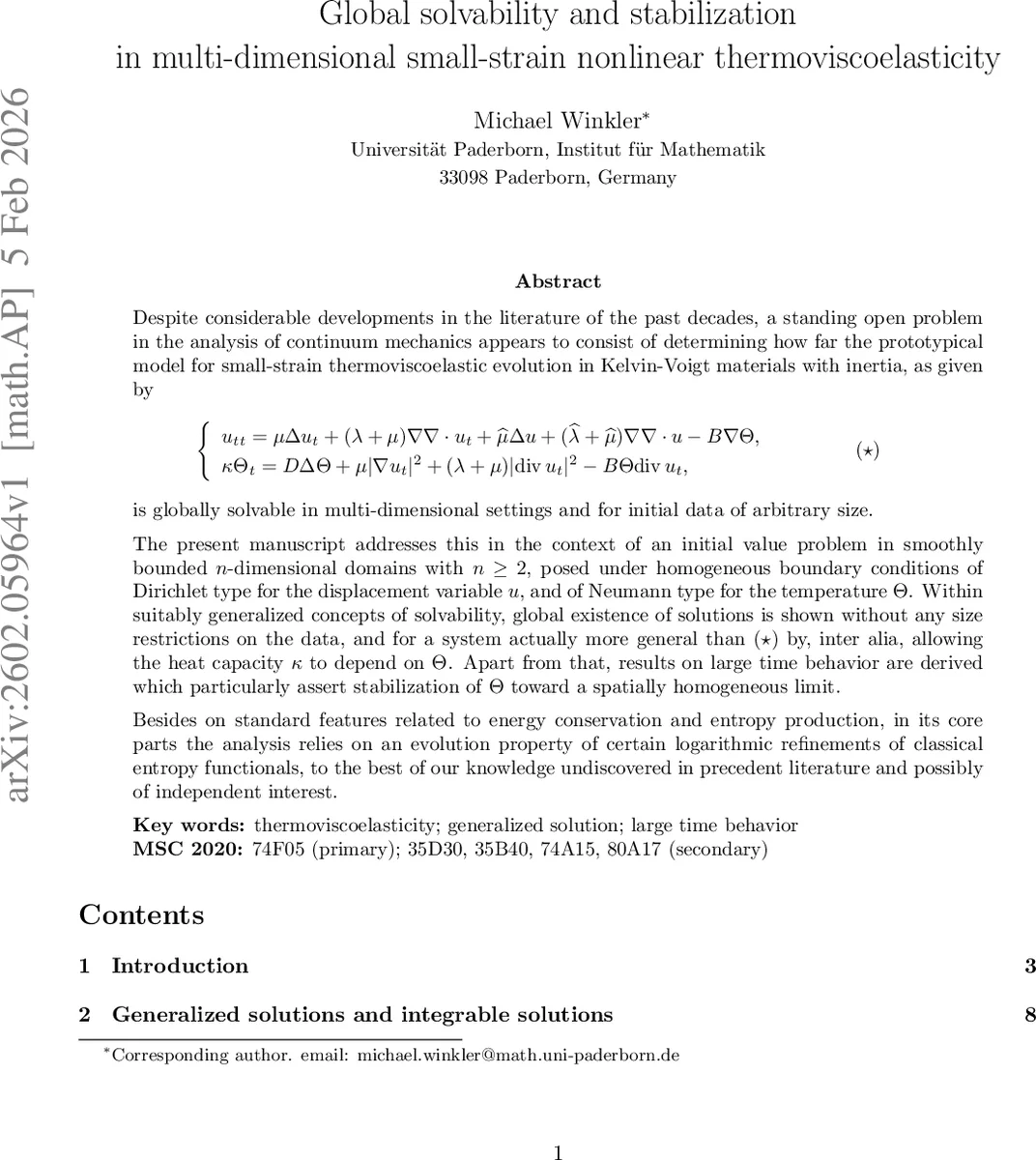
Despite considerable developments in the literature of the past decades, a standing open problem in the analysis of continuum mechanics appears to consist of determining how far the prototypical model for small-strain thermoviscoelastic evolution in Kelvin-Voigt materials with inertia, as given by [ u_{tt} = μΔu_t + (λ+μ)\nabla\nabla\cdot u_t + \hatμ Δu + (\hatλ+\hatμ) \nabla\nabla\cdot u - B\nablaΘ, \qquad \qquad κΘ_t = DΔΘ+ μ|\nabla u_t|^2 + (λ+μ) |{\rm div} , u_t|^2 - BΘ{\rm div} , u_t, \qquad \qquad \qquad (\star) ] is globally solvable in multi-dimensional settings and for initial data of arbitrary size. The present manuscript addresses this in the context of an initial value problem in smoothly bounded $n$-dimensional domains with $n\ge 2$, posed under homogeneous boundary conditions of Dirichlet type for the displacement variable $u$, and of Neumann type for the temperature $Θ$. Within suitably generalized concepts of solvability, global existence of solutions is shown without any size restrictions on the data, and for a system actually more general than ($\star$) by, inter alia, allowing the heat capacity $κ$ to depend on $Θ$. Apart from that, results on large time behavior are derived which particularly assert stabilization of $Θ$ toward a spatially homogeneous limit. Besides on standard features related to energy conservation and entropy production, in its core parts the analysis relies on an evolution property of certain logarithmic refinements of classical entropy functionals, to the best of our knowledge undiscovered in precedent literature and possibly of independent interest.
💡 Research Summary
The paper addresses a long‑standing open problem in continuum mechanics: the global solvability of the prototypical small‑strain thermoviscoelastic system in Kelvin‑Voigt materials with inertia, in arbitrary space dimensions (n ≥ 2) and for arbitrarily large initial data. The authors consider a generalized version of the classical model, allowing a temperature‑dependent heat capacity κ(Θ) and incorporating full viscous, elastic, and thermal dilation terms. The system is posed on a smooth bounded domain with homogeneous Dirichlet boundary conditions for the displacement u and homogeneous Neumann conditions for the temperature Θ.
Two fundamental identities are recalled: the mechanical energy balance (1.3) and the entropy production identity (1.4). While these are standard, they are insufficient to control the quadratic heat source terms μ|∇u_t|²+(λ+μ)|div u_t|² that appear in the temperature equation. The core innovation of the work is the introduction of a logarithmically weighted entropy functional
\
Comments & Academic Discussion
Loading comments...
Leave a Comment