Task-Adaptive Physical Reservoir Computing via Tunable Molecular Communication Dynamics
Physical Reservoir Computing (PRC) offers an efficient paradigm for processing temporal data, yet most physical implementations are static, limiting their performance to a narrow range of tasks. In this work, we demonstrate in silico that a canonical Molecular Communication (MC) channel can function as a highly versatile and task-adaptive PRC whose computational properties are reconfigurable. Using a dual-simulation approach – a computationally efficient deterministic mean-field model and a high-fidelity particle-based stochastic model (Smoldyn) – we show that tuning the channel’s underlying biophysical parameters, such as ligand-receptor kinetics and diffusion dynamics, allows the reservoir to be optimized for distinct classes of computation. We employ Bayesian optimization to efficiently navigate this high-dimensional parameter space, identifying discrete operational regimes. Our results reveal a clear trade-off: parameter sets rich in channel memory excel at chaotic time-series forecasting tasks (e.g., Mackey Glass), while regimes that promote strong receptor nonlinearity are superior for nonlinear data transformation. We further demonstrate that post-processing methods improve the performance of the stochastic reservoir by mitigating intrinsic molecular noise. These findings establish the MC channel not merely as a computational substrate, but as a design blueprint for tunable, bioinspired computing systems, providing a clear optimization framework for future wetware AI implementations.
💡 Research Summary
Physical Reservoir Computing (PRC) leverages the intrinsic dynamics of physical systems to process temporal data with low energy consumption. However, most existing physical reservoirs are static; their dynamics are fixed by construction, which limits their performance to a narrow set of tasks. In this paper the authors propose a fundamentally different approach: they treat a canonical molecular communication (MC) channel as a reconfigurable PRC whose computational properties can be tuned by adjusting biophysical parameters such as diffusion coefficient, transmitter‑receiver distance, and ligand‑receptor kinetics.
System model
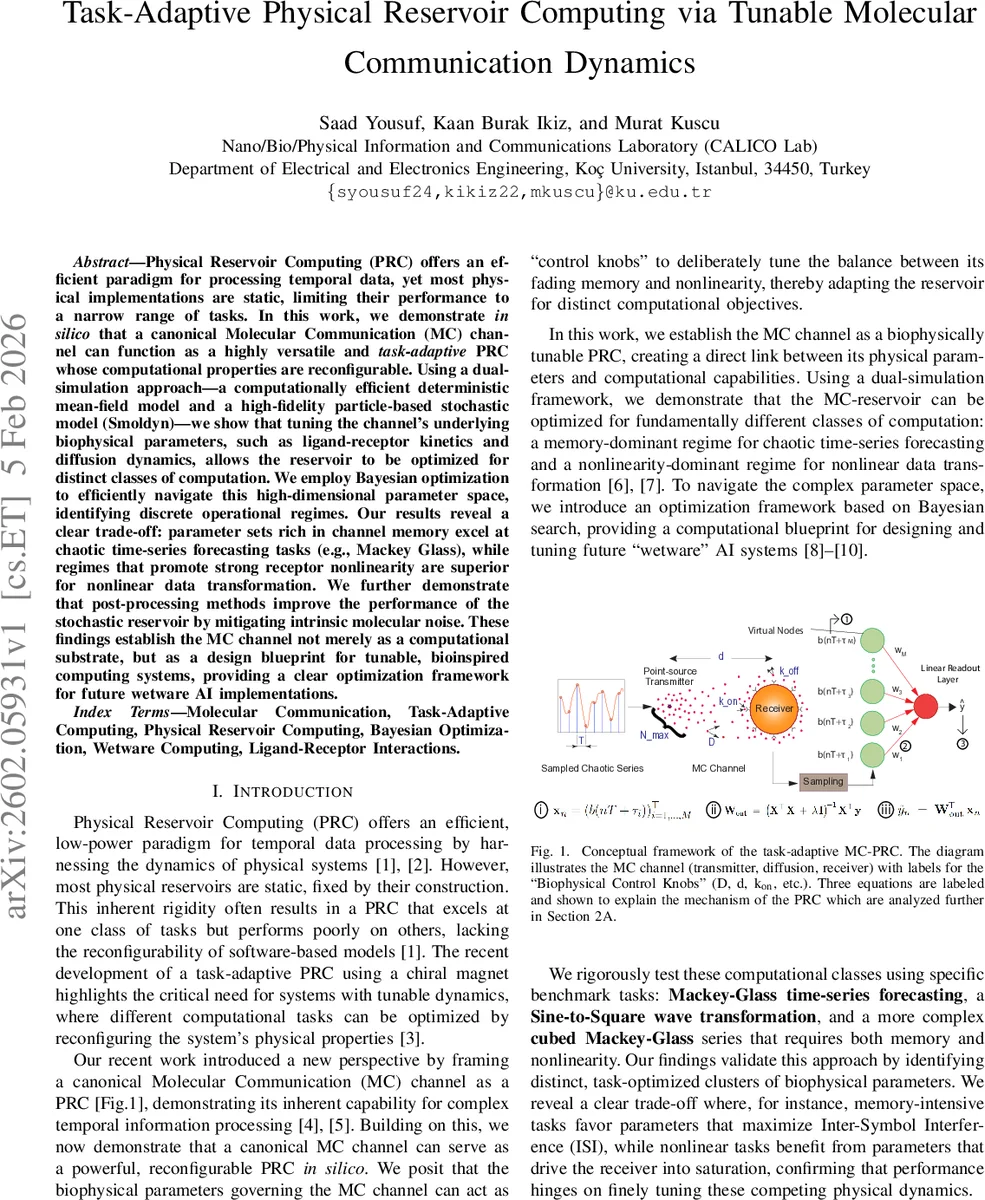
The MC‑PRC consists of a point transmitter that releases a burst of messenger molecules, a 3‑D diffusive medium, and a spherical receiver covered with binding receptors. The input at discrete time step n is encoded as the number of molecules released (N_max). Diffusion follows Fick’s second law (∂c/∂t = D∇²c) and creates a long impulse response h(t) that spreads the signal over many symbol intervals, generating inter‑symbol interference (ISI). ISI provides a natural fading memory. At the receiver, the mean fraction of bound receptors b(t) evolves according to first‑order kinetics: db/dt = k_on·c_R(t)·(1‑b) – k_off·b. The saturating term (1‑b) introduces a strong nonlinearity. By sampling b(t) at M distinct delays within each symbol interval, a high‑dimensional virtual‑node state vector x_n ∈ ℝ^M is built. A linear readout layer, trained via ridge regression (or analytically with the Moore‑Penrose pseudoinverse), maps x_n to the desired output ŷ_n.
Control knobs
Four families of parameters act as “knobs”:
- Diffusion (D) and distance (d) – lower D or larger d increase the temporal spread of the concentration pulse, lengthening the memory window.
- Binding kinetics (k_on, k_off) – the ratio K_D = k_off/k_on determines affinity. High affinity (low K_D) pushes the receiver into saturation, enhancing nonlinearity but potentially reducing effective memory.
- Signal encoding (N_max, symbol period T) – larger N_max drives the system deeper into the nonlinear regime; longer T increases ISI and thus memory.
- Readout memory length – the number of recent virtual‑node samples used for prediction.
Optimization methodology
Because the objective function (NRMSE after a full MC‑PRC simulation) is expensive to evaluate and the parameter space is high‑dimensional, the authors employ Bayesian optimization. A Gaussian Process surrogate models the NRMSE surface, and Expected Improvement (EI) guides the selection of the next parameter set. Only 200 deterministic‑model evaluations are required to locate high‑performing regions for each task.
Benchmark tasks
Three standard RC benchmarks are used to probe the memory–nonlinearity trade‑off:
- Chaotic time‑series forecasting – Mackey‑Glass series (β=0.2, γ=0.1, n=10, τ=17). This task demands long, structured memory.
- Nonlinear transformation – Sine‑to‑Square mapping, which primarily tests the reservoir’s ability to implement a strong static nonlinearity.
- Hybrid task – Cubed Mackey‑Glass series (y = x_MG³), requiring both memory and nonlinear processing.
Performance is measured with Normalized Root Mean Square Error (NRMSE).
Results
- Memory‑dominant regime (optimal for Mackey‑Glass forecasting): low diffusion coefficient, large transmitter‑receiver distance, high unbinding rate (k_off) → long ISI, short receptor saturation. Achieved NRMSE ≈ 0.097.
- Nonlinearity‑dominant regime (optimal for sine‑to‑square): high binding rate (k_on), low K_D, large N_max → receptor quickly saturates, producing a sharp threshold‑like response. NRMSE ≈ 0.308.
- Hybrid regime (optimal for cubed Mackey‑Glass): intermediate diffusion and binding rates, moderate symbol period, and a readout memory window that balances past information with current nonlinearity. NRMSE ≈ 0.238.
Parallel‑coordinates plots of the top‑10 parameter sets for each task reveal clear clustering, confirming that distinct physical configurations are required for different computational objectives. When a parameter set optimized for one task is applied to another, performance degrades substantially, underscoring the necessity of task‑specific tuning.
Stochastic simulations and noise mitigation
To assess robustness, the authors also simulate the MC‑PRC with Smoldyn, a particle‑based stochastic framework that captures molecular noise. Unsurprisingly, the stochastic reservoir yields higher NRMSE values than the deterministic mean‑field model. However, simple post‑processing techniques—such as low‑pass filtering of the virtual‑node time series or averaging over multiple stochastic runs—significantly reduce the error, demonstrating that intrinsic molecular noise can be mitigated in practice.
Implications and future directions
The study reframes biophysical parameters from being mere constraints to being tunable hyperparameters that directly shape the computational profile of a physical reservoir. This opens the door to truly adaptive “wetware” AI systems where the reservoir can be reconfigured on‑the‑fly, for example by using optogenetically controllable receptors, electrically modulated release rates, or microfluidic adjustments of the diffusion path. Moreover, the Bayesian‑optimization‑driven design workflow is generic and can be transferred to other physical substrates (photonic, spintronic, mechanical) that exhibit analogous memory‑nonlinearity trade‑offs.
In summary, the paper demonstrates that a molecular communication channel can serve as a versatile, task‑adaptive physical reservoir. By systematically tuning diffusion, distance, binding kinetics, and encoding parameters, and by employing Bayesian optimization to navigate the high‑dimensional design space, the authors achieve state‑of‑the‑art performance on canonical RC benchmarks. The work provides both a concrete computational blueprint and a compelling proof‑of‑concept for future bio‑inspired, reconfigurable computing platforms.
Comments & Academic Discussion
Loading comments...
Leave a Comment