Early growth of massive black holes in dynamical dark energy models with negative cosmological constant
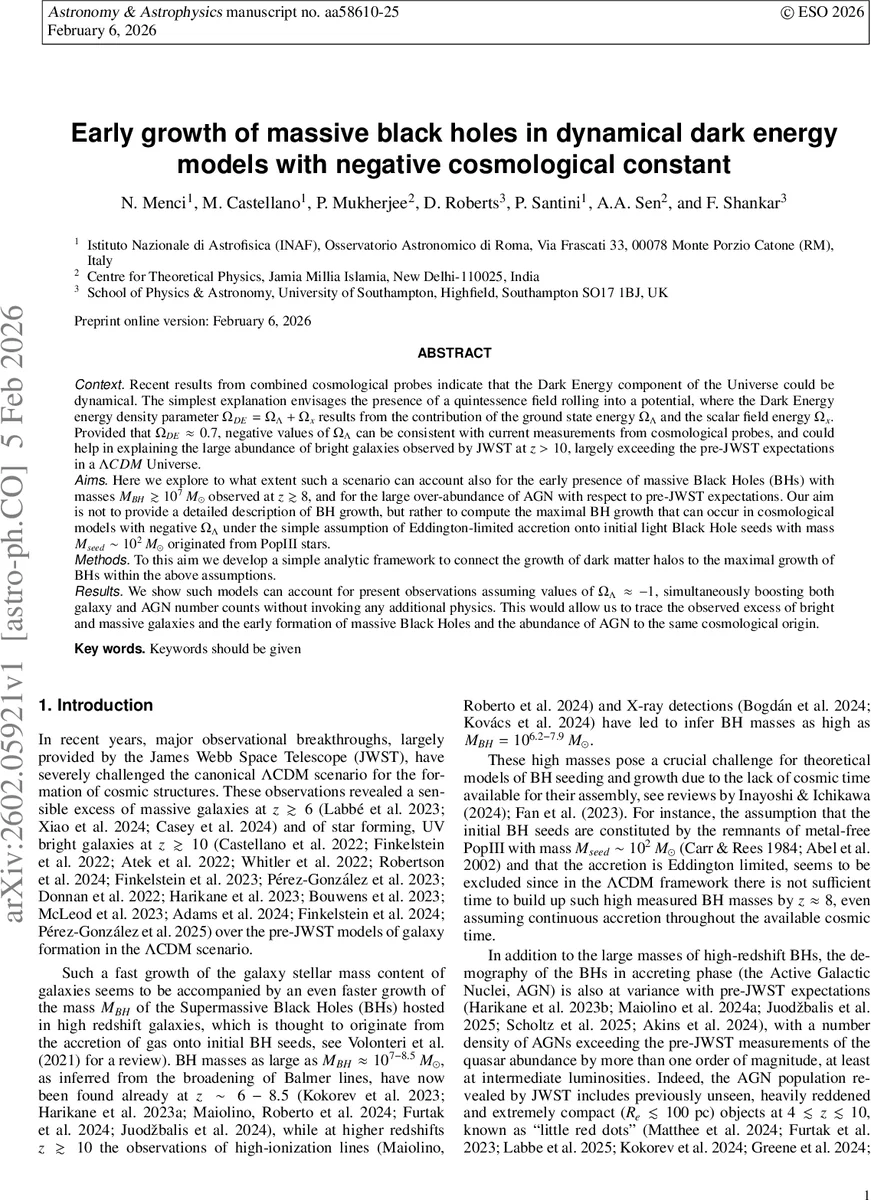
Recent results from combined cosmological probes indicate that the Dark Energy component of the Universe could be dynamical. The simplest explanation envisages the presence of a quintessence field rolling into a potential, where the Dark Energy energy density parameter $Ω_{DE}=Ω_Λ+Ω_{x}$ results from the contribution of the ground state energy $Ω_Λ$ and the scalar field energy $Ω_{x}$. Provided that $Ω_{DE}\approx 0.7$, negative values of $Ω_Λ$ can be consistent with current measurements from cosmological probes, and could help in explaining the large abundance of bright galaxies observed by JWST at $z> 10$, largely exceeding the pre-JWST expectations in a $ΛCDM$ Universe. Here we explore to what extent such a scenario can account also for the early presence of massive Black Holes (BHs) with masses $M_{BH}\gtrsim 10^7,M_{\odot}$ observed at $z\gtrsim 8$, and for the large over-abundance of AGN with respect to pre-JWST expectations. Our aim is not to provide a detailed description of BH growth, but rather to compute the maximal BH growth that can occur in cosmological models with negative $Ω_Λ$ under the simple assumption of Eddington-limited accretion onto initial light Black Hole seeds with mass $M_{seed}\sim 10^2,M_{\odot}$ originated from PopIII stars. To this aim we develop a simple analytic framework to connect the growth of dark matter halos to the maximal growth of BHs within the above assumptions. We show such models can account for present observations assuming values of $Ω_Λ\approx -1$, simultaneously boosting both galaxy and AGN number counts without invoking any additional physics. This would allow us to trace the observed excess of bright and massive galaxies and the early formation of massive Black Holes and the abundance of AGN to the same cosmological origin.
💡 Research Summary
The paper addresses a pressing tension in modern cosmology: the unexpectedly large number of bright galaxies and massive black holes (BHs) observed by the James Webb Space Telescope (JWST) at redshifts z ≳ 8–10. In the standard ΛCDM framework, the limited cosmic time available between the formation of the first Pop III stellar remnants (seed masses ≈10² M⊙) and these epochs makes it impossible to grow BHs to the inferred masses (10⁷–10⁸ M⊙) using only Eddington‑limited accretion. Moreover, the observed AGN number densities exceed ΛCDM predictions by more than an order of magnitude.
To resolve this, the authors explore a class of dynamical dark energy (DDE) models in which the total dark‑energy density Ω_DE ≈ 0.7 is split into a constant vacuum term (Λ) and a time‑varying scalar field component (x). Crucially, they allow the vacuum term to be negative (Ω_Λ < 0), while the scalar field contributes positively, yielding an overall accelerating universe at low redshift. The scalar field equation‑of‑state is parameterized by the Chevallier‑Polarski‑Linder (CPL) form w_x(z)=w₀+w_a(1‑a). By choosing parameters such as Ω_Λ≈‑1, w₀≈‑1.2 and w_a≈0.3, the model remains compatible with recent BAO, CMB, and Type‑Ia supernova data at the 3σ level.
The negative Λ reduces the Hubble expansion rate at early times, effectively enhancing the growth rate of density perturbations. This accelerates the formation of massive dark‑matter (DM) halos at high redshift. The authors construct an analytic pipeline: (1) generate a Monte‑Carlo sample of halos at z_i=20 drawn from the high‑σ tail (≥3.5σ) of the halo mass function; (2) evolve each halo along its main progenitor branch using extended Press‑Schechter‑type growth formulas adapted to the modified expansion history; (3) within each halo, grow a central BH by (a) assuming the fractional mass increase from mergers tracks the fractional halo mass growth, and (b) continuous Eddington‑limited gas accretion with a duty cycle of unity; (4) derive a deterministic BH‑halo mass relation (no scatter) and map the halo mass function onto a BH mass function; (5) convert the BH mass function into an AGN luminosity function, assuming all BHs radiate at the Eddington limit.
The results show that, for Ω_Λ≈‑1, BHs can reach ≳10⁷ M⊙ by z≈8–10 starting from 10² M⊙ seeds, matching the masses inferred from broad‑line spectroscopy and high‑ionisation line detections. The predicted AGN luminosity function reproduces the observed excess of faint‑to‑moderate‑luminosity AGN (the “little red dots”) without invoking super‑Eddington phases or heavy seeds (≈10⁵ M⊙). Simultaneously, the same cosmology yields a UV galaxy luminosity function consistent with JWST’s bright‑galaxy counts at z ≳ 10, providing a unified explanation for both galaxy and AGN over‑abundances.
The authors acknowledge several caveats. Their maximal‑growth assumption (continuous Eddington accretion, duty cycle = 1, merger growth directly proportional to halo growth) likely overestimates realistic BH masses, as feedback, metal enrichment, and gas supply limitations would reduce accretion efficiency. Ignoring scatter in the BH‑halo relation may artificially sharpen the high‑mass tail of the BH mass function. Moreover, a large negative Ω_Λ raises concerns about the ultimate fate of the universe (potential recollapse) and must be reconciled with low‑z structure observations.
Nevertheless, the study demonstrates that a modest modification of the cosmological model—allowing a negative cosmological constant within a dynamical dark‑energy framework—can, by itself, provide sufficient early structure growth to explain JWST’s high‑z BH and AGN observations without resorting to exotic astrophysical mechanisms. The work suggests a promising avenue for future research: detailed numerical simulations of structure formation in NCC cosmologies, inclusion of realistic BH feedback, and tighter observational constraints on high‑z BH masses and AGN duty cycles to test the viability of this unified cosmological solution.
Comments & Academic Discussion
Loading comments...
Leave a Comment