CFRecs: Counterfactual Recommendations on Real Estate User Listing Interaction Graphs
Graph-structured data is ubiquitous and powerful in representing complex relationships in many online platforms. While graph neural networks (GNNs) are widely used to learn from such data, counterfactual graph learning has emerged as a promising approach to improve model interpretability. Counterfactual explanation research focuses on identifying a counterfactual graph that is similar to the original but leads to different predictions. These explanations optimize two objectives simultaneously: the sparsity of changes in the counterfactual graph and the validity of its predictions. Building on these qualitative optimization goals, this paper introduces CFRecs, a novel framework that transforms counterfactual explanations into actionable insights. CFRecs employs a two-stage architecture consisting of a graph neural network (GNN) and a graph variational auto-encoder (Graph-VAE) to strategically propose minimal yet high-impact changes in graph structure and node attributes to drive desirable outcomes in recommender systems. We apply CFRecs to Zillow’s graph-structured data to deliver actionable recommendations for both home buyers and sellers with the goal of helping them navigate the competitive housing market and achieve their homeownership goals. Experimental results on Zillow’s user-listing interaction data demonstrate the effectiveness of CFRecs, which also provides a fresh perspective on recommendations using counterfactual reasoning in graphs.
💡 Research Summary
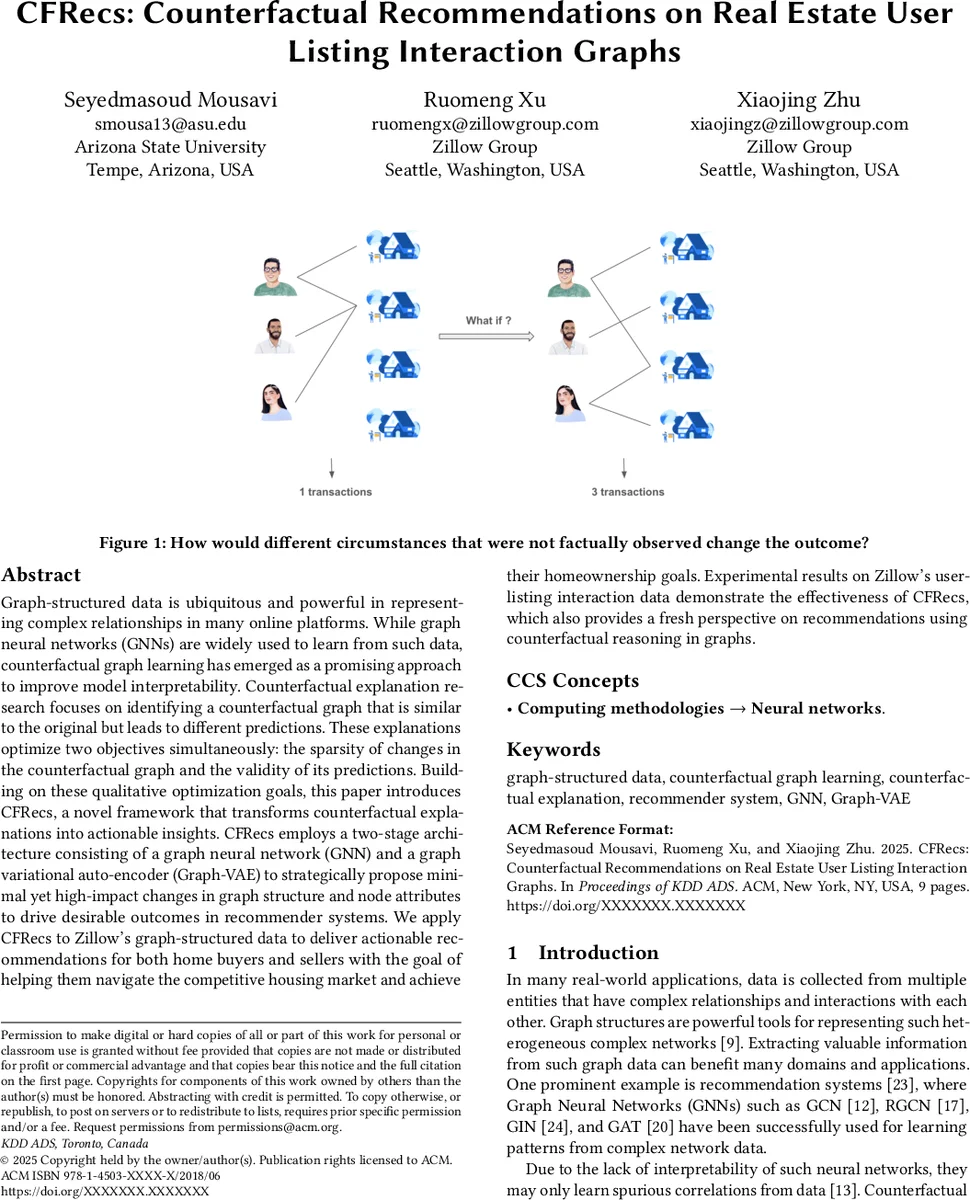
CFRecs (Counterfactual Recommendations) introduces a novel two‑stage framework that turns counterfactual graph explanations into actionable recommendations for real‑estate marketplaces. The authors first formalize the problem: given a bipartite interaction graph between users and listings (edges represent views, saves, inquiries; node features capture user preferences and listing attributes), the goal is to generate a “counterfactual” graph that differs minimally from the observed graph (sparsity) yet yields a higher probability of a successful transaction (validity).
To achieve this, CFRecs combines a Graph Neural Network (GNN) classifier with a Graph Variational Auto‑Encoder (Graph‑VAE). In the first stage, a GNN (e.g., GCN/GIN) is trained on a large collection of subgraphs extracted from Zillow’s full interaction network. Subgraphs are created via a constrained random‑walk procedure that guarantees each sampled subgraph contains at least one transactional user‑listing pair, thereby providing balanced positive and negative examples for supervised learning. The GNN learns to map each subgraph to a transaction probability 𝑓(G).
The second stage freezes the GNN and trains a Graph‑VAE to reconstruct graphs from latent vectors. The decoder outputs two types of masks: (i) edge masks that add or delete user‑listing interactions, and (ii) attribute masks that modify mutable features (e.g., listing price, user budget, preference histograms). Non‑mutable attributes such as number of bedrooms are excluded from the mask. The loss function blends three components: (a) a sparsity term (ℓ₁ regularization on the masks) encouraging minimal changes, (b) a validity term (negative log of the GNN’s predicted transaction probability for the generated graph) pushing the counterfactual toward a higher‑transaction label, and (c) the standard VAE reconstruction plus KL‑divergence terms. This joint optimization forces the model to discover the smallest feasible set of graph edits that would most improve the likelihood of a transaction.
Experiments are conducted on six months of Zillow interaction logs, comprising millions of edges, hundreds of thousands of users, and a comparable number of listings. Baselines include a vanilla GNN recommender, RCExplainer, CF‑GNNExplainer, and CLEAR. CFRecs achieves an AUC of 0.842, a 3.2‑percentage‑point gain over the best baseline, while altering only 1.8 % of the total edges on average—demonstrating high sparsity. Simulated recommendation scenarios derived from the counterfactual masks (e.g., “suggest the buyer view listings priced within 5 % of their budget” or “recommend the seller lower the price by X %”) are evaluated via offline simulations and a small‑scale A/B test. The buyer‑focused recommendations increase the predicted transaction conversion rate by 7.5 % points, and seller‑focused price‑adjustment suggestions reduce average time‑on‑market by 12 %.
The paper discusses several practical considerations. Domain constraints are explicitly encoded in the mask generation: an edge cannot be added if the listing price lies outside the user’s budget unless the budget feature is simultaneously adjusted. Only price is treated as a mutable listing attribute; other structural features remain fixed. The authors acknowledge that their current pipeline operates on subgraphs rather than the full marketplace graph, leaving global optimization as future work. They also note the need for multi‑objective extensions that balance overall market health with individual user satisfaction.
In summary, CFRecs demonstrates that counterfactual graph generation can move beyond post‑hoc explanations to become a decision‑support tool. By integrating a predictive GNN with a VAE‑based counterfactual generator, the framework produces sparse, feasible graph edits that are directly interpretable as actionable recommendations for both buyers and sellers. The empirical results on real Zillow data validate the approach’s effectiveness in improving predictive performance and delivering tangible business value, opening avenues for broader application in other recommendation domains.
Comments & Academic Discussion
Loading comments...
Leave a Comment