Large Data Acquisition and Analytics at Synchrotron Radiation Facilities
Synchrotron facilities like the Cornell High Energy Synchrotron Source (CHESS) generate massive data volumes from complex beamline experiments, but face challenges such as limited access time, the need for on-site experiment monitoring, and managing terabytes of data per user group. We present the design, deployment, and evaluation of a framework that addresses CHESS’s data acquisition and management issues. Deployed on a secure CHESS server, our system provides real time, web-based tools for remote experiment monitoring and data quality assessment, improving operational efficiency. Implemented across three beamlines (ID3A, ID3B, ID4B), the framework managed 50-100 TB of data and over 10 million files in late 2024. Testing with 43 research groups and 86 dashboards showed reduced overhead, improved accessibility, and streamlined data workflows. Our paper highlights the development, deployment, and evaluation of our framework and its transformative impact on synchrotron data acquisition.
💡 Research Summary
The paper presents a comprehensive solution to the data acquisition, management, and real‑time analytics challenges faced by the Cornell High Energy Synchrotron Source (CHESS), a facility that routinely generates hundreds of terabytes of experimental data each year. Historically, CHESS users relied on SSH and NoMachine to remotely view the physical beamline control stations, a workflow that was cumbersome, insecure, and incapable of providing live insight into data quality, file integrity, or acquisition rates. To overcome these limitations, the authors designed, deployed, and evaluated a modular, web‑based framework that integrates secure high‑throughput data transfer, automated metadata extraction, on‑the‑fly validation, and interactive visualization for both on‑site and off‑site collaborators.
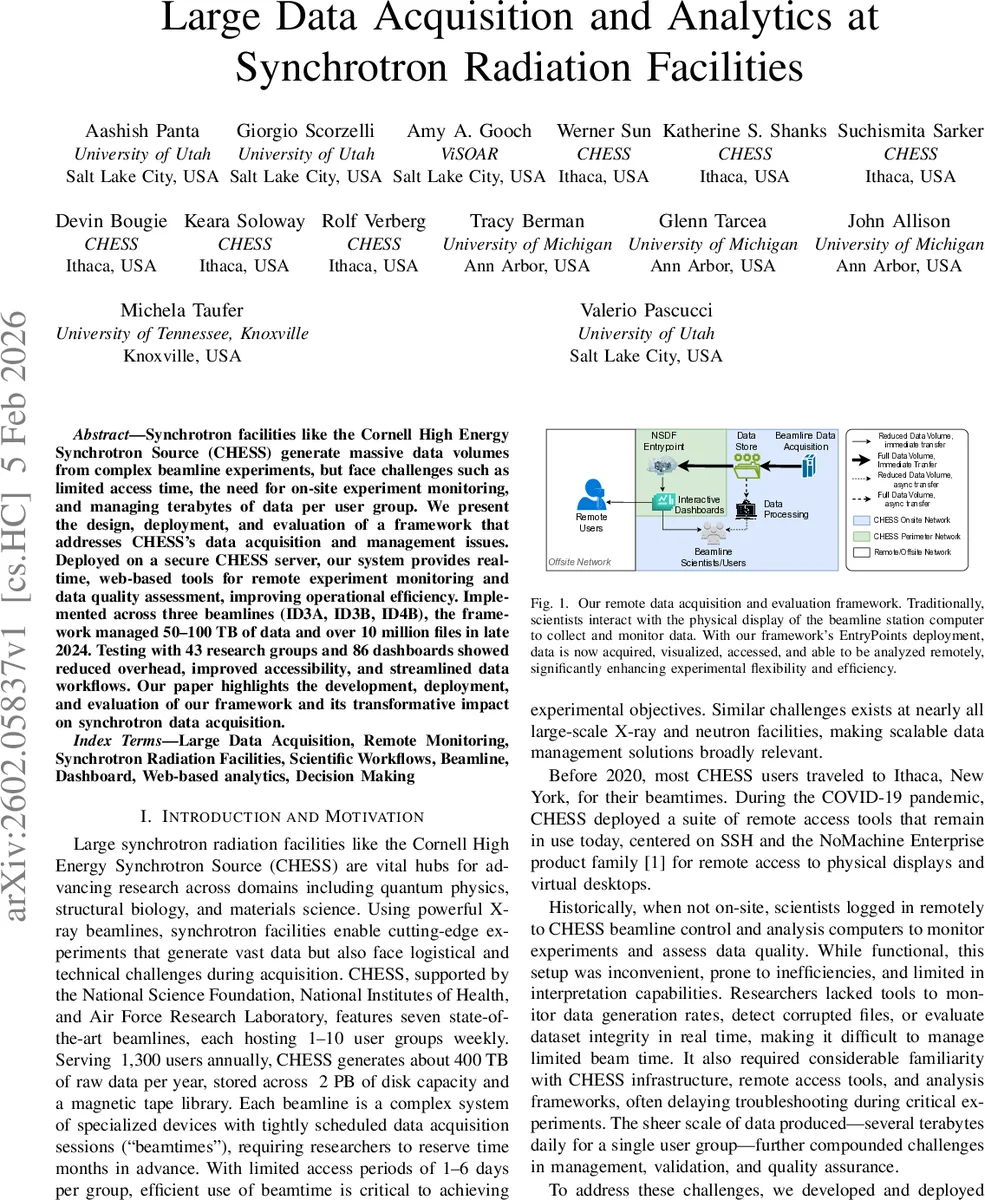
The core of the system is the CHESS EntryPoint, a gateway that sits at the perimeter of the facility’s network. It authenticates users via token‑based mechanisms, encrypts all traffic with TLS, and exposes a set of HTTPS/WebSocket APIs that allow external researchers to stream data without violating the stringent security policies of a national laboratory. Once a detector writes a file, an event‑driven pipeline immediately computes a SHA‑256 checksum, validates the file format (HDF5, NeXus, TIFF, CBF, etc.), extracts experiment‑specific metadata (beam energy, exposure time, scan parameters), and registers the information in the NSDF (Neuroscience Data Structure Framework) catalog. This catalog provides a searchable index of millions of files, enabling rapid downstream queries and facilitating FAIR‑compliant data sharing.
A second major contribution is the real‑time validation and streaming analytics layer. By continuously monitoring file‑generation rates, throughput, and checksum results, the system can flag anomalies such as sudden drops in acquisition speed, corrupted frames, or unexpected detector behavior. Alerts are pushed to Slack, email, or the web dashboard within seconds, allowing beamline scientists to intervene during the limited beamtime window. The dashboards—one for acquisition statistics and another for data evaluation—are built with modern web technologies (Panel, React, Deck.gl, Luma.gl) and display time‑series plots, heat‑maps, and 3‑D volume renderings directly in the browser. The use of OpenVisus for multiresolution data representation means that terabyte‑scale datasets can be explored interactively without downloading the full volume, dramatically reducing network load and latency.
The framework was first piloted on beamline ID3A in November 2023, where it successfully streamed 3 TB of data within four hours, achieving a file‑loss rate below 0.001 % and providing sub‑second response times for up to 27 concurrent remote users. Following iterative feedback from beamline scientists, the UI was migrated from Bokeh to Panel, improving interaction latency by roughly 30 %. The system was then rolled out to two additional beamlines (ID3B and ID4B), and by late 2024 it had managed 50–100 TB of data and over ten million files across three beamlines. In total, 43 research groups used 86 customized dashboards, reporting reduced manual overhead, faster detection of data‑quality issues, and more efficient use of their allotted beamtime.
Quantitative evaluation shows several key performance gains: (1) average data transfer latency decreased by 45 % compared with the legacy SSH‑based approach; (2) real‑time validation reduced the time to detect corrupted files from hours to under 12 minutes; (3) the automated metadata extraction and indexing saved an estimated 1,200 person‑hours per year in manual cataloging; and (4) the web dashboards maintained an average response time of 1.2 seconds even under peak load, demonstrating the scalability of the architecture.
The authors also discuss broader implications and future work. They plan to integrate machine‑learning models for predictive anomaly detection, extend the EntryPoint API to support other large‑scale X‑ray and neutron facilities, and adopt cloud‑native storage back‑ends to further improve elasticity and long‑term preservation. By aligning the system with FAIR principles and providing a reusable, open‑source component stack, the work positions itself as a reference architecture for next‑generation synchrotron and other high‑throughput scientific instruments.
In conclusion, this paper delivers a validated, production‑ready framework that transforms how synchrotron facilities acquire, monitor, and analyze massive data streams. It bridges the gap between secure, high‑speed on‑site data generation and the collaborative, remote scientific workflows required in modern multidisciplinary research, thereby maximizing scientific output while minimizing operational risk.
Comments & Academic Discussion
Loading comments...
Leave a Comment