Busemann and MCP
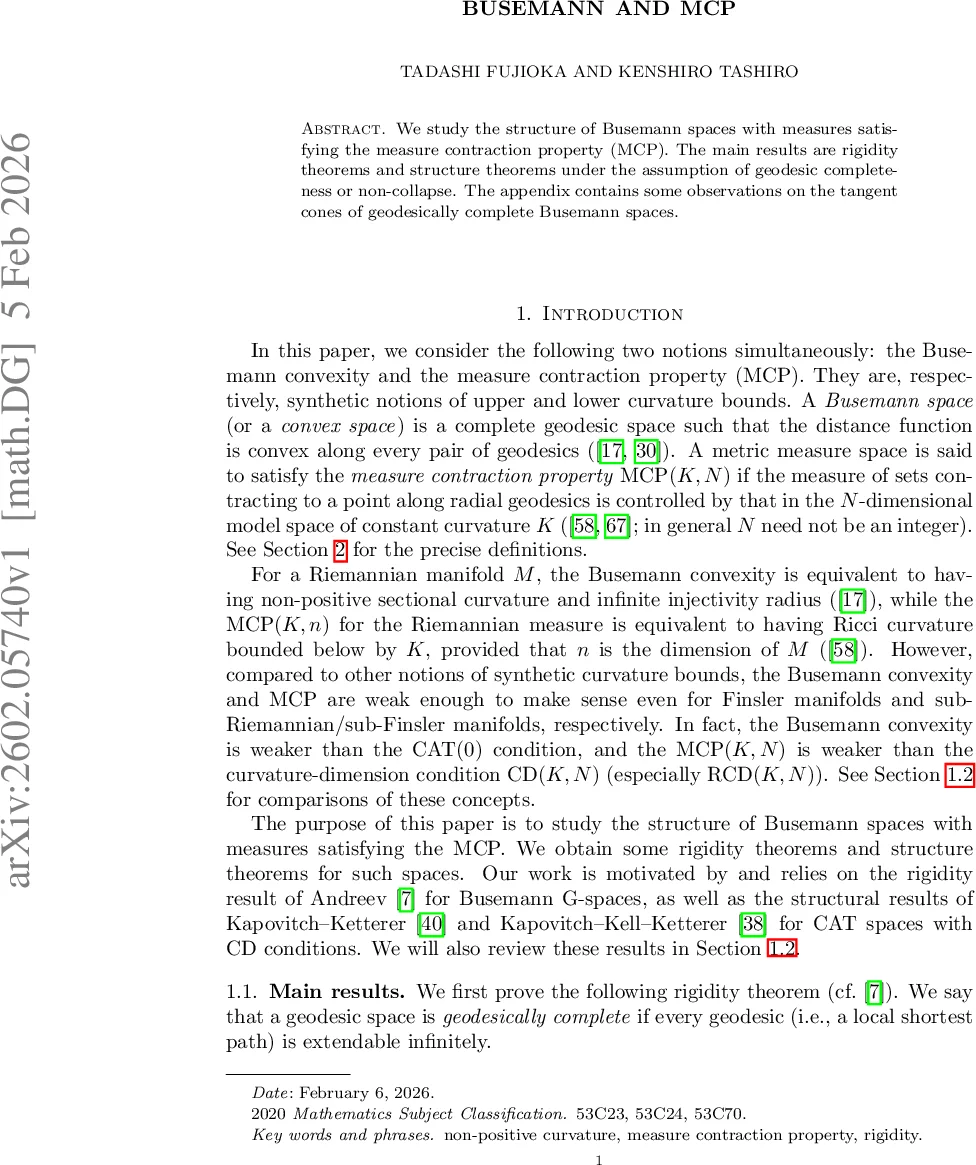
We study the structure of Busemann spaces with measures satisfying the measure contraction property (MCP). The main results are rigidity theorems and structure theorems under the assumption of geodesic completeness or non-collapse. The appendix contains some observations on the tangent cones of geodesically complete Busemann spaces.
💡 Research Summary
**
The paper investigates metric‑measure spaces that simultaneously satisfy two synthetic curvature conditions: Busemann convexity and the Measure Contraction Property (MCP). A Busemann space is a complete geodesic space whose distance function is convex along every pair of geodesics; this condition is weaker than the CAT(0) inequality and remains meaningful for Finsler, sub‑Riemannian and sub‑Finsler manifolds. MCP(K,N) controls how a reference measure contracts along radial geodesics toward a point, generalising a lower Ricci bound together with an upper dimension bound. While each condition alone has been extensively studied, their joint effect had not been clarified, especially in non‑Riemannian settings.
The authors obtain several rigidity and structure theorems. The first (Theorem 1.1) assumes geodesic completeness and MCP(0,N). Under these hypotheses the space X is isometric to a strictly convex Banach space of dimension n ≤ N. The proof relies on Andreev’s rigidity theorem for Busemann G‑spaces, together with two new lemmas: homogeneity of the reference measure and a parallel‑translation construction that yields Busemann concavity. This shows that non‑positive sectional curvature (Busemann) together with non‑negative Ricci curvature (MCP) forces flatness, but the flat model is a Banach rather than a Hilbert space because the setting allows Finsler‑type anisotropy.
When geodesic completeness is dropped, a non‑collapsing assumption (the MCP holds for the n‑dimensional Hausdorff measure) is imposed. Theorem 1.3 then states that n must be an integer and X is isometric to a closed convex subset of a strictly convex Banach space of dimension n. The non‑collapsing hypothesis is essential: small balls in the hyperbolic plane satisfy MCP(0,N) for any N > 2 but are not Banach‑type.
The central result (Theorem 1.5) treats locally Busemann spaces with local non‑collapsed MCP(K,n) for K ≤ 0. It proves that X is an n‑dimensional topological manifold with (possibly) non‑empty boundary; the interior is geodesically convex, carries the full reference measure, and coincides with the set of n‑regular points (points whose tangent cone is uniquely a strictly convex Banach space). The proof proceeds in several steps. First, using the recent structure theorem for non‑collapsed MCP spaces by Magnabosco–Mondino–Rossi, the authors obtain almost‑uniqueness of tangent cones and almost‑extendability of geodesics. This yields the existence of at least one manifold point. Then, a Banach‑cone argument (Lemma 5.3) shows that the set of manifold points is strongly convex, allowing a global manifold structure to be built. The non‑collapsing condition is only needed to guarantee the existence of a manifold point; if any manifold point is present, the conclusion holds without it (Corollary 5.11).
Theorem 1.7 refines the interior description: every interior point has a neighbourhood that is almost isometric (bi‑Lipschitz with constants arbitrarily close to 1) to an open subset of a strictly convex Banach space of dimension n. This “almost rigidity” is proved by adapting the local part of the argument for Theorem 1.3 to an “almost MCP(0,n)” setting, using a quantitative version of the exponential map and the continuity of tangent cones.
Throughout, the authors compare their results with the richer CAT(κ)+CD (or RCD) theory. In the CAT(0) case, stronger tools such as splitting theorems, local‑to‑global curvature propagation, and infinitesimal Hilbertianity are available, leading to Riemannian metrics on the regular set. By contrast, Busemann convexity does not guarantee a unique angle structure, and MCP lacks local‑to‑global stability, making the analysis more delicate. Nevertheless, by exploiting Andreev’s rigidity, the Banach‑cone structure of tangent spaces, and recent MCP regularity results, the paper succeeds in extending many structural conclusions to the broader, anisotropic setting.
The paper concludes with a list of open problems, notably whether the interior admits a genuine Finsler metric, whether the non‑collapsing hypothesis can be removed entirely, and how to develop a dimension theory for Busemann spaces analogous to Kleiner’s theory for CAT spaces. An appendix provides observations on tangent cones of geodesically complete Busemann spaces, which may be useful for future work.
In summary, this work establishes that the combination of Busemann convexity and MCP imposes strong flatness and manifold‑type structure, even in settings where classical synthetic curvature tools fail. It bridges a gap between lower‑section‑curvature and lower‑Ricci‑curvature synthetic theories, opening new avenues for the study of Finsler and sub‑Riemannian geometries under weak curvature bounds.
Comments & Academic Discussion
Loading comments...
Leave a Comment