Weak and strong averaging principle for 2D Boussinesq equations with non-Lipschitz Poisson jump noise
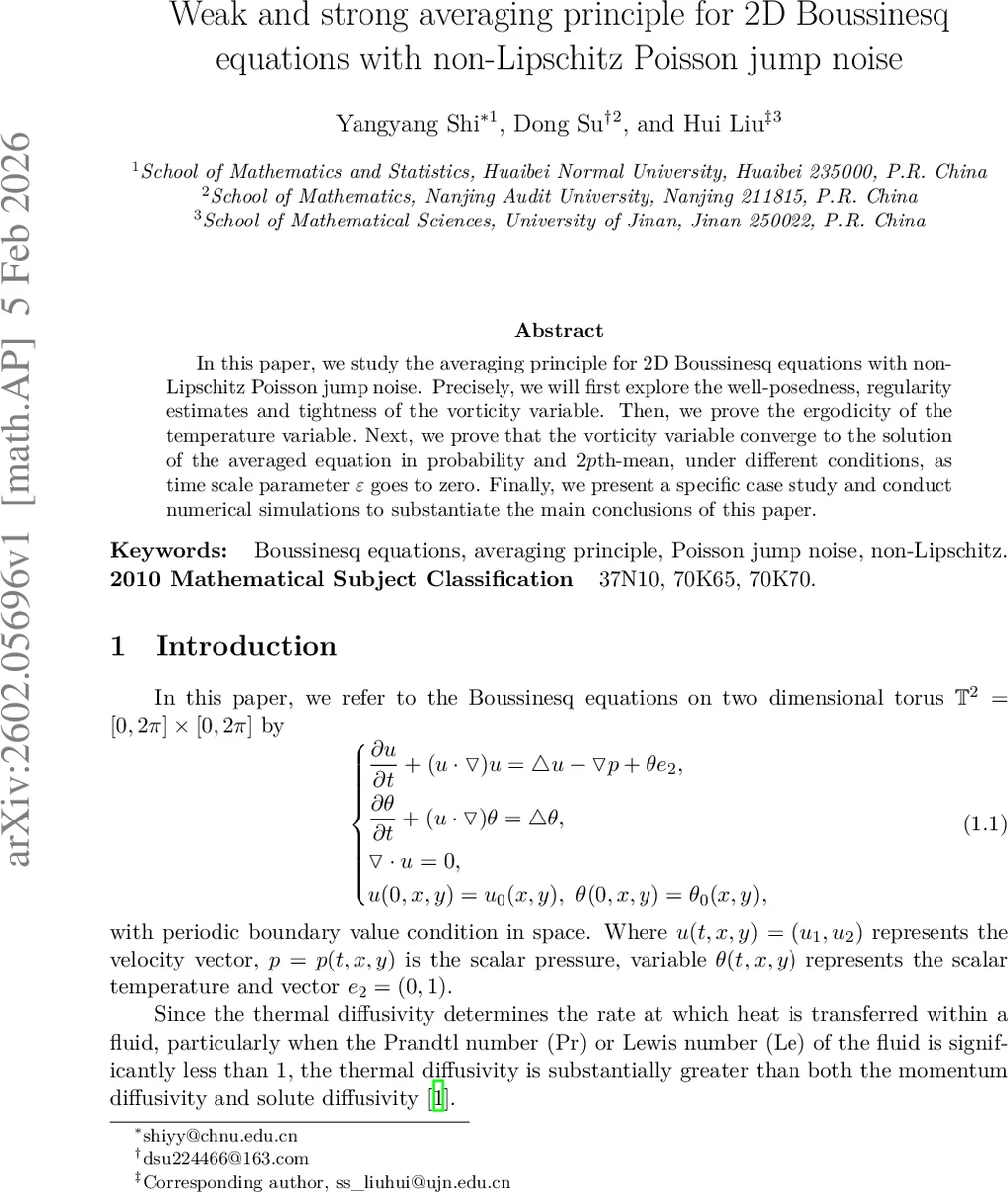
In this paper, we study the averaging principle for 2D Boussinesq equations with non-Lipschitz Poisson jump noise. Precisely, we will first explore the well-posedness, regularity estimates and tightness of the vorticity variable. Then, we prove the ergodicity of the temperature variable. Next, we prove that the vorticity variable converge to the solution of the averaged equation in probability and $2p$th-mean, under different conditions, as time scale parameter $\varepsilon$ goes to zero. Finally, we present a specific case study and conduct numerical simulations to substantiate the main conclusions of this paper.
💡 Research Summary
This paper investigates the averaging principle for a two‑scale stochastic Boussinesq system on the two‑dimensional torus, where the fast variable is the vorticity (or vorticity potential) and the slow variable is the temperature. The dynamics are driven by non‑Lipschitz Poisson jump noise, i.e., compensated Poisson random measures with intensity measures that may have infinite activity but are truncated to jumps of size less than one. The small parameter ε ≪ 1 represents the ratio of the fast time scale (vorticity) to the slow time scale (temperature).
The authors first formulate precise structural assumptions on the nonlinear drift f, the jump coefficients σ₁ and σ₂, and the noise intensity. These assumptions replace the usual Lipschitz condition by a “non‑Lipschitz” continuity expressed through a concave function κ(·) together with linear growth bounds. An additional spectral condition λₚ > 0 (Assumption 4) guarantees overall dissipativity of the system.
Under these hypotheses, the paper proves global well‑posedness of the coupled stochastic partial differential equations. Using a Galerkin approximation, Itô‑Lévy formula, and Burkholder‑Davis‑Gundy inequalities, the authors obtain uniform (in ε) moment bounds for both the vorticity and temperature in L²‑based Sobolev spaces. Specifically, for any p ≥ 1, the estimates (3.1) and (3.2) show that
E sup₀≤t≤T‖j^ε(t)‖{L²}^{2p} + E∫₀ᵀ‖j^ε(t)‖{L²}^{2(p‑1)}‖∇j^ε(t)‖{L²}² dt ≤ C_T(1+‖j₀‖{L²}^{2p}+‖θ₀‖_{L²}^{2p}),
and an analogous bound for θ^ε. These uniform estimates are the cornerstone for later tightness arguments.
The temperature equation, after freezing the fast variable (the “frozen” equation), is shown to be ergodic. The authors verify that the frozen dynamics generate a strong Feller, irreducible Markov semigroup with a unique invariant measure μ. This ergodicity is essential for defining the averaged coefficients that appear in the limit equation for the vorticity.
The main results are twofold:
-
Strong averaging principle – For any integer p ≥ 1, the vorticity satisfies
E sup₀≤t≤T‖j^ε(t)‑\bar{j}(t)‖_{L²}^{2p} ≤ C ε^{p},
where \bar{j} solves the deterministic averaged equation obtained by replacing the temperature-dependent terms with their μ‑averages. The proof relies on a careful decomposition of the error, Itô‑Lévy calculus, and the uniform moment bounds. -
Weak averaging principle – The family {j^ε}_ε is tight in the Skorokhod space D(
Comments & Academic Discussion
Loading comments...
Leave a Comment