Polynomial functors in π-clans for the semantics of type theory
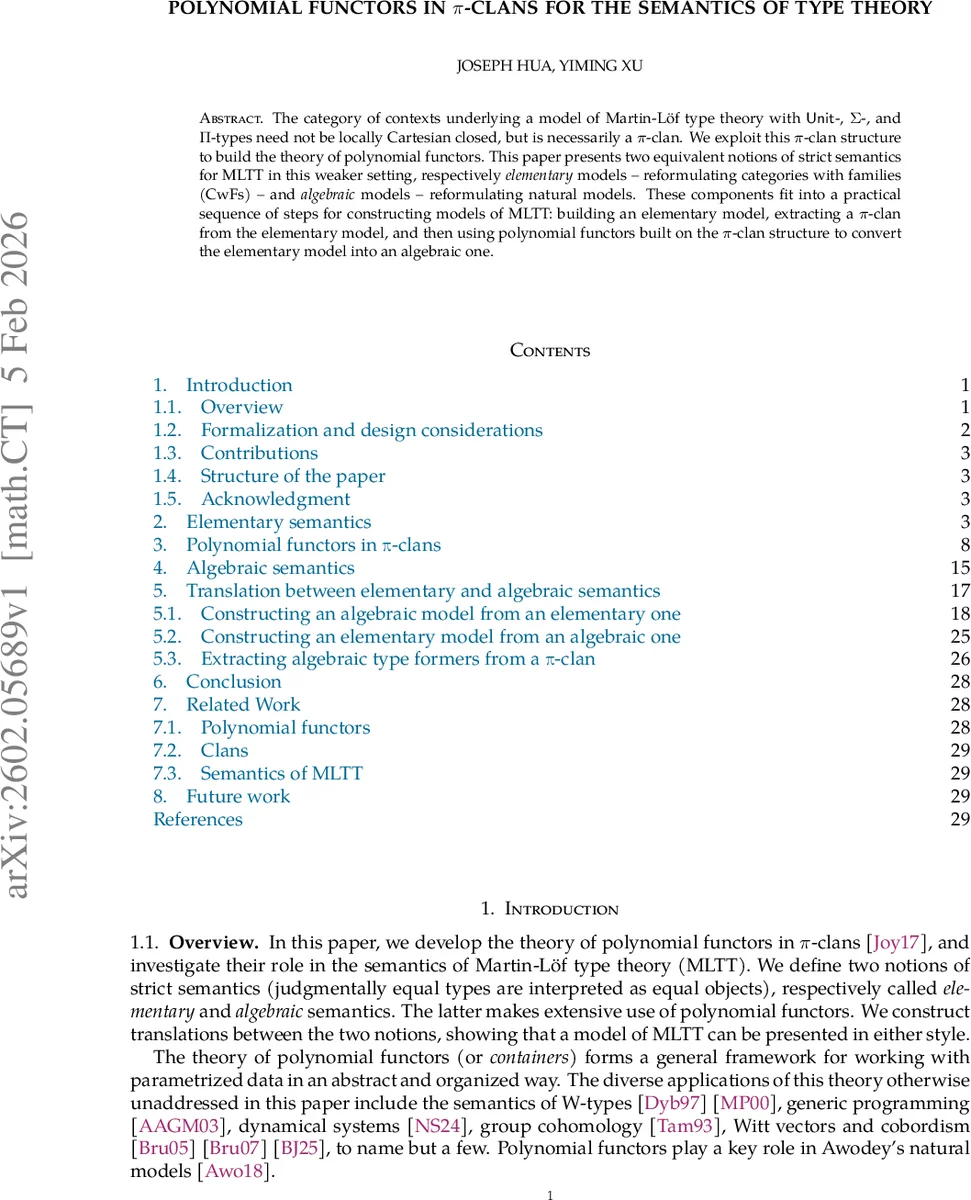
The category of contexts underlying a model of Martin-Löf type theory with Unit-, $Σ$-, and $Π$-types need not be locally Cartesian closed, but is necessarily a $π$-clan. We exploit this $π$-clan structure to build the theory of polynomial functors. This paper presents two equivalent notions of strict semantics for MLTT in this weaker setting, respectively “elementary models” - reformulating categories with families - and “algebraic models” - reformulating natural models. These components fit into a practical sequence of steps for constructing models of MLTT: building an elementary model, extracting a $π$-clan from the elementary model, and then using polynomial functors built on the $π$-clan structure to convert the elementary model into an algebraic one.
💡 Research Summary
The paper investigates the categorical foundations required for strict semantics of Martin‑Löf type theory (MLTT) equipped with the basic type formers Unit, Σ, and Π. While the context category of a model of MLTT is not necessarily locally Cartesian closed (LCC), the authors observe that it must at least form a π‑clan—a structure introduced by Taylor and later formalized by Joyal. A π‑clan is a category equipped with context extensions that are exponentiable relative to one another, a strictly weaker requirement than full LCC but sufficient for a weak interpretation of MLTT.
Building on this observation, the authors develop a theory of polynomial functors (also known as containers) in the setting of π‑clans. Classical polynomial functors are defined in LCC categories: a map f : E → B serves as a signature and induces a functor P_f : C → C. Weber generalized this to any category with pullbacks, requiring the signature maps to be exponentiable. The authors further specialize this to π‑clans, where only the context‑extension maps need to be exponentiable. This allows the construction of polynomial functors in categories such as Cat or Top, which are not LCC, and in particular in the context categories arising from the initial syntactic model of MLTT.
With polynomial functors in hand, the paper introduces two equivalent notions of strict semantics:
-
Elementary semantics (Section 2) – essentially a reformulation of Categories with Families (CwFs). A universe is given by a global morphism tp : Tm → Ty. Types are morphisms Γ → Ty, terms are morphisms Γ → Tm satisfying the appropriate typing equation. The elementary presentation supplies explicit rules for Unit, Π, Σ, and Id types, together with β‑η equalities and substitution stability. This approach does not require any polynomial‑functor machinery; it is a direct, syntax‑mirroring categorical semantics.
-
Algebraic semantics (Section 4) – a reformulation of natural models (also called Martin‑Löf algebras). Here each type former is expressed as a cartesian natural transformation between polynomial functors. For instance, a Π‑type corresponds to a pullback square relating the polynomial functors representing the domain and codomain families; Σ‑types correspond to pushout squares; Id‑types are encoded via a specific pullback that captures identity elimination. In this view, the existence of a type former reduces to a closure property of polynomial functors under the relevant categorical constructions.
The central technical contribution is the bidirectional translation between these two presentations (Section 5). Starting from an elementary model, one extracts a π‑clan by forgetting the universe morphism and retaining only the context‑extension structure. Using the polynomial‑functor theory on this π‑clan, one builds the natural transformations required for an algebraic model. Conversely, given an algebraic model, the pullback and pushout squares provide the data needed to reconstruct the CwF‑style operations (context extension, term formation, substitution) and thus recover an elementary model. The authors prove that these constructions are mutually inverse up to isomorphism, establishing the equivalence of the two strict semantics.
Beyond the core theory, the paper reports a formalization of all definitions and theorems in Lean 4 as part of the HoTTLean project. The formalization uses a notation where composition is written f » g (matching Lean’s arrow convention) and marks every formally verified statement with a special symbol linking to the repository. This mechanised development demonstrates that the proposed framework is not only mathematically sound but also amenable to computer‑checked verification.
The contributions can be summarised as follows:
- Development of polynomial functors in the minimal categorical setting of π‑clans, extending the usual LCC‑based theory.
- Application of this theory to give an algebraic presentation of the basic MLTT type formers, yielding a strict “algebraic model”.
- Definition of elementary semantics (CwF‑style) and a rigorous proof of equivalence with algebraic semantics via explicit translations.
- Full Lean formalisation, providing a certified basis for further developments such as higher inductive types, universe polymorphism, and more complex categorical models (e.g., groupoid or simplicial set models).
The authors also discuss related work on polynomial functors, clans, and MLTT semantics, emphasizing that their approach removes the need for full LCC while still supporting the essential type formers. In the “Future work” section they outline extensions to W‑types, higher‑dimensional identity types, and the integration of the framework with other categorical models of homotopy type theory.
In summary, the paper establishes a robust, minimal categorical infrastructure—π‑clans equipped with polynomial functors—sufficient for a strict semantics of MLTT, bridges the gap between CwF‑style and natural‑model‑style presentations, and validates the whole theory through a machine‑checked Lean development, opening the way for further exploration of type‑theoretic models in settings where LCC is unavailable.
Comments & Academic Discussion
Loading comments...
Leave a Comment