Vector bundles on Olsson fans
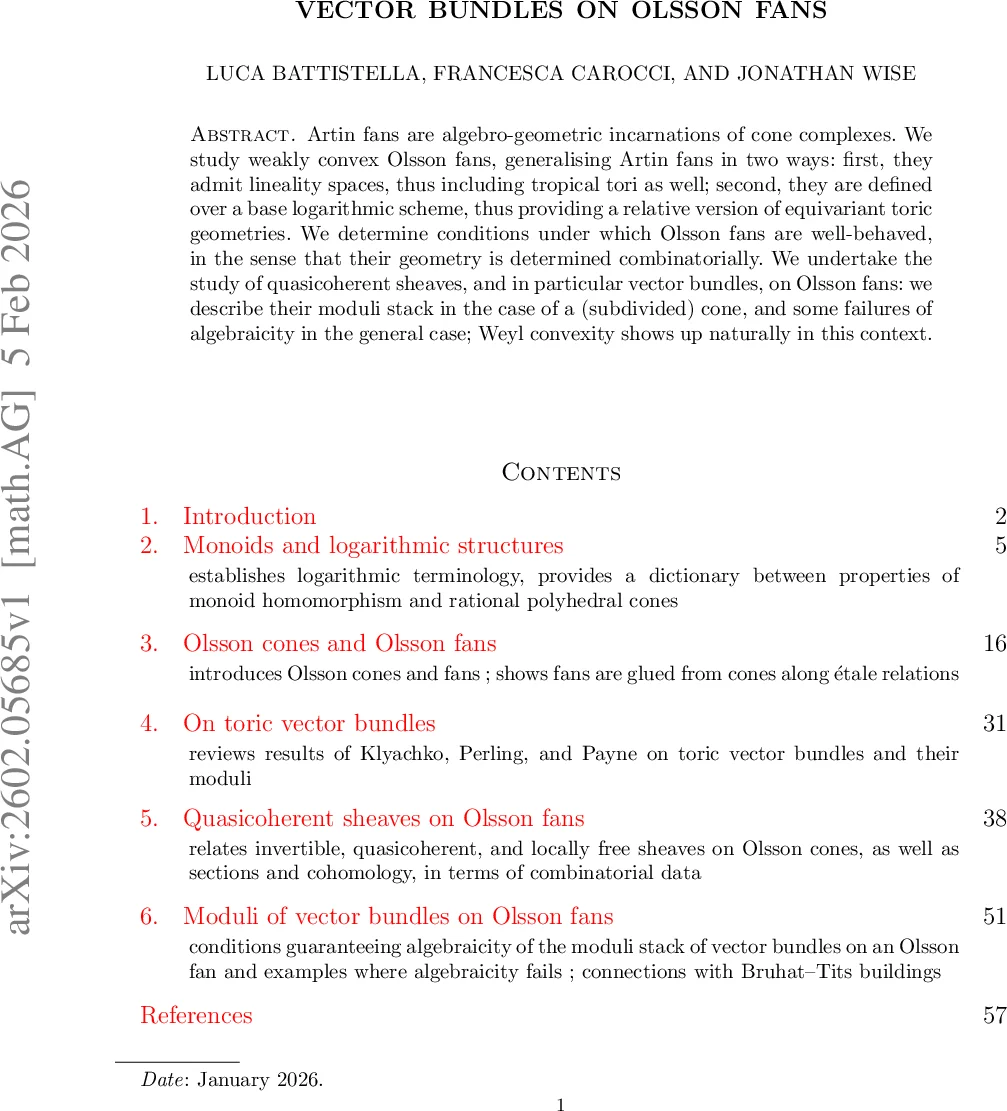
Artin fans are algebro-geometric incarnations of cone complexes. We study weakly convex Olsson fans, generalising Artin fans in two ways: first, they admit lineality spaces, thus including tropical tori as well; second, they are defined over a base logarithmic scheme, thus providing a relative version of equivariant toric geometries. We determine conditions under which Olsson fans are well-behaved, in the sense that their geometry is determined combinatorially. We undertake the study of quasicoherent sheaves, and in particular vector bundles, on Olsson fans: we describe their moduli stack in the case of a (subdivided) cone, and some failures of algebraicity in the general case; Weyl convexity shows up naturally in this context.
💡 Research Summary
The paper introduces “weakly convex Olsson fans,” a relative generalisation of Artin fans that incorporates lineality spaces (allowing tropical tori) and is defined over an arbitrary fine, saturated logarithmic base scheme S. The authors first establish that any Olsson fan admits a strict étale cover by Olsson cones (Theorem 3.21), i.e. the fan’s geometry is locally modelled by saturated extensions of the characteristic monoid of S. Consequently, higher étale cohomology of any abelian sheaf on an Olsson fan vanishes (Theorem 1.2), so cohomology can be computed via a Čech complex built from the cone charts.
The core technical contribution concerns the classification of invertible and locally free sheaves on weakly convex Olsson cones. Theorem 1.3 shows that any invertible sheaf on a cone σ is, étale‑locally on S, the pull‑back of an invertible sheaf on S twisted by a linear function λ on σ; λ is unique up to addition of constants. Theorem 1.4 proves that any locally free sheaf on σ becomes a direct sum of such invertible sheaves after a suitable strict étale base change. These results extend Klyachko’s description of equivariant vector bundles on affine toric varieties to the logarithmic setting.
When a cone σ carries an integral subdivision Σ, Corollary 1.5 shows that the fibered groupoid parametrising locally free sheaves on Σ is an algebraic stack. However, the authors demonstrate that for a general Olsson fan the stack of locally free sheaves need not be algebraic (Section 6). The failure is linked to the presence of non‑convex combinatorial data; the authors introduce the notion of Weyl convexity to capture a condition under which extensions of bundles are well‑behaved. Corollary 1.6 states that if σ sits inside a tropical torus T and τ denotes the Weyl convex hull of σ in T, then any locally free sheaf on σ extends uniquely (up to unique isomorphism) to τ.
The paper situates these results within a broader historical context: from Kato fans and Olsson’s stacks of logarithmic structures to modern applications such as logarithmic Gromov–Witten theory, Donaldson–Thomas theory, and the compactifications of thin Schubert cells. A motivating application is the theory of logarithmic linear series, which seeks to describe limits of linear series on nodal curves. In this setting, a limit linear series corresponds to a vector bundle on the Olsson fan Γ associated to the nodal curve, and the moduli problem for such bundles turns out to be non‑algebraic in general, prompting the need for additional restrictions (e.g., tautological bundles on Lafforgue’s compactifications).
Overall, the work provides a comprehensive combinatorial framework for studying quasicoherent sheaves on Olsson fans, establishes precise criteria for when the associated moduli stacks are algebraic, and highlights natural obstacles and new convexity conditions that arise in the relative logarithmic setting. This bridges toric vector bundle theory, logarithmic geometry, and moduli theory, and opens avenues for future research on logarithmic linear series and related moduli problems.
Comments & Academic Discussion
Loading comments...
Leave a Comment