The sharp Whitney extension theorem for convex $C^1$ Lipschitz functions
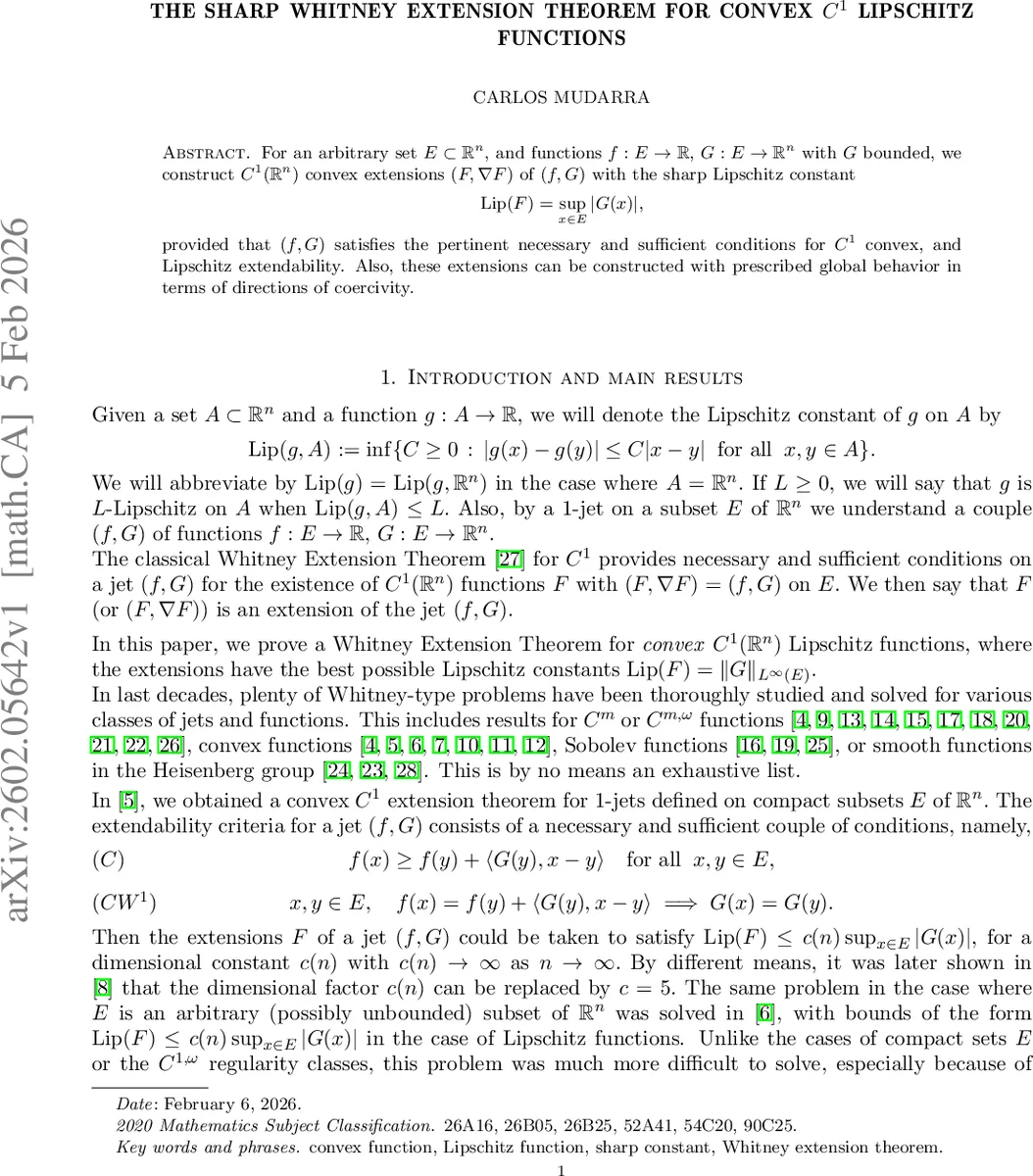
For an arbitrary set $E \subset \mathbb{R}^n$, and functions $f:E \to \mathbb{R}$, $G: E\to \mathbb{R}^n$ with $G$ bounded, we construct $C^1(\mathbb{R}^n)$ convex extensions $(F, \nabla F)$ of $(f,G)$ with the sharp Lipschitz constant $$ \mathrm{Lip}(F) = \sup_{x\in E} |G(x)|, $$ provided that $(f,G)$ satisfies the pertinent necessary and sufficient conditions for $C^1$ convex, and Lipschitz extendability. Also, these extensions can be constructed with prescribed global behavior in terms of directions of coercivity.
💡 Research Summary
The paper establishes a sharp Whitney‑type extension theorem for convex C¹ functions that are Lipschitz. Given an arbitrary subset E ⊂ ℝⁿ and a 1‑jet (f,G) defined on E with bounded G, the author identifies a set of necessary and sufficient conditions—denoted (C_b), (S_{Y,X}), (C_{Y,X}) and (CW₁_X)—under which there exists a convex C¹ extension F to the whole space such that (F,∇F) coincides with (f,G) on E, the Lipschitz constant of F satisfies
Lip(F) = sup_{x∈E}|G(x)|,
and the global coercivity direction of F is a prescribed linear subspace X (i.e., X_F = X).
The conditions are as follows. (C_b) requires G to be continuous and bounded and the convexity inequality f(x) ≥ f(y)+⟨G(y),x−y⟩ for all x,y∈E. (S_{Y,X}) defines Y = span{G(x)−G(y): x,y∈E} and demands Y⊂X. (C_{Y,X}) handles the case Y≠X by insisting that there exist finitely many points p₁,…,p_{d−k} outside E together with orthogonal directions w_j that generate cones V_j disjoint from E; this guarantees enough “room’’ to enlarge the jet so that the span of the new gradient differences equals X. (CW₁_X) is a “no‑corner‑at‑infinity’’ condition: for any sequences (x_j),(z_j) in E with bounded projections onto X, if the affine discrepancy f(x_j)−f(z_j)−⟨G(z_j),x_j−z_j⟩ tends to zero, then |G(x_j)−G(z_j)| must also tend to zero.
The proof proceeds in several stages. First, the minimal convex extension
m(x) = sup_{y∈E}{ f(y) + ⟨G(y), x−y⟩ }
is constructed. Using a new decomposition theorem (Theorem 2.2), any non‑affine convex Lipschitz function can be written as
m = c∘P_Y + ⟨v,·⟩,
where P_Y is the orthogonal projection onto Y, c is convex and coercive on Y, and the linear part satisfies |v| < L with L = sup_{E}|G|. This strict inequality is crucial; it is obtained by a careful analysis of the Euclidean norm’s strict convexity on ℝⁿ{0}.
Next, condition (C_{Y,X}) is employed to add the points q_j ∈ V_j to the domain, forming an enlarged jet (f*,G*) on E* = E ∪ {q_j}. The construction guarantees that span{G*(x)−G*(y)} = X and that (CW₁_X) still holds, while keeping |G*| ≤ L. The corresponding minimal convex extension m* for (f*,G*) remains L‑Lipschitz and admits a decomposition
m* = c_∘P_X + ⟨v_,·⟩
with |v_*| < L.
A smooth convex coercive function H : X → ℝ is then built so that (H,∇H) matches (c_,∇c_) on the projected set P_X(E*). Defining
F̃(x) = H(P_X x) + ⟨v_*, x⟩,
one obtains a C¹ convex function whose gradient coincides with G* on E*. Finally, the Lipschitz envelope
F(x) = inf_{y∈ℝⁿ}{ F̃(y) + L|x−y| }
is taken. Because m* ≤ F̃ ≤ F and m* is exactly L‑Lipschitz, the envelope does not increase the Lipschitz constant; consequently Lip(F) = L = sup_{E}|G|. Moreover, the envelope preserves the prescribed coercivity subspace, yielding X_F = X.
The paper also discusses why the trivial case of constant G is excluded (the extension is affine and the prescribed X may be forced to {0}), and it compares the result with earlier work where a dimension‑dependent factor c(n) appeared. The new theorem eliminates that factor entirely, providing a dimension‑free sharp bound.
Beyond the theoretical contribution, the result has practical implications for convex optimization, variational analysis, and any setting where one needs to extend gradient information from a scattered set while preserving convexity, differentiability, and optimal Lipschitz control. The ability to prescribe the global coercivity direction further enables the design of extensions with tailored growth behavior, useful in applications ranging from machine‑learning regularizers to physical potentials.
In summary, the author delivers a complete characterization of when a convex C¹ Lipschitz extension exists with the optimal Lipschitz constant, constructs such extensions explicitly, and shows how to control their asymptotic geometry. This resolves a long‑standing gap in the Whitney‑extension theory for convex functions and opens the door to sharper, dimension‑independent tools in analysis and applied mathematics.
Comments & Academic Discussion
Loading comments...
Leave a Comment