Large time existence in a thermoviscoelastic evolution problem with mildly temperature-dependent parameters
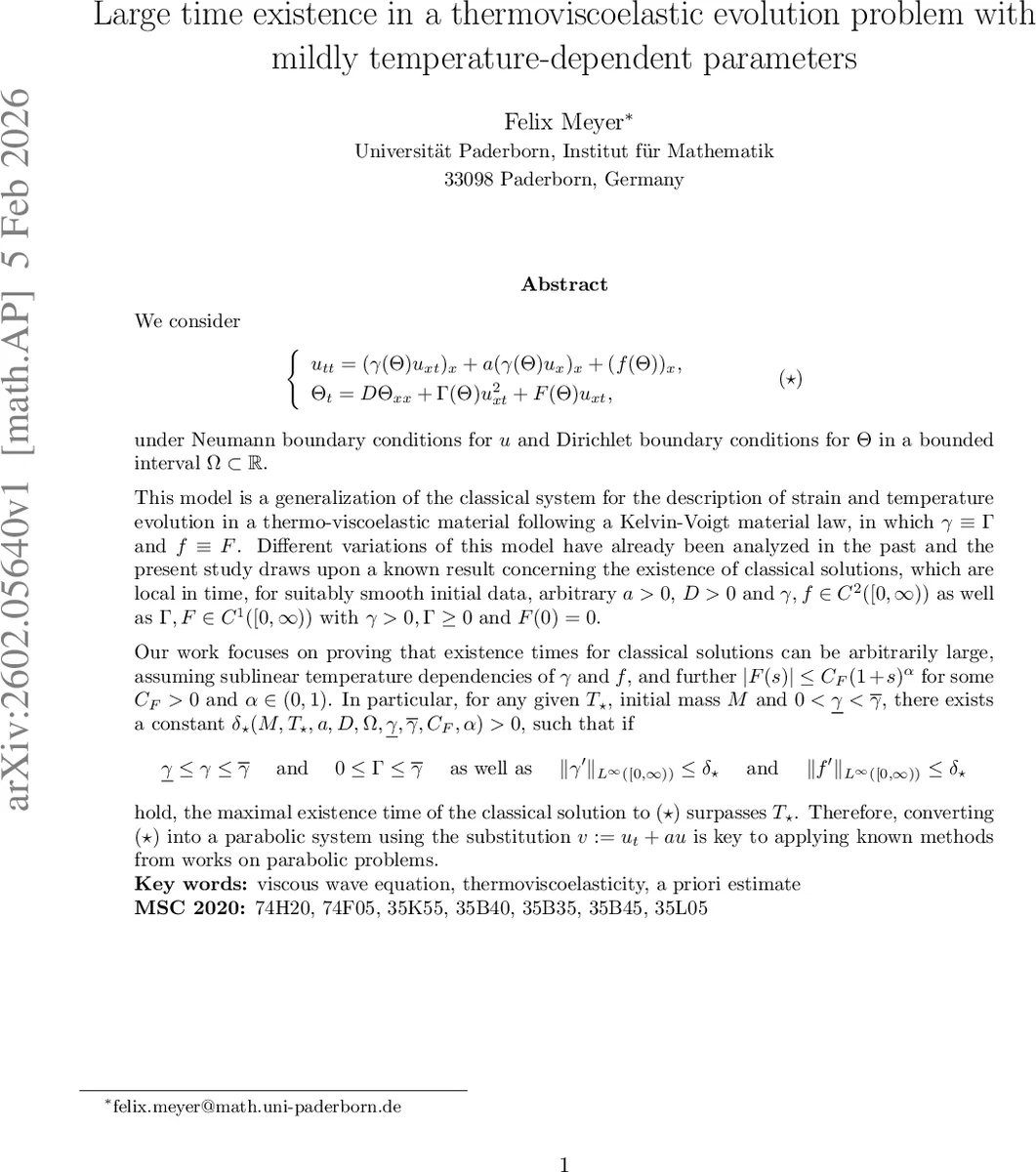
We consider \begin{align*} \label{HS} \left{ \begin{array}{l} u_{tt} = (γ(Θ) u_{xt})x + a (γ(Θ) u_x)x +(f(Θ))x, \[1mm] Θ_t = DΘ{xx} + Γ(Θ) u{xt}^2 + F(Θ) u{xt}, \end{array}\right. \qquad \qquad (\star) \end{align*} under Neumann boundary conditions for $u$ and Dirichlet boundary conditions for $Θ$ in a bounded interval $Ω\subset\mathbb{R}$. \abs This model is a generalization of the classical system for the description of strain and temperature evolution in a thermo-viscoelastic material following a Kelvin-Voigt material law, in which $γ\equiv Γ$ and $f\equiv F$. Different variations of this model have already been analyzed in the past and the present study draws upon a known result concerning the existence of classical solutions, which are local in time, for suitably smooth initial data, arbitrary $a>0$, $D>0$ and $γ,f\in C^2([0,\infty))$ as well as $Γ,F\in C^1([0,\infty))$ with $γ>0,Γ\ge0$ and $F(0)=0$. Our work focuses on proving that existence times for classical solutions can be arbitrarily large, assuming sublinear temperature dependencies of $γ$ and $f$, and further $|F(s)|\le C_F(1+s)^α$ for some $C_F>0$ and $α\in(0,1)$. In particular, for any given $T_\star$, initial mass $M$ and $0<\underlineγ<\overlineγ$, there exists a constant $δ_\star(M,T_\star,a,D, Ω, \underlineγ, \overlineγ,C_F,α)>0$, such that if $$\underlineγ\leγ\le \overlineγ\quad\mbox{ and }\quad 0\le Γ\le \overlineγ\quad \mbox{ as well as } \quad|γ’|{L^\infty([0,\infty))}\le δ\star \quad \mbox{ and }\quad |f’|{L^\infty([0,\infty))}\le δ\star $$ hold, the maximal existence time of the classical solution to $(\star)$ surpasses $T_\star$.
💡 Research Summary
The paper investigates a one‑dimensional thermo‑viscoelastic evolution system describing the coupling between mechanical displacement u and temperature Θ in a Kelvin‑Voigt material. The governing equations are
u_{tt} = (γ(Θ) u_{xt})_x + a (γ(Θ) u_x)_x + (f(Θ))_x,
Θ_t = D Θ_{xx} + Γ(Θ) u_{xt}² + F(Θ) u_{xt},
with Neumann boundary conditions for u and Dirichlet conditions for Θ on a bounded interval Ω⊂ℝ. Classical local‑in‑time existence for smooth data is known under fairly general regularity assumptions on the coefficients: γ,f∈C², Γ,F∈C¹, γ>0, Γ≥0, and F(0)=0. However, global (or arbitrarily long) existence has only been proved under restrictive hypotheses such as constant γ, small initial data, or strong growth control on the nonlinearities.
The authors aim to extend the existence time to any prescribed horizon T★ by imposing only mild temperature dependence on the material parameters. The key hypotheses are:
- γ and f are C² functions with uniformly bounded derivatives, and their derivatives are required to be sufficiently small: ‖γ′‖{L^∞}, ‖f′‖{L^∞} ≤ δ_★.
- γ is bounded away from zero and above: 0<\underlineγ ≤ γ(s) ≤ \overlineγ for all s≥0.
- Γ satisfies 0 ≤ Γ(s) ≤ \overlineγ, while the heat source term F fulfills a sub‑linear growth condition |F(s)| ≤ C_F (1+s)^α with 0<α<1.
- The initial data (u₀, u₀_t, Θ₀) are smooth (u₀∈C², u₀_t,Θ₀∈C^{1+μ}) and satisfy a mass bound ∫Ω (u₀²+|∇u₀|²+|∇u₀|⁴+Θ₀²) ≤ M.
The analysis proceeds through several steps:
-
Parabolic Reformulation – By introducing the auxiliary variable v := u_t + a u, the original second‑order hyperbolic‑parabolic system is rewritten as a coupled parabolic system (2.1). This transformation is crucial because it allows the use of well‑developed theory for quasilinear parabolic equations and facilitates energy estimates.
-
Energy Functional Construction – The authors define a composite energy functional
y(t) = 1 + (δ₁/2)∫Ω Θ_x² + (δ_β ρ)∫Ω |∇u|⁴ + ∫Ω v_x² + 4a²∫Ω u_x²,
where δ₁, δ_β, ρ are positive constants depending on a, D, and the bounds of γ. The functional captures the L²‑norm of the temperature gradient, the fourth‑power norm of the strain gradient, and the kinetic‑plus‑elastic energy of the mechanical part. -
Differential Inequalities – Lemmas 3.1–3.3 provide basic evolution inequalities for ∫Ω u_x², ∫Ω u_x⁴, ∫Ω v_x², and ∫Ω Θ_x². The terms involving γ′ and f′ appear only multiplied by δ_★, which can be made arbitrarily small. Consequently, the potentially destabilising cross‑terms (e.g., γ′(Θ)²/γ(Θ) v_x² Θ_x²) are controlled by the smallness of δ_★.
-
Control of Higher‑Order Terms – The energy inequality inevitably contains fourth‑order integrals such as ∫Ω v_x⁴ and ∫Ω Θ_x⁴. Using the Gagliardo‑Nirenberg interpolation inequality together with Young’s inequality, Lemma 3.4 shows that these terms can be bounded by a combination of diffusion terms (∫Ω v_{xx}², ∫Ω Θ_{xx}²) and a cubic term proportional to (∫Ω Θ² + ∫Ω v²)³, with a coefficient δ_κ that depends only on α. The sub‑linear growth of F (α<1) is essential here; it guarantees that the cubic term does not dominate for moderate values of the energy.
-
ODE Comparison Argument – Collecting all estimates yields a differential inequality of the form
y′(t) ≤ δ κ y(t)³ + C y(t),
where δ is essentially the bound on ‖γ′‖{∞} and ‖f′‖{∞}. For a given initial mass M, the initial energy y(0) is bounded by a constant depending on M. By choosing δ sufficiently small (i.e., δ ≤ δ_★(M,T★,a,D,Ω,\underlineγ,\overlineγ,C_F,α)), the cubic term remains negligible on the interval
Comments & Academic Discussion
Loading comments...
Leave a Comment