Global smooth solutions in a one-dimensional thermoviscoelastic model with temperature-dependent paramaters
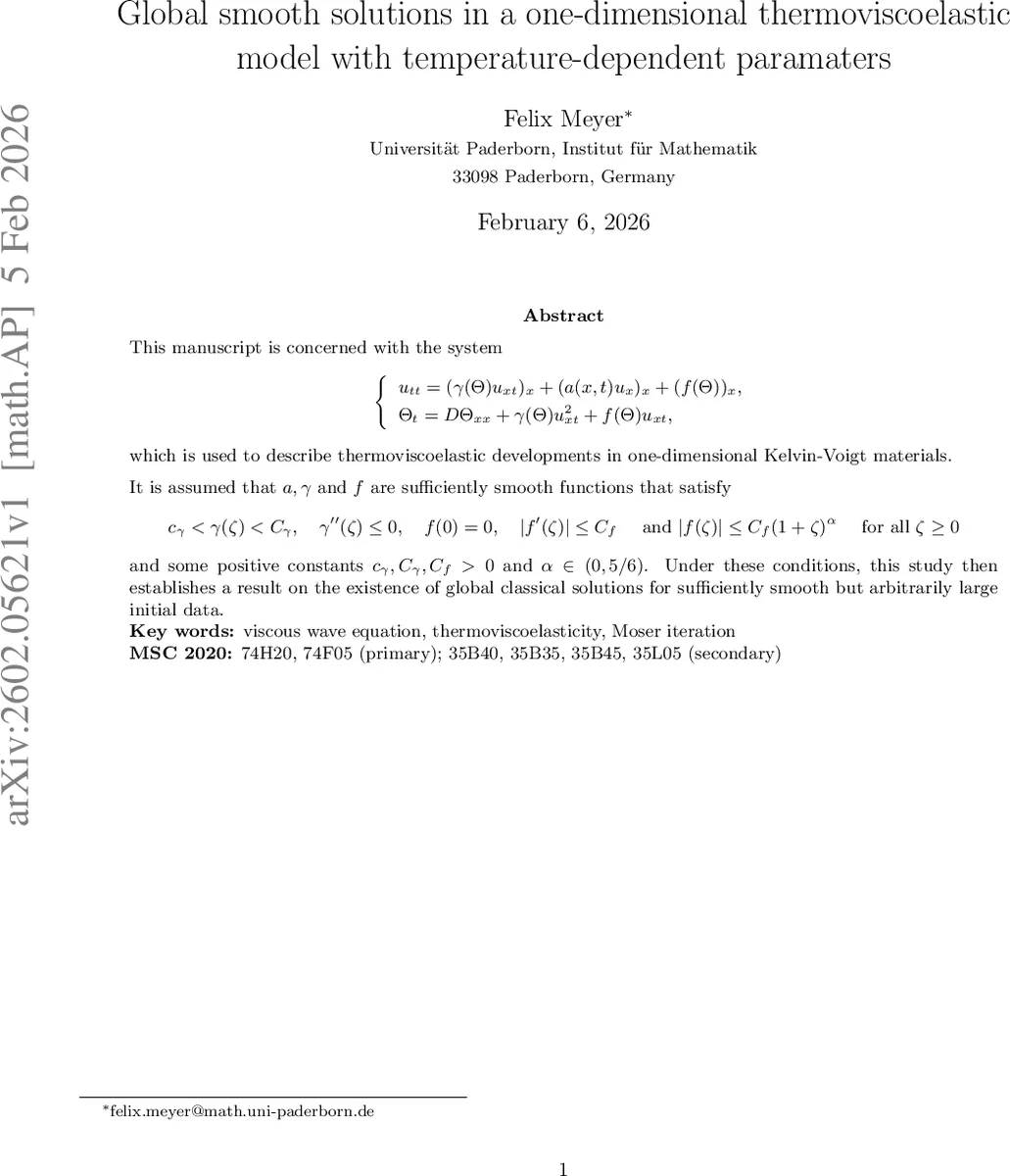
This manuscript is concerned with the system \begin{align*} \left{ \begin{array}{l} u_{tt} = (γ(Θ) u_{xt})x + (a(x,t) u_x)x +(f(Θ))x, \[1mm] Θ_t = DΘ{xx} + γ(Θ) u{xt}^2 + f(Θ) u{xt}, \end{array} \right. \end{align*} which is used to describe thermoviscoelastic developments in one-dimensional Kelvin-Voigt materials. \abs It is assumed that $a,γ$ and $f$ are sufficiently smooth functions that satisfy $$c_γ<γ(ζ)<C_γ, \quad γ’’(ζ) \le 0,\quad f(0)=0, \quad |f’(ζ)|\le C_f \quad \mbox{ and } |f(ζ)|\le C_f(1+ζ)^α\quad \mbox{ for all }ζ\ge 0 $$ and some positive constants $c_γ,C_γ,C_f>0$ and $α\in (0,5/6)$. Under these conditions, this study then establishes a result on the existence of global classical solutions for sufficiently smooth but arbitrarily large initial data.
💡 Research Summary
The paper investigates a one‑dimensional thermoviscoelastic system of Kelvin‑Voigt type in which both the viscosity coefficient γ and the heat source term f depend on the temperature Θ. The governing equations are
u_tt = (γ(Θ) u_xt)_x + (a(x,t) u_x)_x + (f(Θ))_x,
Θ_t = D Θ_xx + γ(Θ) u_xt² + f(Θ) u_xt,
with homogeneous Neumann boundary conditions and smooth initial data. The authors assume that a(x,t) is a positive C² function, γ∈C²(
Comments & Academic Discussion
Loading comments...
Leave a Comment