Numerical Evaluation of Angle-Dependent IR-Transparent Radiative Cooling Performance for Asymmetric Periodic Structures
Infrared (IR)-transparent passive radiative cooling (PRC) enables non-contact thermal management by regulating radiative heat exchange without direct attachment to the cooling object. While asymmetric IR transmission at a specific incidence angle – typically normal incidence – is often emphasized, we show that such single-angle asymmetry is neither sufficient nor predictive of practical cooling performance. In this work, we demonstrate that effective non-contact PRC requires angularly distributed asymmetric IR transparency evaluated through hemispherical integration over emission directions, rather than asymmetry at a single incidence angle. To quantify this effect, an angle-resolved full-wave electromagnetic (EM) model with Bloch periodic boundary conditions and Floquet mode decomposition is employed to compute wavelength- and angle-dependent bidirectional reflection and transmission of periodic PRC structures. The resulting EM response is coupled to an energy-balance-based thermal model to predict the transient temperature evolution of the cooling object. By comparing models that account for the full angular distribution with normal-incidence-only approximations, we show that pronounced asymmetric transmission at normal incidence is generally not preserved at oblique angles. As a result, angular integration yields only marginal cooling or may even result in net heating, whereas normal-incidence-based models can substantially overestimate cooling performance. These results establish angularly distributed asymmetric transparency as a key EM design principle for IR-transparent PRC and wide-angle asymmetric metasurfaces.
💡 Research Summary
The paper investigates the practical cooling capability of infrared‑transparent passive radiative cooling (PRC) structures that rely on asymmetric transmission of thermal radiation. While many recent metasurface designs report strong asymmetric transmission at normal incidence—high transmission from the object to the sky (OTS) and low transmission from the sky to the object (STO)—the authors argue that such single‑angle metrics are insufficient for predicting real‑world performance because thermal radiation is emitted over a whole hemisphere.
To address this, the authors develop an angle‑resolved full‑wave electromagnetic (EM) solver based on discrete exterior calculus (DEC) with Bloch periodic boundary conditions. The unit cell is a 2‑D periodic triangular geometry previously used as a benchmark. By imposing a phase shift on the lateral boundaries, the solver efficiently computes the scattered fields for any incidence angle using a single periodic cell. The fields are expanded in Whitney forms, and Floquet mode decomposition yields angle‑ and wavelength‑dependent reflection (R) and transmission (T) coefficients for both STO and OTS directions. Validation against a conventional finite‑difference time‑domain (FDTD) code shows excellent agreement for normal‑incidence spectra, confirming the accuracy of the DEC implementation.
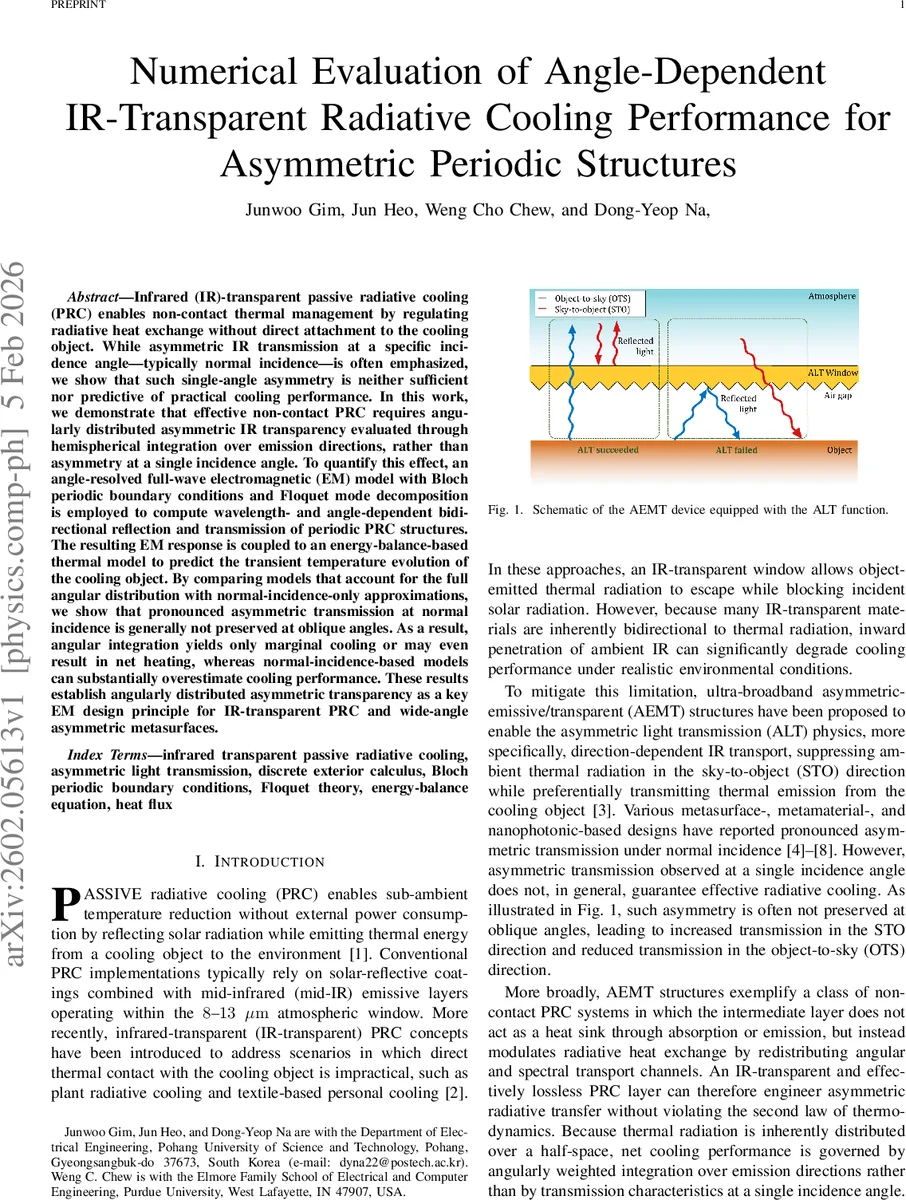
The EM results reveal that the pronounced asymmetry observed at θ≈0° rapidly degrades as the incidence angle increases. Beyond roughly 10°, STO transmission rises sharply while OTS transmission falls, effectively reversing the intended directionality over a broad angular range. This angular deterioration is visualized in wavelength‑angle maps for R and T, demonstrating that the metasurface’s asymmetric response is confined to a narrow cone around the normal.
The authors then couple these EM data to an energy‑balance thermal model. Radiative power exchange is expressed as a hemispherical integral weighted by cosθ, with a spectral‑angular weighting factor q(λ,θ) that equals the direction‑dependent transmittance τ(λ,θ) obtained from the EM simulations. The net heat flux into the object is
P_net(T) = P_in(T_amb; τ_STO) – P_out(T; τ_OTS) – h_c (T – T_amb),
where h_c represents effective convective and conductive heat transfer to the surrounding air, and C is the lumped heat capacity of the object. The transient temperature evolution follows C dT/dt = P_net(T), and the steady‑state temperature T_∞ is obtained by numerical integration.
Two modeling scenarios are compared:
- Case A (normal‑incidence approximation): τ(λ,θ) is replaced by τ(λ,0) for all angles.
- Case B (full angular integration): the complete τ(λ,θ) from the EM solver is used.
In Case A, the thermal model predicts substantial cooling (T_∞ < T_amb) across a wide range of h_c values, suggesting that the metasurface would be effective if only normal‑incidence data were considered. In contrast, Case B yields T_∞ ≥ T_amb for almost all h_c, indicating that the angular loss of asymmetry eliminates any net cooling and can even cause heating. As h_c increases, both cases converge toward ambient temperature because non‑radiative heat exchange dominates, but the gap between the two cases remains significant at low h_c where radiative effects are most important.
The study therefore demonstrates that relying on normal‑incidence measurements dramatically overestimates the cooling performance of asymmetric IR‑transparent metasurfaces. Effective non‑contact PRC requires that the asymmetric transmission be maintained over the entire angular spectrum of thermal emission. Consequently, the authors propose “angularly distributed asymmetric transparency” as a fundamental design principle for future wide‑angle metasurfaces intended for radiative cooling, wearable thermal management, and other applications where direct contact with the cooled object is impractical.
In summary, the paper provides (1) a rigorous EM simulation framework capable of delivering angle‑resolved optical responses of periodic structures, (2) a thermodynamic model that correctly integrates these responses over the hemispherical emission of a blackbody, and (3) clear evidence that only metasurfaces engineered for broadband, wide‑angle asymmetry can deliver genuine passive cooling in realistic environments. This insight reshapes the design strategy for IR‑transparent radiative coolers and highlights the necessity of combined electromagnetic‑thermal co‑optimization.
Comments & Academic Discussion
Loading comments...
Leave a Comment