Long-time asymptotics for Airy wanderer line ensembles
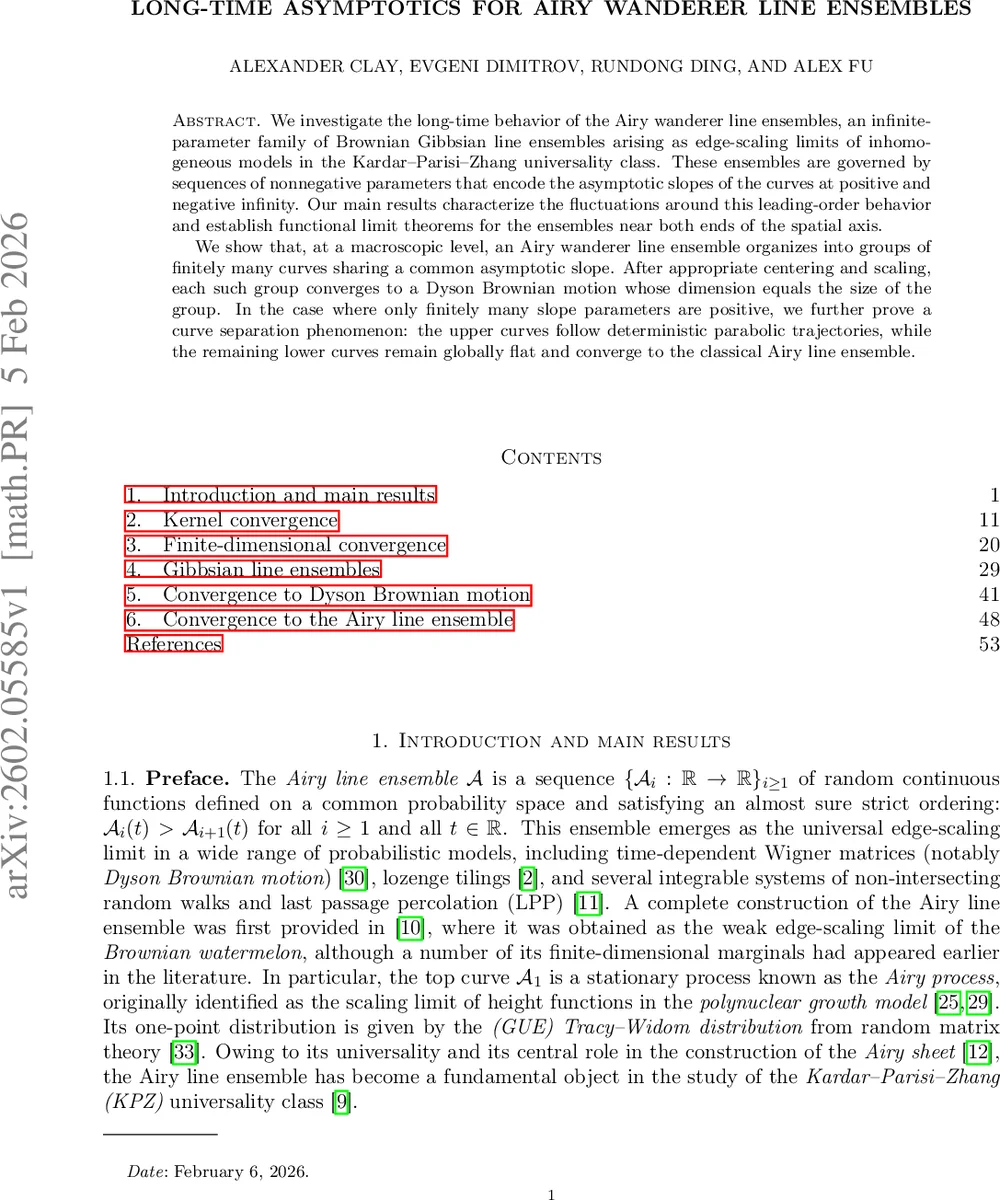
We investigate the long-time behavior of the Airy wanderer line ensembles, an infinite-parameter family of Brownian Gibbsian line ensembles arising as edge-scaling limits of inhomogeneous models in the Kardar–Parisi–Zhang universality class. These ensembles are governed by sequences of nonnegative parameters that encode the asymptotic slopes of the curves at positive and negative infinity. Our main results characterize the fluctuations around this leading-order behavior and establish functional limit theorems for the ensembles near both ends of the spatial axis. We show that, at a macroscopic level, an Airy wanderer line ensemble organizes into groups of finitely many curves sharing a common asymptotic slope. After appropriate centering and scaling, each such group converges to a Dyson Brownian motion whose dimension equals the size of the group. In the case where only finitely many slope parameters are positive, we further prove a curve separation phenomenon: the upper curves follow deterministic parabolic trajectories, while the remaining lower curves remain globally flat and converge to the classical Airy line ensemble.
💡 Research Summary
The paper studies the long‑time behavior of the Airy wanderer line ensembles (AWE), an infinite‑parameter family of Brownian‑Gibbs line ensembles that arise as edge‑scaling limits of inhomogeneous models in the KPZ universality class. An AWE is specified by two non‑increasing sequences of non‑negative numbers ({a_i}{i\ge1}) and ({b_i}{i\ge1}) together with a real shift (c). The sequences encode the asymptotic slopes of the curves as the spatial variable (t) tends to (+\infty) (via the (a)-parameters) and to (-\infty) (via the (b)-parameters). The authors first reorganize the parameters into distinct positive values (v_a^1>v_a^2>\dots) with multiplicities (m_a^1,m_a^2,\dots) (and similarly (v_b^k,m_b^k)). Curves sharing the same asymptotic slope form a “group’’; the (k)-th group contains (m_a^k) curves (or (m_b^k) curves on the left side).
The main contributions are two families of functional limit theorems.
-
Convergence to Dyson Brownian Motion (Theorem 1.14).
For each group, after centering by the deterministic parabola (t^2) and the linear term (-2t/v_a^k) (or (-2t/v_b^k) on the left) and scaling space by (t^{1/3}), the finite‑dimensional distributions converge to those of an (m_a^k)‑dimensional (or (m_b^k)‑dimensional) Dyson Brownian motion started from the origin. In other words, the Airy wanderer ensemble decomposes into independent Dyson Brownian motions, each corresponding to a distinct asymptotic slope. The proof proceeds by (i) showing pointwise convergence of the determinantal kernel (K_{a,b,c}) to the transition kernel of Dyson Brownian motion, (ii) establishing finite‑dimensional convergence via the determinantal structure, and (iii) using the Brownian Gibbs property to obtain tightness of the whole line ensemble. The analysis exploits the explicit contour integral representation of the kernel, the meromorphic function (\Phi_{a,b,c}), and the fact that the kernel’s dependence on (t) separates after the scaling. -
Curve‑Separation Phenomenon (Theorem 1.16).
When only finitely many of the (a_i) (or (b_i)) are positive, say (J_a) (resp. (J_b)), the top (J_a) curves on the right side (resp. top (J_b) on the left) follow deterministic parabolic trajectories determined by the corresponding slopes, while all lower curves stay globally flat. After removing the deterministic part, the lower curves converge to the classical Airy line ensemble. This “separation’’ is proved by combining the Dyson‑Brownian‑motion limit for the top groups with monotone couplings (Proposition 1.10) that order ensembles with larger parameters above those with smaller ones, and by invoking the Brownian Gibbs resampling to control the interaction between the separated layers.
The paper also collects several structural properties of AWE proved in earlier work: translation invariance, reflection symmetry (swap of (a) and (b)), continuity in the parameters, monotonicity under parameter increase, and extremality in the space of Brownian‑Gibbs ensembles. These are used repeatedly to reduce general parameter choices to a canonical “positive’’ class (P_{\text{pos}}) and to transfer results across different parameter regimes.
Technical challenges stem from the infinite‑parameter nature of the model, which makes the kernel highly intricate. The authors handle this by carefully choosing contour deformations for the integrals defining (K_{a,b,c}) and by establishing uniform bounds that survive the scaling limit. They also treat the delicate case of curves whose slope parameter is zero, proving tightness separately for those curves.
Overall, the work provides a comprehensive description of the macroscopic organization of Airy wanderer ensembles: groups of curves with the same asymptotic slope behave like independent Dyson Brownian motions, while groups with zero slope merge into the classical Airy line ensemble. The results give a universal picture for a broad class of inhomogeneous KPZ models, including geometric and exponential last‑passage percolation with spatially varying rates, spiked random matrix ensembles, and directed polymers with non‑uniform initial data. The methods combine determinantal point‑process techniques, Brownian Gibbs resampling, and monotone couplings, and they are expected to be adaptable to other integrable and non‑integrable models within the KPZ class.
Comments & Academic Discussion
Loading comments...
Leave a Comment