Uncovering Residual Factors in Financial Time Series via PCA and MTP2-constrained Gaussian Graphical Models
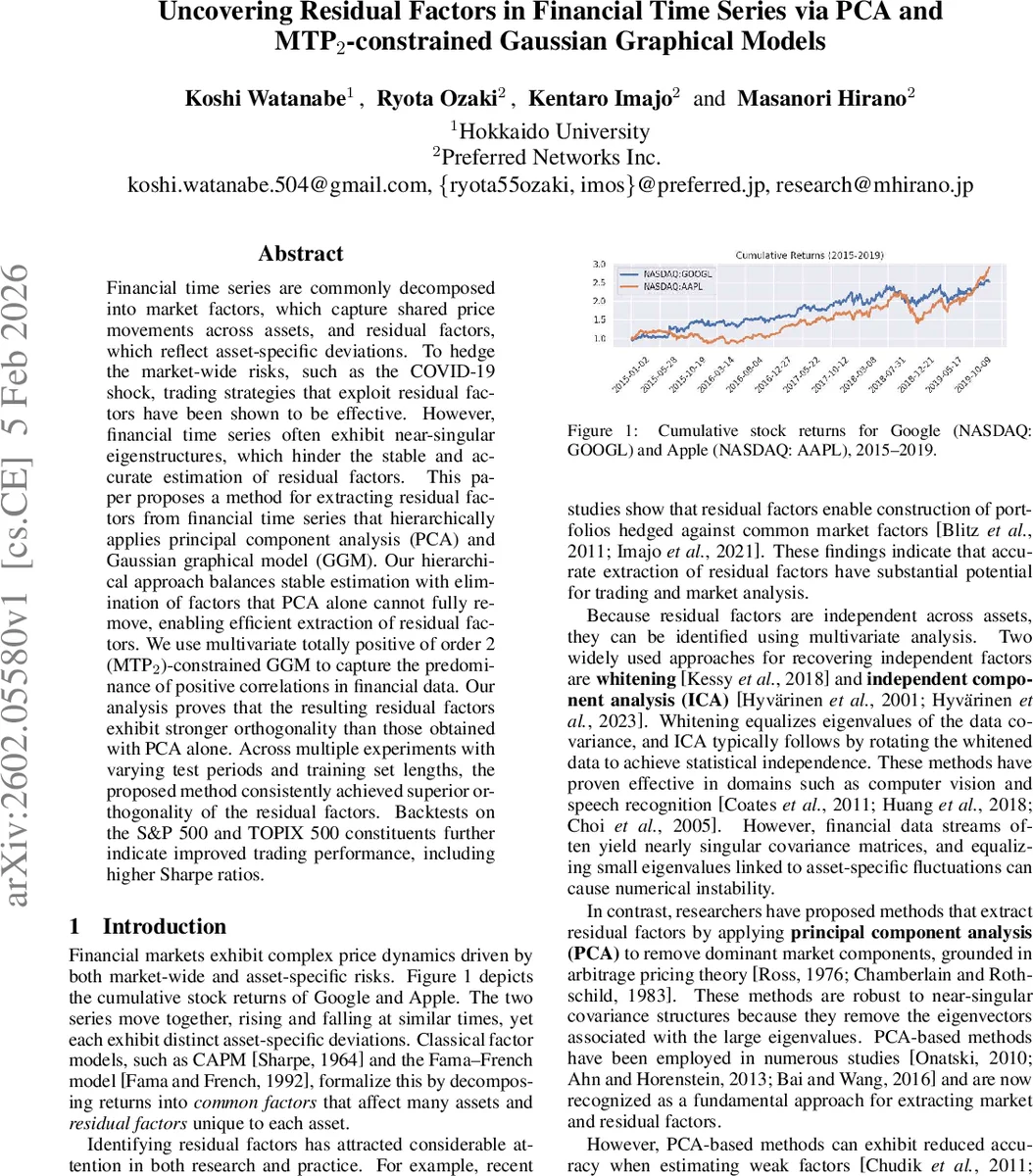
Financial time series are commonly decomposed into market factors, which capture shared price movements across assets, and residual factors, which reflect asset-specific deviations. To hedge the market-wide risks, such as the COVID-19 shock, trading strategies that exploit residual factors have been shown to be effective. However, financial time series often exhibit near-singular eigenstructures, which hinder the stable and accurate estimation of residual factors. This paper proposes a method for extracting residual factors from financial time series that hierarchically applies principal component analysis (PCA) and Gaussian graphical model (GGM). Our hierarchical approach balances stable estimation with elimination of factors that PCA alone cannot fully remove, enabling efficient extraction of residual factors. We use multivariate totally positive of order 2 (MTP2)-constrained GGM to capture the predominance of positive correlations in financial data. Our analysis proves that the resulting residual factors exhibit stronger orthogonality than those obtained with PCA alone. Across multiple experiments with varying test periods and training set lengths, the proposed method consistently achieved superior orthogonality of the residual factors. Backtests on the S&P 500 and TOPIX 500 constituents further indicate improved trading performance, including higher Sharpe ratios.
💡 Research Summary
The paper introduces a two‑stage hierarchical method for extracting residual factors from financial return series. First, principal component analysis (PCA) removes the dominant market‑wide components, selecting the number of factors via standard information criteria (Bai‑Ng, Onatski, Ahn‑Horenstein, etc.). While PCA is numerically stable even when the covariance matrix is near‑singular, it cannot fully eliminate weaker, sector‑level correlations. To address this gap, the authors apply a Gaussian graphical model (GGM) to the PCA‑filtered residual matrix Z, imposing a multivariate total positivity of order 2 (MTP₂) constraint on the precision matrix Λ. This constraint forces Λ to be an M‑matrix (positive semidefinite with non‑positive off‑diagonal entries), guaranteeing that all partial correlations are non‑negative—a property empirically observed in equity markets where assets within the same industry tend to move together.
Optimization proceeds by maximizing the penalized log‑likelihood log|Λ| − tr(Λ Z H Zᵀ) using projected gradient ascent. After each gradient step, Λ is projected onto the feasible M‑matrix set via Dykstra’s algorithm, which alternates projections onto the cone of positive semidefinite matrices and the set of matrices with non‑positive off‑diagonal entries. Closed‑form expressions for both projections are provided, ensuring computational tractability. Once the optimal Λ is obtained, the conditional expectation E
Comments & Academic Discussion
Loading comments...
Leave a Comment