Hidden simplicity in AdS spinning Mellin amplitudes via scaffolding
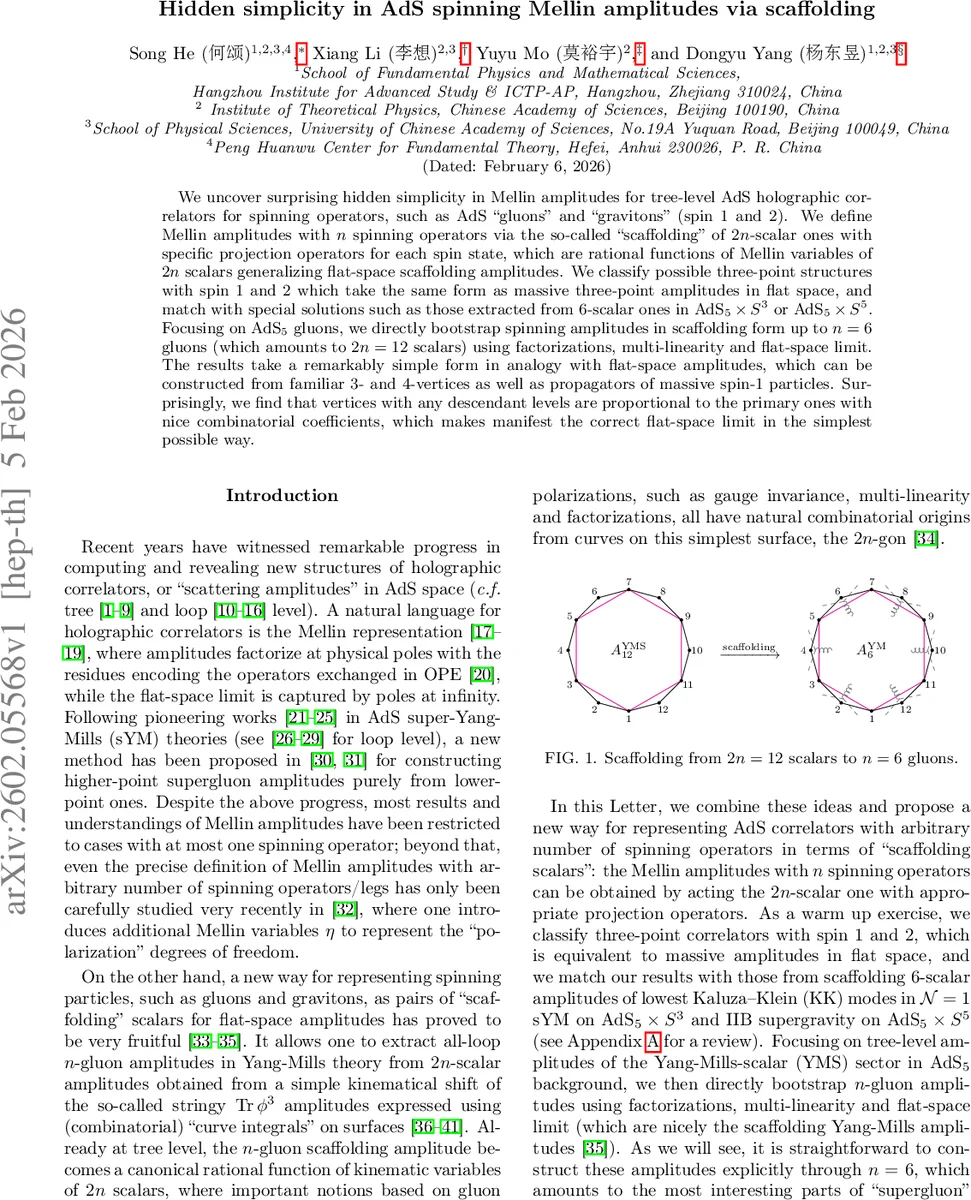
We uncover surprising hidden simplicity in Mellin amplitudes for tree-level AdS holographic correlators for spinning operators, such as AdS “gluons” and “gravitons” (spin 1 and 2). We define Mellin amplitudes with $n$ spinning operators via the so-called “scaffolding” of $2n$-scalar ones with specific projection operators for each spin state, which are rational functions of Mellin variables of $2n$ scalars generalizing flat-space scaffolding amplitudes. We classify possible three-point structures with spin 1 and 2 which take the same form as massive three-point amplitudes in flat space, and match with special solutions such as those extracted from 6-scalar ones in $\mathrm{AdS}_5\times S^3$ or $\mathrm{AdS}_5\times S^5$. Focusing on $\mathrm{AdS}_5$ gluons, we directly bootstrap spinning amplitudes in scaffolding form up to $n=6$ gluons (which amounts to $2n=12$ scalars) using factorizations, multi-linearity and flat-space limit. The results take a remarkably simple form in analogy with flat-space amplitudes, which can be constructed from familiar 3- and 4-vertices as well as propagators of massive spin-1 particles. Surprisingly, we find that vertices with any descendant levels are proportional to the primary ones with nice combinatorial coefficients, which makes manifest the correct flat-space limit in the simplest possible way.
💡 Research Summary
The paper presents a new systematic construction of tree‑level AdS holographic correlators involving arbitrary numbers of spinning operators (spin‑1 “gluons” and spin‑2 “gravitons”) by exploiting a “scaffolding” procedure that lifts scalar Mellin amplitudes to spinning ones. The authors start from the well‑understood Mellin representation of 2 n scalar correlators, introduce 2 n planar variables X_{i,j} (the analogue of the associahedron coordinates) and define auxiliary momenta p_i that satisfy P_i·p_i=0 and p_i²=−τ_i. For each pair of scalars (p_{2i‑1}, p_{2i}) they form a formal momentum k_i = p_{2i‑1}+p_{2i} and a formal polarization e_i = (1−α)p_{2i}−αp_{2i‑1} with α=½. This reproduces the familiar flat‑space kinematic data in the large‑β limit where X → βX.
Spinning Mellin amplitudes A(s₁,…,s_n)n are then defined by acting on the scalar Mellin amplitude M{2n}(δ_{ij}) with spin‑projectors P(s_i)i that extract the desired power of the formal polarization on each external leg, and by taking residues at X{2i‑1,2i+1}=0 for all i. The projectors are built from the basic operator P(e)_i = e_i·∂/∂e_i; for spin‑2 they become quadratic polynomials in P(e)_i (see Table I). This construction automatically incorporates all descendant contributions (derivatives with respect to the Mellin variables) required by AdS bulk interactions.
The authors first classify all possible three‑point structures with spins (1,1,1) and (2,2,2). Imposing (i) multi‑linearity (the amplitude is invariant under the action of the projectors) and (ii) the flat‑space limit (β→∞ reproduces massive Yang‑Mills or massive gravity amplitudes) uniquely fixes the three‑point forms up to an overall constant and, for the graviton case, a theory‑dependent λ. The resulting expressions are A(1,1,1)3 = 2∑{cyc} (e_i·e_j)(e_k·k_i) and A(2,2,2)_3 = 4
Comments & Academic Discussion
Loading comments...
Leave a Comment