On Path-based Marginal Cost of Heterogeneous Traffic Flow for General Networks
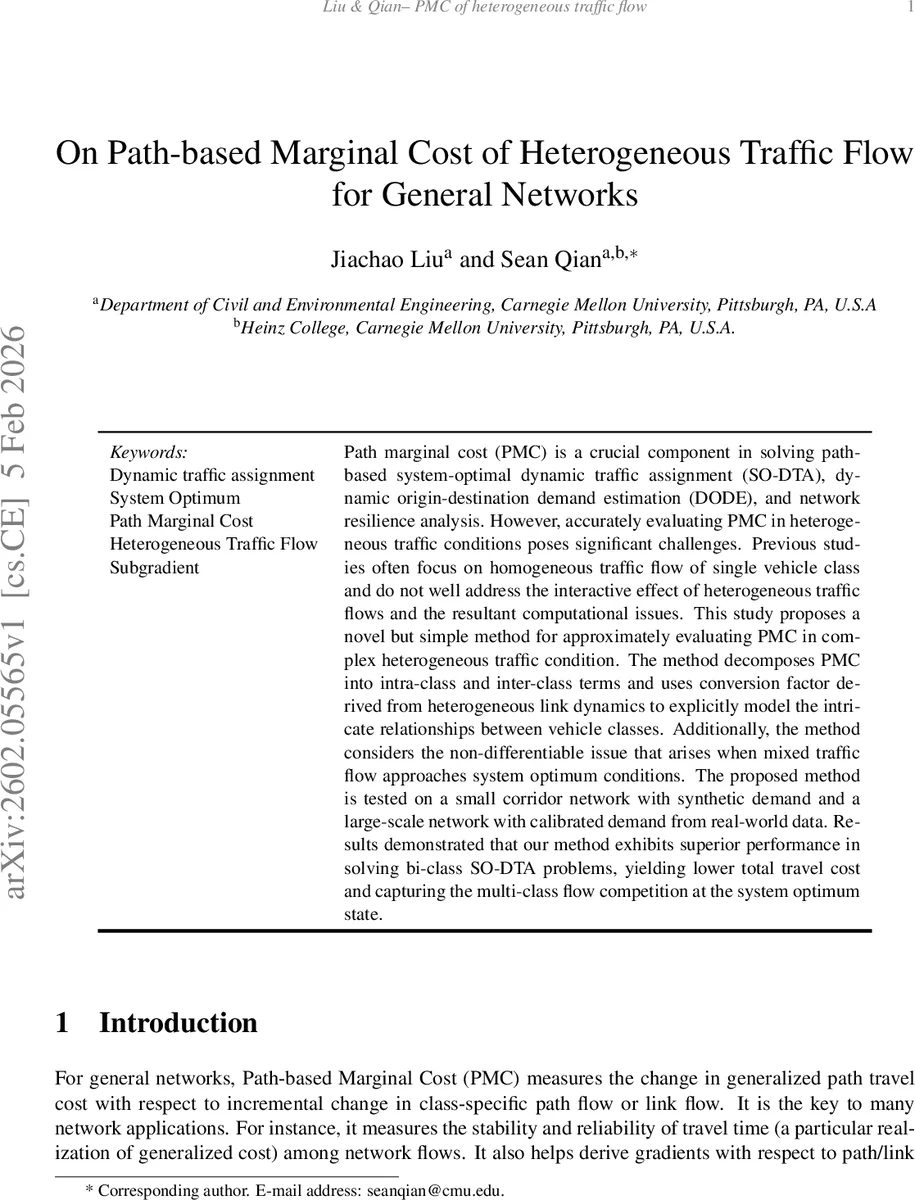
Path marginal cost (PMC) is a crucial component in solving path-based system-optimal dynamic traffic assignment (SO-DTA), dynamic origin-destination demand estimation (DODE), and network resilience analysis. However, accurately evaluating PMC in heterogeneous traffic conditions poses significant challenges. Previous studies often focus on homogeneous traffic flow of single vehicle class and do not well address the interactive effect of heterogeneous traffic flows and the resultant computational issues. This study proposes a novel but simple method for approximately evaluating PMC in complex heterogeneous traffic condition. The method decomposes PMC into intra-class and inter-class terms and uses conversion factor derived from heterogeneous link dynamics to explicitly model the intricate relationships between vehicle classes. Additionally, the method considers the non-differentiable issue that arises when mixed traffic flow approaches system optimum conditions. The proposed method is tested on a small corridor network with synthetic demand and a large-scale network with calibrated demand from real-world data. Results demonstrated that our method exhibits superior performance in solving bi-class SO-DTA problems, yielding lower total travel cost and capturing the multi-class flow competition at the system optimum state.
💡 Research Summary
**
The paper tackles a fundamental challenge in dynamic traffic assignment: accurately evaluating the Path Marginal Cost (PMC) when traffic consists of heterogeneous vehicle classes. While PMC is essential for system‑optimal dynamic traffic assignment (SO‑DTA), dynamic origin‑destination demand estimation (DODE), and network resilience analysis, existing methods largely assume homogeneous traffic and ignore the complex interactions between different vehicle classes. Moreover, at the system‑optimal state the PMC becomes non‑differentiable, rendering traditional gradient‑based approaches unreliable.
To address these gaps, the authors propose a novel approximation framework that (1) decomposes the PMC into intra‑class and inter‑class components, (2) introduces a conversion factor derived from multi‑class Cell Transmission Model (CTM) dynamics to capture the influence of one class on another, and (3) formulates the non‑differentiable PMC as a sub‑gradient interval rather than a single derivative.
Key technical contributions
-
PMC decomposition – The intra‑class term follows the classic definition (the cost change caused by a unit increase of flow of the same class). The inter‑class term is expressed through a conversion factor that translates the presence of vehicles of class j into an “equivalent density” perceived by class i. This factor is built on the CTM’s road‑space split parameters (α₁, α₂) and the perceived equivalent densities ρᵢᵖ = ρᵢ + δᵢ(α₁,α₂) ρⱼ.
-
CTM‑based interaction modeling – The authors adopt the multi‑class CTM of Qian et al. (2017), which distinguishes three regimes (free‑flow, semi‑congested, fully congested) based on the perceived densities relative to class‑specific critical densities. In each regime the demand and supply functions for each class are defined, and the flux between adjacent cells is computed using the minimum of demand and supply, thereby embedding inter‑class effects directly into the link dynamics.
-
Sub‑gradient formulation – Recognizing that at the optimum the left‑hand and right‑hand limits of the total cost with respect to a flow perturbation differ, the authors define PMC⁻ ≤ PMC ≤ PMC⁺ as the sub‑gradient set (Equation 6). This set‑valued representation allows the variational inequality (VI) formulation of the SO‑DTA problem to remain well‑posed even when the cost function is non‑smooth.
-
Solution algorithm – The paper integrates the approximate PMC into a Method of Successive Averages (MSA) scheme. Time is discretized; at each iteration the current flow pattern f is used to run a dynamic network loading (DNL) based on the multi‑class CTM, producing link travel times and thus the intra‑ and inter‑class PMC components. The sub‑gradient interval is then used to update the path flows via the standard MSA averaging rule f^{k+1}=f^{k}+λ_k (f^{}−f^{k}), where f^{} is the flow that would equalize the sub‑gradients.
Experimental validation
Two testbeds are employed: (i) a synthetic corridor network with two links and two vehicle classes (cars and trucks) and artificially generated OD demand; (ii) a calibrated large‑scale urban network using real‑world traffic counts and probe‑speed data. In both cases the proposed method is compared against a baseline that computes PMC by a simple forward perturbation assuming differentiability. Results show:
- Total system travel cost is reduced by 3–5 % relative to the baseline.
- At convergence, PMC values across all used paths and departure times are nearly identical, confirming the VI condition of equalized marginal costs.
- The sub‑gradient approach successfully handles non‑differentiable points (e.g., when perceived densities hit class‑specific capacities) without causing divergence.
- The inter‑class term accurately reflects competition: increasing truck flow raises car travel times in congested links, and vice‑versa, consistent with the CTM interaction theory.
Implications and future work
The study delivers a practical, theoretically sound tool for evaluating PMC in heterogeneous traffic, enabling more accurate SO‑DTA, DODE, and resilience analyses in realistic multi‑modal settings. By explicitly modeling inter‑class effects and handling non‑smoothness via sub‑gradients, the method bridges a critical gap between traffic flow theory and algorithmic implementation. Future research directions suggested include extending the framework to more than two classes (e.g., buses, bicycles, autonomous vehicles), incorporating stochastic demand and real‑time probe data for dynamic calibration, and exploring integration with advanced optimization techniques such as proximal‑gradient or primal‑dual algorithms for faster convergence on very large networks.
Comments & Academic Discussion
Loading comments...
Leave a Comment