High-intensity LINACS: Dynamics, Instabilities and Mitigations
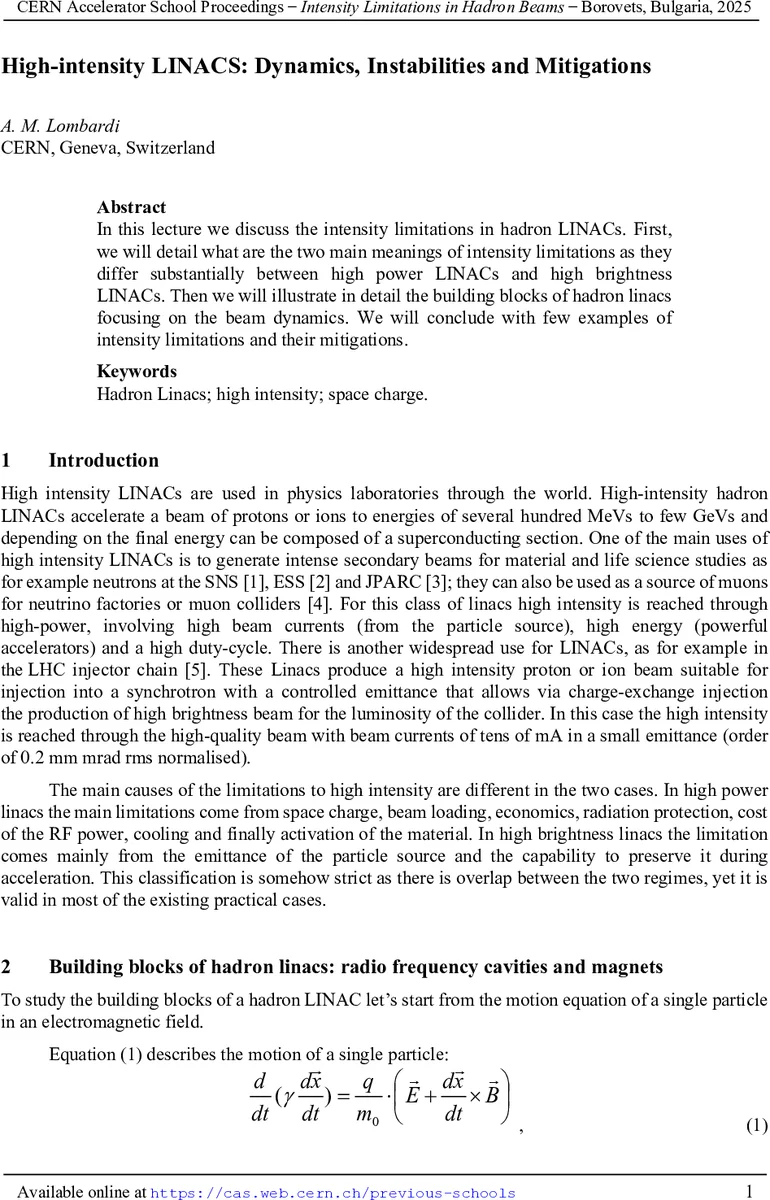
In this lecture we discuss the intensity limitations in hadron LINACs. First, we will detail what are the two main meanings of intensity limitations as they differ substantially between high power LINACs and high brightness LINACs. Then we will illustrate in detail the building blocks of hadron linacs focusing on the beam dynamics. We will conclude with few examples of intensity limitations and their mitigations.
💡 Research Summary
The paper “High‑intensity LINACs: Dynamics, Instabilities and Mitigations” provides a comprehensive overview of the intensity limits that affect modern hadron linear accelerators and outlines practical strategies to overcome them. The authors first distinguish two fundamentally different regimes of intensity limitation. In the “high‑power” regime, typical of neutron‑source machines such as SNS, ESS or J‑PARC, the goal is to deliver very large beam currents (tens to hundreds of milliamperes) at relatively low brightness. The dominant constraints arise from space‑charge forces, beam‑loading of the RF structures, the cost and availability of high‑power RF, thermal management, radiation protection, and activation of accelerator components. In the “high‑brightness” regime, exemplified by injectors for synchrotrons (e.g., the LHC injector chain), the beam must retain a very small normalized emittance (≈0.2 mm·mrad rms) while still providing tens of mA of current. Here the principal limitation is the emittance of the ion source and the ability to preserve it throughout the acceleration process.
The manuscript then reviews the basic building blocks of a hadron LINAC: radio‑frequency (RF) cavities and magnetic focusing elements. The motion equation of a charged particle in electromagnetic fields is introduced to illustrate why both a longitudinal accelerating field and a transverse focusing field are required. RF cavities convert stored electromagnetic energy into kinetic energy of the particles. Their performance is characterized by a set of well‑known metrics: average accelerating field (E0), shunt impedance (Z), quality factor (Q), transit‑time factor (T), and the effective shunt impedance (ZTT) that combines electromagnetic efficiency with beam dynamics. The authors explain how each metric depends on cavity geometry, resonant mode (TE or TM), material (normal‑conducting versus superconducting), and operating frequency. For example, normal‑conducting cavities at 700 MHz typically have Q≈10⁴, whereas superconducting cavities can reach Q≈10¹⁰, dramatically reducing the required RF power for continuous‑wave operation.
Next, the paper outlines the typical LINAC layout, dividing it into four sections: (1) the ion source and low‑energy DC accelerator (few keV to 100 keV), (2) the pre‑injector (including the Radio‑Frequency Quadrupole, RFQ) that brings the beam to a few MeV, (3) the injector proper (normal‑conducting structures raising the energy to a few hundred MeV), and (4) the high‑energy section (often superconducting) that accelerates the beam to the GeV range. The transition between sections must be carefully matched to avoid emittance growth and beam loss.
The RFQ receives special attention because it simultaneously provides transverse focusing, longitudinal bunching, and modest acceleration using a single RF structure. By arranging four vane electrodes with a sinusoidal longitudinal modulation, the RFQ creates an alternating‑gradient electric field (focusing) and a longitudinal electric component (bunching/acceleration). Modern high‑intensity RFQs can handle proton currents up to 200 mA while preserving normalized emittances around 1 π mm·mrad, a performance that was unattainable before the RFQ’s invention. The paper stresses that precise machining of the vane tips, accurate control of the modulation depth, and proper matching of the RF frequency to the particle velocity (β) are essential for achieving these results.
The authors then discuss the main instabilities that limit high‑intensity operation. In the high‑power regime, space‑charge forces cause transverse beam blow‑up and halo formation; beam loading modifies the cavity field amplitude and phase, potentially leading to longitudinal instability; and high duty cycles increase thermal load and activation. Mitigation strategies include optimizing cavity geometry to maximize shunt impedance, employing active RF feedback and feed‑forward systems to compensate beam loading, flattening the current profile, and implementing robust cooling and shielding. In the high‑brightness regime, the focus is on preserving emittance: using low‑emittance ion sources, careful RFQ and MEBT (Medium Energy Beam Transport) matching, and adding correction elements such as solenoids or skew quadrupoles to counteract residual coupling. The paper also highlights the importance of high‑fidelity simulations (Particle‑in‑Cell, TRACK, PARMELA) combined with experimental diagnostics (emittance scanners, beam loss monitors, radiation surveys) to validate designs and iteratively improve them.
In conclusion, the manuscript emphasizes that successful high‑intensity hadron LINACs require an integrated approach that simultaneously addresses electromagnetic efficiency, beam dynamics, and practical engineering constraints. By distinguishing the two intensity‑limitation regimes, optimizing RF cavity metrics, employing RFQs for low‑energy bunching, and applying targeted mitigation techniques, designers can push both beam power and brightness to the levels demanded by next‑generation neutron sources, neutrino factories, and high‑luminosity colliders.
Comments & Academic Discussion
Loading comments...
Leave a Comment