On the Resistance Conjecture
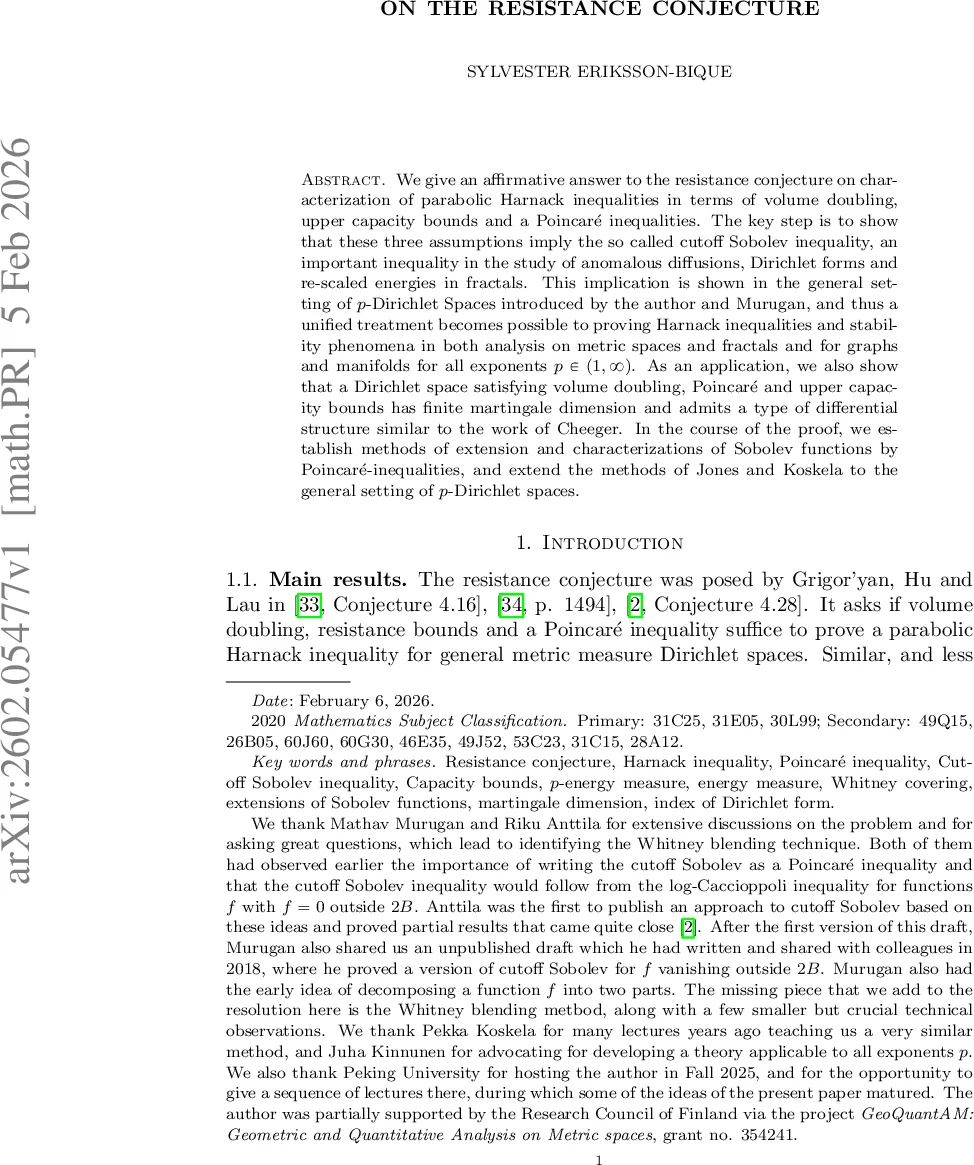
We give an affirmative answer to the resistance conjecture on characterization of parabolic Harnack inequalities in terms of volume doubling, upper capacity bounds and a Poincaré inequalities. The key step is to show that these three assumptions imply the so called cutoff Sobolev inequality, an important inequality in the study of anomalous diffusions, Dirichlet forms and re-scaled energies in fractals. This implication is shown in the general setting of $p$-Dirichlet Spaces introduced by the author and Murugan, and thus a unified treatment becomes possible to proving Harnack inequalities and stability phenomena in both analysis on metric spaces and fractals and for graphs and manifolds for all exponents $p\in (1,\infty)$. As an application, we also show that a Dirichlet space satisfying volume doubling, Poincaré and upper capacity bounds has finite martingale dimension and admits a type of differential structure similar to the work of Cheeger. In the course of the proof, we establish methods of extension and characterizations of Sobolev functions by Poincaré-inequalities, and extend the methods of Jones and Koskela to the general setting of $p$-Dirichlet spaces.
💡 Research Summary
This paper resolves the long‑standing “resistance conjecture” by showing that three classical analytic‑geometric conditions—volume doubling, an upper capacity bound, and a Poincaré inequality—are sufficient to characterize parabolic Harnack inequalities (PHI) on very general metric measure Dirichlet spaces. The authors work in the framework of p‑Dirichlet spaces for any exponent p∈(1,∞), which includes manifolds, graphs, and a wide class of fractal spaces.
The central technical achievement is the proof that the above three assumptions automatically imply the cutoff Sobolev inequality (CSₚ). Historically, CSₚ has been a mysterious and difficult condition to verify; it was often introduced as an extra hypothesis in the equivalence between PHI, heat kernel estimates (HKE), and elliptic Harnack inequalities. The paper introduces a novel “Whitney blending” technique: given a ball B, one constructs a cutoff function ψ_B as a capacity minimizer (a harmonic function with prescribed boundary values) and then blends interior and exterior data without requiring ψ_B to be Lipschitz. This overcomes the major obstacle that the energy measure Γₚ(ψ_B) may be singular with respect to the reference measure μ, a phenomenon typical in fractal settings. By rewriting CSₚ as a two‑weighted Poincaré inequality, the authors sidestep the singularity and obtain a form that is independent of the scaling exponent β.
The main results are:
-
Theorem 1.1 – Equivalence of four statements: (i) PHIₚ,β, (ii) heat kernel estimates together with volume doubling, (iii) volume doubling + elliptic Harnack + two‑sided capacity bounds, and (iv) volume doubling + Poincaré inequality + upper capacity bound. This unifies and extends earlier work of Grigor’yan, Saloff‑Coste, Barlow, Bass, and many others to the full range of p‑energies.
-
Theorem 1.2 – Any space satisfying the three basic assumptions has finite martingale dimension (the index of the Dirichlet form) and admits a measurable Riemannian structure in the sense of Cheeger. Thus the analytic regularity implied by PHI also yields a geometric differential structure.
-
Theorem 1.4 – In a regular local p‑Dirichlet space with μ‑doubling, the Poincaré inequality and the upper capacity bound imply the cutoff Sobolev inequality. The proof relies on the Whitney blending argument and shows that harmonic cutoff functions (capacity minimizers) can be used directly, a new observation even for classical manifolds when β≠p.
Beyond these theorems, the paper discusses several important corollaries: the self‑improvement property of CSₚ (allowing arbitrary θ∈(0,1) in the energy decay), applications to reflected processes, blow‑up arguments, and bounds on martingale dimension. It also raises an open problem (Question 1.5) asking whether a “ball‑capacity” estimate together with volume doubling suffices to derive the Poincaré inequality, which would further simplify the characterization of Harnack inequalities.
Methodologically, the work blends ideas from analysis on metric spaces (Whitney coverings, extension domains, two‑weight Poincaré inequalities) with probabilistic potential theory (capacity estimates, martingale dimension) and fractal analysis (p‑energies, singular energy measures). The authors carefully navigate the lack of smooth structure by working with quasi‑continuous representatives and by exploiting the locality of the Dirichlet form.
In summary, the paper provides a clean and unified framework: volume doubling + upper capacity bound + Poincaré inequality ⇔ cutoff Sobolev inequality ⇔ parabolic Harnack inequality ⇔ heat kernel estimates. This not only settles the resistance conjecture in full generality but also opens the door to new stability results, extensions to non‑linear p‑Laplacians, and deeper connections between analytic inequalities and geometric structures on highly irregular spaces.
Comments & Academic Discussion
Loading comments...
Leave a Comment