Ferron-Polaritons in Superconductor/Ferroelectric/Superconductor Heterostructures
We predict the formation of ferron-polariton - a hybrid light-matter quasiparticle arising from the coupling between collective ferroelectric excitations (ferrons) and Swihart photons in a superconductor/ferroelectric/superconductor heterostructure. The coupling provides direct evidence for ferrons and reaches the ultrastrong-coupling regime, with a spectral gap in the terahertz range, orders of magnitude larger than those in magnetic analogues, reflecting the superior strength of electric dipole interactions. Our work establishes superconductor-ferroelectric heterostructures as a novel platform for exploring extreme light-matter coupling and for developing high-speed, ferroelectric-based quantum technologies at terahertz frequencies.
💡 Research Summary
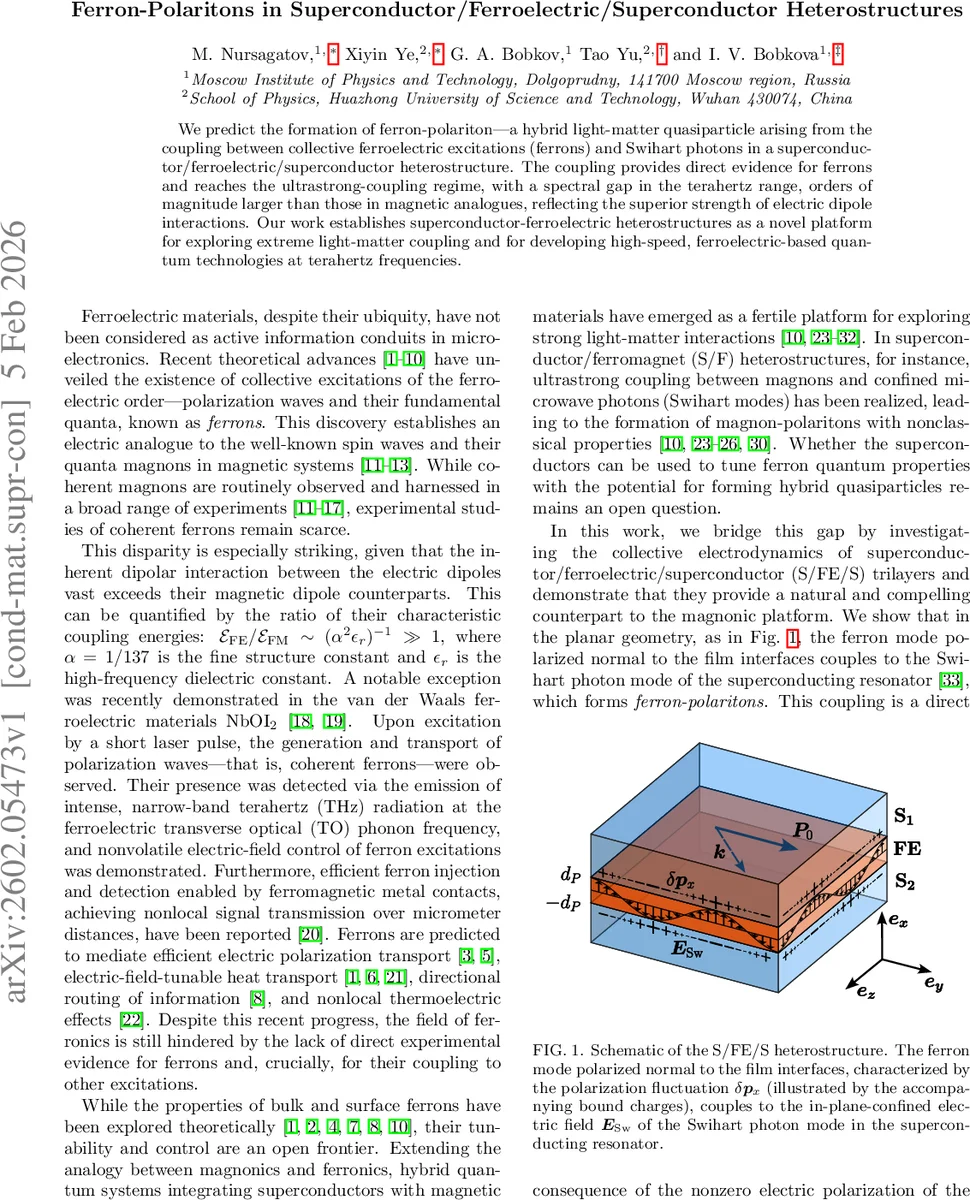
The authors present a comprehensive theoretical study of a novel hybrid quasiparticle— the ferron‑polariton— that emerges in a planar superconductor/ferroelectric/superconductor (S/FE/S) heterostructure. In this architecture a thin ferroelectric film of thickness 2d_P is sandwiched between two semi‑infinite superconducting electrodes. The ferroelectric is described by a Landau free‑energy functional with an easy‑axis polarization P_0 along the y‑direction. Small fluctuations δp around P_0 obey a linearized Landau‑Khalatnikov‑Tani (LKT) equation, which couples the polarization dynamics to the depolarization electric field E_d generated by the fluctuations themselves.
Maxwell’s equations together with the constitutive relations D = ε_0E + P and B = μ_0H are solved for the electromagnetic fields radiated by the ferronic excitations. In the superconducting leads the complex conductivity is taken from microscopic BCS theory, σ_S(ω)=i/(ωμ_0λ_eff^2), where λ_eff is an effective penetration depth that can differ from the London value. Because the operating frequencies lie in the terahertz (THz) range, the superconductors behave as lossless inductors (the real part of σ_S vanishes for ℏω < 2Δ). This leads to a large imaginary wave‑vector k_S≈i/λ_eff, which far exceeds the in‑plane wave‑vector k of the collective mode.
In the thin‑film limit (k d_P ≪ 1) the polarization fluctuations are assumed uniform across the ferroelectric layer. The analysis shows that only the x‑component of the polarization fluctuation (δp_x, i.e., normal to the interfaces) creates a sizable depolarization field inside the ferroelectric. The resulting field can be written as E_d = – N(k, ω) δp, where the tensor N is diagonal with a single non‑zero element N_x(k, ω) = ω^2ε_0
Comments & Academic Discussion
Loading comments...
Leave a Comment