Reduced-Order Surrogates for Forced Flexible Mesh Coastal-Ocean Models
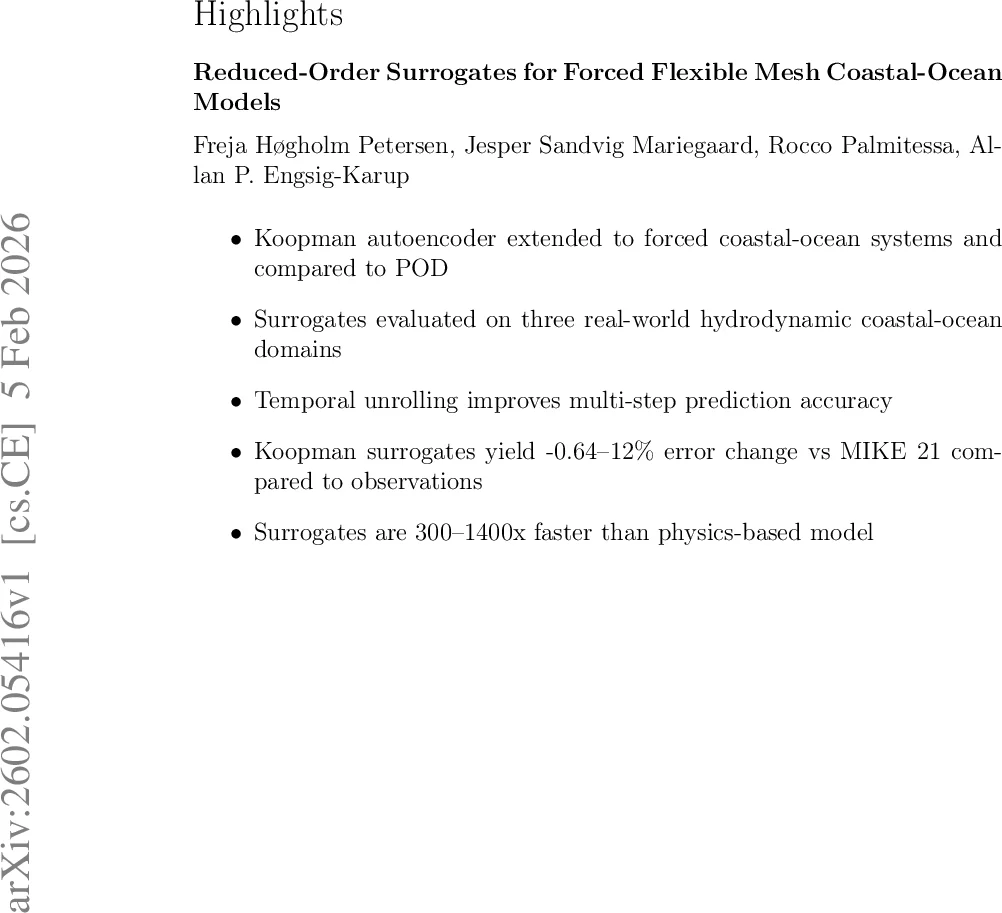
While POD-based surrogates are widely explored for hydrodynamic applications, the use of Koopman Autoencoders for real-world coastal-ocean modelling remains relatively limited. This paper introduces a flexible Koopman autoencoder formulation that incorporates meteorological forcings and boundary conditions, and systematically compares its performance against POD-based surrogates. The Koopman autoencoder employs a learned linear temporal operator in latent space, enabling eigenvalue regularization to promote temporal stability. This strategy is evaluated alongside temporal unrolling techniques for achieving stable and accurate long-term predictions. The models are assessed on three test cases spanning distinct dynamical regimes, with prediction horizons up to one year at 30-minute temporal resolution. Across all cases, the Koopman autoencoder with temporal unrolling yields the best overall accuracy compared to the POD-based surrogates, achieving relative root-mean-squared-errors of 0.01-0.13 and $R^2$-values of 0.65-0.996. Prediction errors are largest for current velocities, and smallest for water surface elevations. Comparing to in-situ observations, the surrogate yields -0.65% to 12% change in water surface elevation prediction error when compared to prediction errors of the physics-based model. These error levels, corresponding to a few centimeters, are acceptable for many practical applications, while inference speed-ups of 300-1400x enables workflows such as ensemble forecasting and long climate simulations for coastal-ocean modelling.
💡 Research Summary
This paper presents a comprehensive study of reduced‑order surrogate models for forced coastal‑ocean simulations, focusing on a novel Koopman Autoencoder (KAE) architecture and its comparison with traditional Proper Orthogonal Decomposition (POD) based surrogates. The authors extend the Koopman framework to handle exogenous meteorological and boundary forcings, which are essential for realistic operational ocean modelling. In the proposed KAE, separate nonlinear encoders compress the high‑dimensional state fields (sea‑surface elevation and depth‑averaged currents) and the forcing fields (wind, pressure, open‑boundary conditions) onto low‑dimensional latent spaces. A learned linear operator Cₓ propagates the latent state forward in time, while a decoder reconstructs the full‑resolution fields. Crucially, the temporal propagator receives both the current and next‑step forcing vectors, improving one‑step accuracy and preserving temporal consistency.
Two stability‑enhancing strategies are investigated. First, eigenvalue regularization constrains the spectrum of Cₓ to lie within the unit circle, preventing exponential growth of latent trajectories. Second, Temporal Unrolling trains the network over multi‑step horizons, accumulating prediction loss across several steps; this reduces error drift that typically plagues single‑step training and yields more reliable long‑term forecasts.
The methodology is evaluated on three real‑world coastal‑ocean test cases that span distinct dynamical regimes: (1) a shallow bay dominated by tidal and wind forcing, (2) an inland waterway with strong, nonlinear current–wind interactions, and (3) a large‑scale coastal shelf where both tidal and atmospheric drivers operate over seasonal to annual scales. All simulations use a 30‑minute timestep, and surrogate predictions are generated for horizons up to one year.
Performance metrics include relative root‑mean‑squared error (RMSE) and coefficient of determination (R²) for both sea‑surface elevation and depth‑averaged currents. Across all cases, the KAE with Temporal Unrolling outperforms the POD surrogate, achieving RMSE values between 0.01 and 0.13 (corresponding to a few centimeters for elevation) and R² ranging from 0.65 to 0.996. Errors are largest for current velocities and smallest for surface elevations. When compared against in‑situ observations, the KAE‑based surrogate changes the water‑surface elevation error of the physics‑based model by only –0.65 % to +12 %, a margin considered acceptable for many operational applications.
Computational speed is a major advantage: on GPU hardware the KAE inference time for a 30‑minute forecast is 0.02–0.05 seconds, whereas the POD surrogate on CPU requires 5–70 seconds. This translates into a 300‑ to 1400‑fold acceleration relative to the full physics‑based model, enabling ensemble forecasting, probabilistic risk assessment, and long‑term climate simulations that would otherwise be prohibitive.
The study also discusses limitations and future directions. The current formulation assumes that all external forcings are known a priori; extending the framework to predict or assimilate uncertain forcings remains an open challenge. Sensitivity to latent‑space dimensionality and regularization hyper‑parameters is noted, suggesting the need for automated hyper‑parameter tuning in operational settings. Potential extensions include control‑oriented Koopman models, Bayesian uncertainty quantification, and application to fully three‑dimensional, non‑hydrostatic ocean models.
In summary, the paper demonstrates that a forced Koopman Autoencoder equipped with eigenvalue regularization and temporal unrolling delivers superior accuracy, long‑term stability, and massive computational speed‑ups compared with conventional POD surrogates. These results position the KAE as a promising, physics‑aware reduced‑order tool for modern coastal‑ocean modelling workflows.
Comments & Academic Discussion
Loading comments...
Leave a Comment