VMF-GOS: Geometry-guided virtual Outlier Synthesis for Long-Tailed OOD Detection
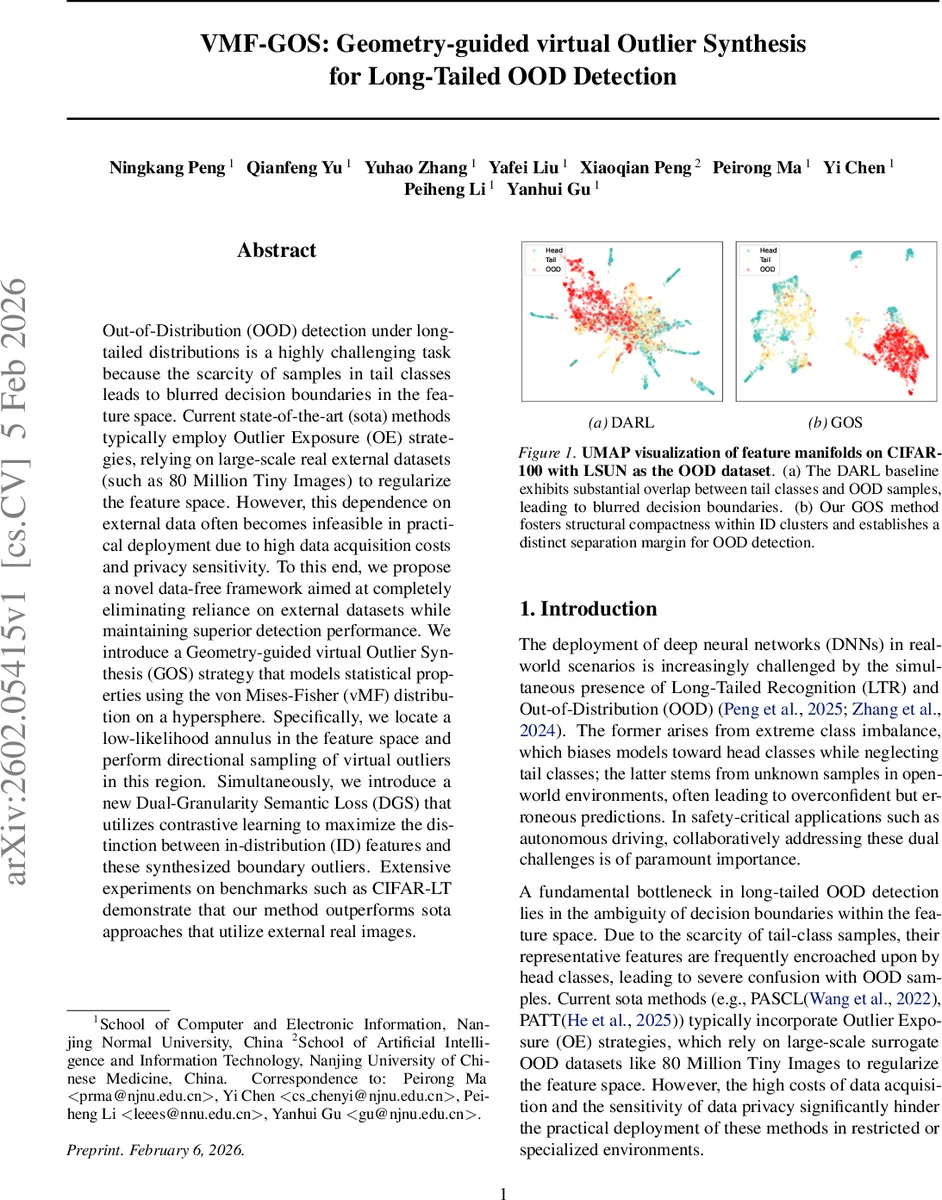
Out-of-Distribution (OOD) detection under long-tailed distributions is a highly challenging task because the scarcity of samples in tail classes leads to blurred decision boundaries in the feature space. Current state-of-the-art (sota) methods typically employ Outlier Exposure (OE) strategies, relying on large-scale real external datasets (such as 80 Million Tiny Images) to regularize the feature space. However, this dependence on external data often becomes infeasible in practical deployment due to high data acquisition costs and privacy sensitivity. To this end, we propose a novel data-free framework aimed at completely eliminating reliance on external datasets while maintaining superior detection performance. We introduce a Geometry-guided virtual Outlier Synthesis (GOS) strategy that models statistical properties using the von Mises-Fisher (vMF) distribution on a hypersphere. Specifically, we locate a low-likelihood annulus in the feature space and perform directional sampling of virtual outliers in this region. Simultaneously, we introduce a new Dual-Granularity Semantic Loss (DGS) that utilizes contrastive learning to maximize the distinction between in-distribution (ID) features and these synthesized boundary outliers. Extensive experiments on benchmarks such as CIFAR-LT demonstrate that our method outperforms sota approaches that utilize external real images.
💡 Research Summary
The paper tackles the challenging problem of out‑of‑distribution (OOD) detection when the in‑distribution (ID) data follow a long‑tailed class distribution. In such scenarios, tail classes have very few samples, causing their feature representations to overlap with those of head classes and leading to blurred decision boundaries. Existing state‑of‑the‑art methods typically rely on Outlier Exposure (OE), which uses large external datasets (e.g., 80 Million Tiny Images) to provide surrogate OOD samples. This reliance creates practical obstacles due to data acquisition costs and privacy concerns, especially in specialized or restricted domains.
VMF‑GOS proposes a completely data‑free framework that eliminates any need for external OOD data while still achieving superior detection performance. The core contributions are twofold: (1) Geometry‑guided virtual Outlier Synthesis (GOS) and (2) Dual‑Granularity Semantic (DGS) loss.
Geometry‑guided virtual Outlier Synthesis (GOS)
The authors first model the ID feature space on a unit hypersphere. Each class y is represented by a von Mises‑Fisher (vMF) distribution with mean direction µ_y and concentration κ_y; class priors π_y reflect the long‑tailed sample frequencies. Leveraging a theoretical result that, in high dimensions, the scaled angular displacement 2κ(1‑cos θ) follows a χ² distribution, they define a low‑likelihood annular region on the hypersphere. Sampling a χ² value ξ from the tail of the distribution (μ_χ² + 2σ_χ² to μ_χ² + 3σ_χ²) and mapping it back to a cosine similarity t = 1 − ξ/(2κ) yields a scalar that determines how far a synthetic point lies from the class mean. A random noise vector is orthogonalized to µ_y via Gram‑Schmidt, producing a tangential component v_⊥. The final virtual outlier is z_gos = t µ_y + √(1‑t²) v_⊥. This construction ensures that synthetic outliers occupy the low‑density region surrounding each class, are directionally diverse, and respect the underlying spherical geometry.
Dual‑Granularity Semantic (DGS) loss
DGS integrates two complementary terms. The first term, Ψ_id, uses the closed‑form expectation of the vMF distribution to encourage each ID feature to align with its class’s continuous semantic region, effectively tightening intra‑class clusters. The second term, Ω_ood, treats each synthesized outlier as a virtual negative class in a contrastive learning framework. It computes a vMF‑based similarity between a query feature and each virtual outlier, weighted by the class prior π_y. Importantly, tail classes (with small π_y) receive amplified penalty when their features approach the synthetic outliers, directly counteracting boundary expansion that plagues long‑tailed settings.
Auxiliary components
To further mitigate the bias inherent in long‑tailed data, the authors adopt Temperature Scaling‑Based Logit Adjustment (TLA), which rescales logits by a temperature ε and incorporates class priors, thereby boosting confidence for minority classes. Energy Polarization Regularization (EPR) explicitly widens the energy gap between ID samples and virtual outliers, facilitating a clearer separation when using energy‑based scores. At test time, the ODIN post‑processing step (input perturbation + temperature scaling) is applied to sharpen the score disparity, especially for tail categories.
Experimental validation
Extensive experiments on CIFAR‑100‑LT, CIFAR‑10‑LT, and other long‑tailed benchmarks demonstrate that VMF‑GOS outperforms recent OE‑based methods such as PASCL, PAT T, and DARL across AUROC, AUPR, and FPR95 metrics. Notably, the improvement is most pronounced for tail classes, where false‑positive OOD rates drop substantially. The method incurs negligible computational overhead because virtual outliers are generated analytically without any real data.
Significance and limitations
VMF‑GOS introduces a principled way to exploit the geometric structure of high‑dimensional feature spaces for OOD synthesis, thereby removing the dependence on external datasets. This makes the approach highly attractive for privacy‑sensitive or resource‑constrained deployments. However, the current implementation relies on relatively simple EM‑style estimation of vMF parameters, which may become less accurate for extremely high‑dimensional embeddings (e.g., 2048‑D). Moreover, while synthetic outliers are mathematically well‑justified, further studies are needed to compare their distributional similarity to real-world OOD data across diverse domains.
In summary, the paper presents a novel, data‑free paradigm for long‑tailed OOD detection that combines hyperspherical statistical modeling, targeted virtual outlier synthesis, and a dual‑granularity contrastive loss. The resulting framework achieves state‑of‑the‑art detection performance without any external OOD data, offering a practical and privacy‑friendly solution for real‑world AI systems.
Comments & Academic Discussion
Loading comments...
Leave a Comment