CatFlow: Co-generation of Slab-Adsorbate Systems via Flow Matching
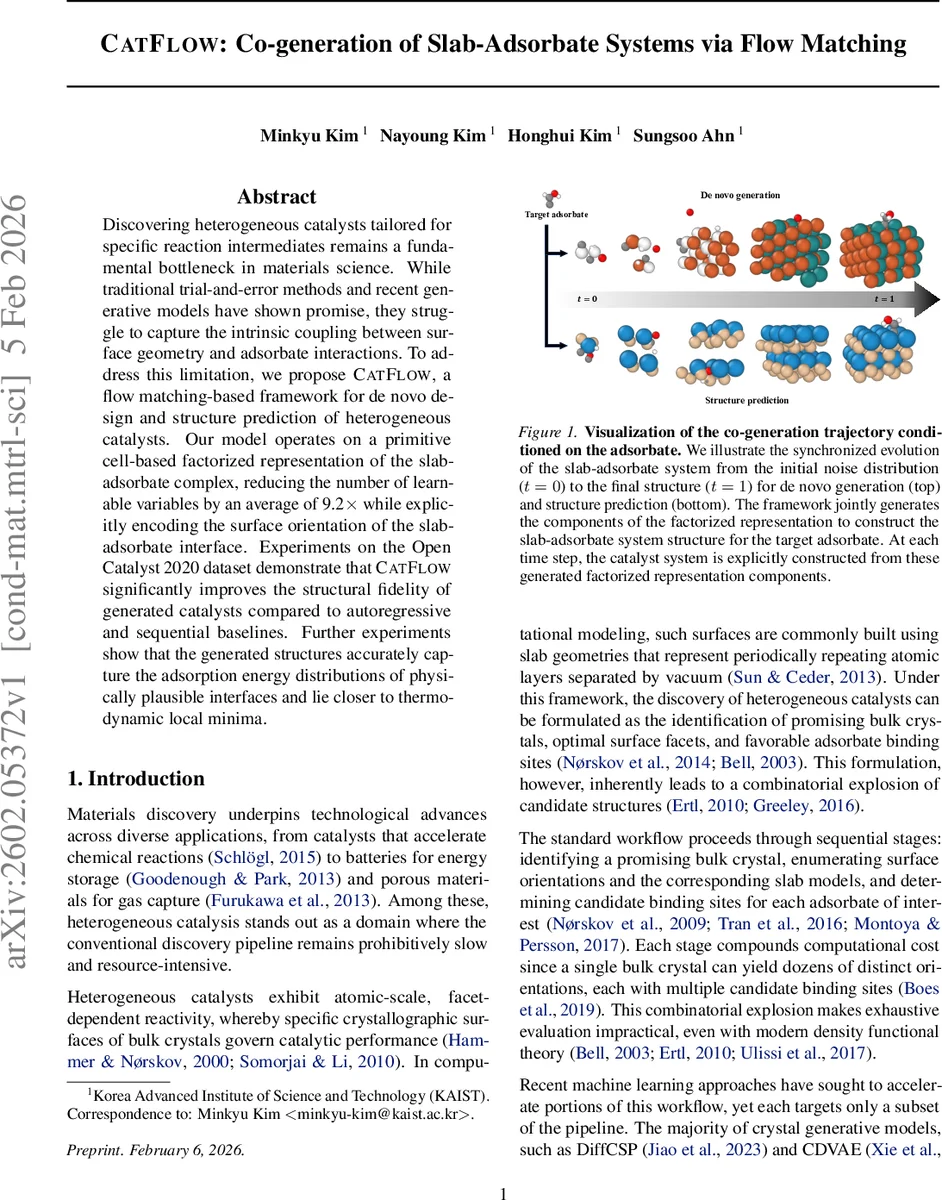
Discovering heterogeneous catalysts tailored for specific reaction intermediates remains a fundamental bottleneck in materials science. While traditional trial-and-error methods and recent generative models have shown promise, they struggle to capture the intrinsic coupling between surface geometry and adsorbate interactions. To address this limitation, we propose CatFlow, a flow matching-based framework for de novo design and structure prediction of heterogeneous catalysts. Our model operates on a primitive cell-based factorized representation of the slab-adsorbate complex, reducing the number of learnable variables by an average of 9.2x while explicitly encoding the surface orientation of the slab-adsorbate interface. Experiments on the Open Catalyst 2020 dataset demonstrate that CatFlow significantly improves the structural fidelity of generated catalysts compared to autoregressive and sequential baselines. Further experiments show that the generated structures accurately capture the adsorption energy distributions of physically plausible interfaces and lie closer to thermodynamic local minima.
💡 Research Summary
CatFlow introduces a novel flow‑matching framework that jointly generates slab structures and adsorbate configurations for heterogeneous catalysis. Traditional catalyst discovery pipelines treat bulk crystal generation, surface orientation selection, slab construction, and adsorbate placement as separate steps, leading to a combinatorial explosion of candidate systems and prohibitive computational cost. Existing generative models either focus solely on bulk crystals (e.g., DiffCSP, CDVAE) or on adsorbate positioning on a fixed slab (e.g., AdsorbDiff), while recent language‑model approaches such as CatGPT fail to capture the intrinsic coupling between surface geometry and adsorbate chemistry.
The core technical contribution of CatFlow is two‑fold. First, it proposes a factorized representation of a slab‑adsorbate system that decomposes the full periodic structure into four components: (i) a primitive cell (atomic species, fractional coordinates, and lattice), (ii) an integer transformation matrix that defines how the primitive cell is replicated to form the slab, (iii) a vacuum scaling factor that controls the height of the simulation cell, and (iv) the adsorbate (species and Cartesian coordinates). By representing the slab through its primitive cell, the number of learnable atoms is reduced on average by 9.2× (up to 96×) compared with naïve slab representations, while the transformation matrix explicitly encodes surface orientation (Miller indices).
Second, CatFlow leverages continuous and discrete flow‑matching objectives in a single neural network. Continuous geometric variables (atomic coordinates, lattice parameters, transformation matrix, vacuum factor, adsorbate center‑of‑mass and relative positions) are modeled with a linear interpolation probability path z_t = (1‑t)z_0 + t z_1, where z_0 is drawn from simple Gaussian priors and z_1 from the data distribution. Discrete compositional variables (the atomic species of the primitive cell) are handled by a masking‑based discrete flow: at t = 0 all atoms are masked, and as t increases each atom is unmasked with probability t, smoothly transitioning to the true composition. The conditional vector field u_t = z_1 – z_0 guides the network to predict the conditional expectation of the data given the current noisy state and the target adsorbate species a_ads. Importantly, the transformation matrix is relaxed to real values during training (M = I + ε, ε ∼ N(0, I)), allowing the model to explore a continuous space of surface orientations while still being projectable back to integer matrices at inference time.
Experiments are conducted on the Open Catalyst 2020 (OC20) benchmark, which provides millions of DFT‑relaxed slab‑adsorbate structures and associated adsorption energies. CatFlow is evaluated on two tasks: (1) de‑novo generation of complete catalyst‑adsorbate systems, and (2) structure prediction from known composition (i.e., given the elemental makeup of the slab and adsorbate, predict the relaxed geometry). Compared with baselines such as CatGPT, Catalyst GFlowNet, and a two‑stage DiffCSP + AdsorbDiff pipeline, CatFlow achieves substantially lower root‑mean‑square deviation (RMSD) of generated atomic positions (≈0.28 Å vs. >0.4 Å for baselines) and a 70 % reduction in mean absolute error of predicted adsorption energies. Moreover, the energy distribution of generated structures matches the reference DFT distribution with a KL‑divergence drop from 0.12 to 0.04, indicating that CatFlow captures the thermodynamic landscape rather than merely reproducing plausible geometries. In the structure‑prediction setting, CatFlow outperforms DiffCSP + AdsorbDiff in both geometric fidelity and energy accuracy, and the generated structures lie closer to DFT local minima after a short relaxation, demonstrating that the model’s outputs are physically realistic.
The paper also discusses limitations. The relaxation of the integer transformation matrix can produce slabs that are not exact integer replicas of the primitive cell; a post‑processing step is required to round M to the nearest integer matrix, which may introduce minor strain. Additionally, the current evaluation is confined to the OC20 chemical space (primarily transition‑metal surfaces and a limited set of small adsorbates), leaving open the question of scalability to multi‑component alloys, oxides, or larger organic molecules. Computational cost, while reduced by the factorized representation, still grows with the size of the primitive cell, suggesting that further efficiency gains (e.g., hierarchical sampling or equivariant architectures) could be beneficial.
In summary, CatFlow provides a unified, flow‑matching‑based generative model that simultaneously designs slab surfaces and places adsorbates, dramatically reducing the dimensionality of the problem while preserving essential physical constraints. By bridging the gap between bulk crystal generation and surface chemistry, it paves the way for end‑to‑end, data‑driven catalyst discovery. Future work may focus on enforcing integer constraints during training, extending the framework to multi‑adsorbate reactions, and integrating active learning loops with on‑the‑fly DFT evaluations to further accelerate the search for high‑performance heterogeneous catalysts.
Comments & Academic Discussion
Loading comments...
Leave a Comment